









Wilson Henry Irvine
American, 1869 - 1936
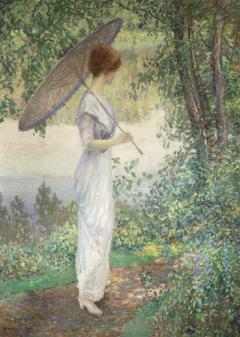
Irvine was born on February 28, 1869, in Byron, Illinois and died on August 21, 1936 in Lyme. He was in Lyme, summers, 1914-17; and permanently, 1918-36. Looking through a glass prism one day in his studio in Lyme, Wilson Irvine became fascinated by the rainbow-like effects. He began to view his subjects through the crystal to create what he called "prismatic paintings." His first exhibition of these jewel-like canvases with heavy impasto (paintings that compare closely with Walter Griffin's work between 1915 and 1930) was a one-man show at the Grand Central Art Galleries in 1930. Critics labeled these paintings "curiosities" and predicted that nothing would come of the experiment. Irvine nevertheless persisted in using the technique and won a fair measure of acceptance for his "prismatic paintings" in the later years of his career. Wilson Irvine had a keenly imaginative mind. He invented and patented a tree swing made off canvas straps that was manufactured by a Chicago firm. In the 1920s he experimented with what he called "aqua-prints," in which he controlled the process of making marbleized paper in order to introduce naturalistic subject matter. Always looking for new modes of visual expression, Irvine warned that "any painter who in this day and age clings tenaciously to the one thing which he can do best, in a technical sense, and is satisfied, is not only standing still, he is actually retrograding." Like so many of the American Impressionists, Irvine was largely self-taught. The only formal training he had was in evening classes at the Art Institute of Chicago. It has yet tobe determined how long Irvine studied or how he established his career m Chicago, but he must have developed a good reputation. He was a member of nearly every Chicago art organization of his day, including the Cliff Dwellers and the Chicago Arts Club, and he served as President for both the Palette and Chisel Club and the Chicago Society of Artists. Irvine and his family first came to Lyme in the summer of 1914, when the artist was forty-five years old. The reasons for this move have not been discovered. But within a few years he bought a permanent home in the Hamburg section of Lyme, where he and his family became good friends with such neighboring artists as Robert and Bessie Potter Vonnola and Guy Wiggins. (By the second decade of this century, many of the artist associated with the Old Lyme colony had moved to the more rural Hamburg, attracted by its picturesque cove of water and its open countryside, and disappointed by Old Lyme's increasing "progress." As early as 1909 Woodrow Wilson was complaining about the noise of motor cars roaring down the main street, something that had not been a problem on his first visit in 1905.) Irvine specialized in painting landscapes, particularly of the Connecticut countryside in spring. Critics frequently noted his ability to paint subtle atmospheric mists and to render tree forms truthfully. Both of these characteristics are in evidence in The Pool (cat. 189, illus. p. 145). He loved to paint outdoors, especially "when there's a kind of hazy beauty in the air." Not much is known about Irvine's exhibition history. He received a silver medal at the Panama-Pacific Exposition of 1915, and in 1926 he was elected an associate of the National Academy of Design. He exhibited regularly with the Lyme Art Association. He is represented in the collections of such museums as the Art Institute of Chicago, the Phoenix Art Museum, the William Benton Museum of Art, and the Lyme Historical Society. Irvine died in Lyme in 1936. Further reading: Aqua-Prints by Wilson Irvine. Exh. cat., Albert Roullier Galleries, New York City, n.d. Wilson Irvine Papers. Archives of American Art microfilm copy.Biography courtesy of Roughton Galleries, www.antiquesandfineart.com/roughton
wilson-irvine-paintings
wilson-irvine-paintings

