








Thomas Worthington Whittredge
American, 1820 - 1910
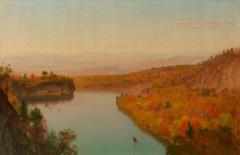
Thomas Worthington Whittredge, an important member of the later Hudson River School, specialized in landscapes, although he also painted some portraits and still lifes. His mature style incorporates both European and American influences, and celebrates the Catskill Mountains in New York and the American West, particularly the Great Plains.
Worthington Whittredge, as he called himself after about 1855, was born on a farm in Springfield, Ohio in 1920. He received little formal education. In 1837, he moved to Cincinnati, where he worked with his brother-in-law, a house and sign painter, while teaching himself to paint portraits and landscapes. He experimented with daguerreotypes in Indianapolis, and opened a portrait studio in Charlestown, West Virginia before returning to Cincinnati.
After about 1843, he devoted himself to landscapes. Works from this period, reveal the romantic influence of Thomas Cole and Thomas Doughty.
Cincinnati at this time boasted a large and wealthy community of art lovers. A number of patrons, headed by Nicholas Longworth, sent Whittredge to Europe to study and paint in 1849. He spent five years in Dusseldorf, where he studied under Carl Lessing and Andreas Achenbach. For a time he adopted the hard, relatively monotone palette of the Dusseldorf School.
He also visited Switzerland and Paris, where he viewed- but was not impressed by- the naturalistic landscapes of the barbizon painters. He than spent five years in Rome, where he was part of an artists' colony that included Frederick Church and Nathaniel Hawthorne. Upon returning to the United States in 1859, Whittredge settled in New York City. He opened a studio and began exhibiting at the National Academy of Design, to which he was elected in 1861: he served briefly as the Academy's president.
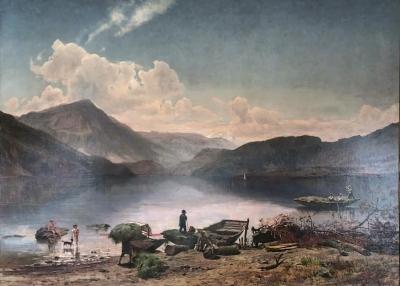
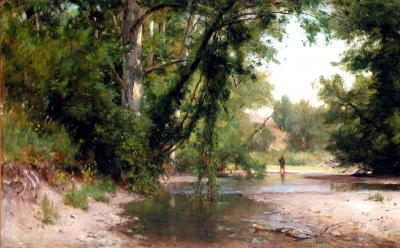
Gradually he abandoned the Dusseldorf manner, painting large, tonally harmonious canvases of woodlands and streams. He became particularly adept at rendering sunlight filtered through dense foliage. He also produced a few still lifes, showing richly colored living fruit on tree branches. A series of trips to the West and Mexico, beginning in 1865, introduced Whittredge to the grandeur of the frontier scenery, which he reflected in broad, spacious paintings. His use of horizontal masses and golden, variegated light suggest vastness and serenity.
Whittredge died in 1910 in Summit, New Jersey.
Member:
National Academy of Design
Public Collections:
Amon Carter Museum of Western Art, Fort Worth, Texas
Century Association, New York City
Cincinnati Museum
Corcoran Gallery of Art, Washington, D.C.
Denver Art Museum
Joslyn Art Museum
Metropolitan Museum of Art, New York City
Reynolda House, Winston-Salem, North Carolina
Biography courtesy of Roughton Galleries, www.antiquesandfineart.com/roughton
Worthington Whittredge, as he called himself after about 1855, was born on a farm in Springfield, Ohio in 1920. He received little formal education. In 1837, he moved to Cincinnati, where he worked with his brother-in-law, a house and sign painter, while teaching himself to paint portraits and landscapes. He experimented with daguerreotypes in Indianapolis, and opened a portrait studio in Charlestown, West Virginia before returning to Cincinnati.
After about 1843, he devoted himself to landscapes. Works from this period, reveal the romantic influence of Thomas Cole and Thomas Doughty.
Cincinnati at this time boasted a large and wealthy community of art lovers. A number of patrons, headed by Nicholas Longworth, sent Whittredge to Europe to study and paint in 1849. He spent five years in Dusseldorf, where he studied under Carl Lessing and Andreas Achenbach. For a time he adopted the hard, relatively monotone palette of the Dusseldorf School.
He also visited Switzerland and Paris, where he viewed- but was not impressed by- the naturalistic landscapes of the barbizon painters. He than spent five years in Rome, where he was part of an artists' colony that included Frederick Church and Nathaniel Hawthorne. Upon returning to the United States in 1859, Whittredge settled in New York City. He opened a studio and began exhibiting at the National Academy of Design, to which he was elected in 1861: he served briefly as the Academy's president.
Gradually he abandoned the Dusseldorf manner, painting large, tonally harmonious canvases of woodlands and streams. He became particularly adept at rendering sunlight filtered through dense foliage. He also produced a few still lifes, showing richly colored living fruit on tree branches. A series of trips to the West and Mexico, beginning in 1865, introduced Whittredge to the grandeur of the frontier scenery, which he reflected in broad, spacious paintings. His use of horizontal masses and golden, variegated light suggest vastness and serenity.
Whittredge died in 1910 in Summit, New Jersey.
Member:
National Academy of Design
Public Collections:
Amon Carter Museum of Western Art, Fort Worth, Texas
Century Association, New York City
Cincinnati Museum
Corcoran Gallery of Art, Washington, D.C.
Denver Art Museum
Joslyn Art Museum
Metropolitan Museum of Art, New York City
Reynolda House, Winston-Salem, North Carolina
Biography courtesy of Roughton Galleries, www.antiquesandfineart.com/roughton


 Loading...
