ACACIA Class Sloop H.M.S. HONEYSUCKLE of 1915
(Dockyard Builder's Model in Mahogany Case )
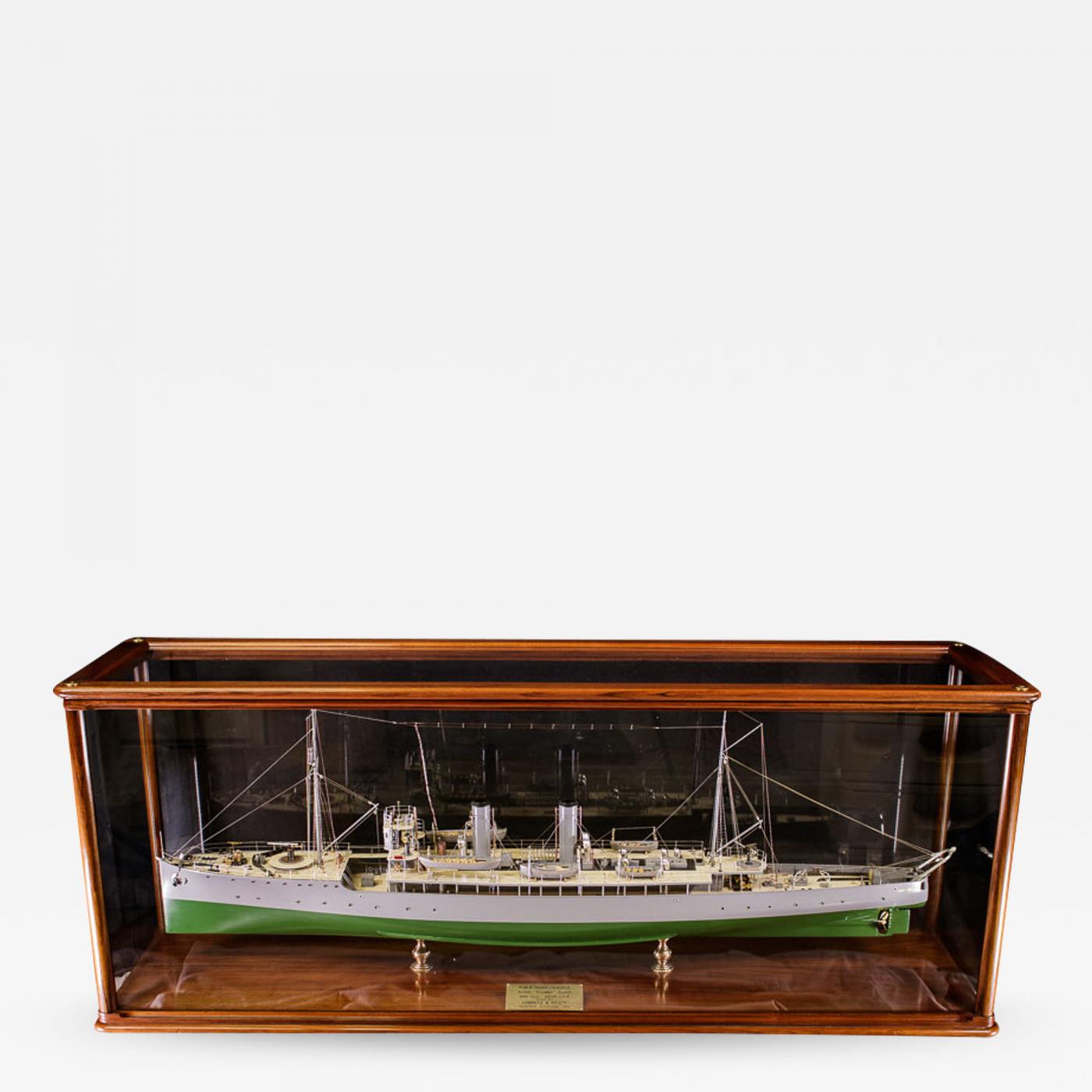
This large, impressive builder’s dockyard model of the H.M.S. HONEYSUCKLE is of museum quality with an outstanding level of detail and craftsmanship. Fitted with gold, silver and copper plated fittings throughout, recently replated.
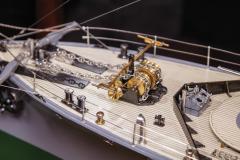
At the bow, a pair of thick anchor chains and a large windlass hold both anchors aloft. Behind, the first deck gun sits on a raised platform. The conning tower rises three levels above the open deck with portholes and rails on each level. One binnacle sits outside at the top with another inside the wheelhouse, behind the fore steering station. Dual searchlights sit on either side of the wheelhouse.
Copper antennae for the wireless telegraph runs between the two masts, with two down leads dropping just fore of the front funnel and ringed in a protective copper fence near the deck, running through it to terminate in the Wireless Office below, a very unusual and innovative for its time, communication configuration.
At the aft, sits the winch leading to the U-shaped support structure at the stern from which the ship would trawl, seeking to set loose mines attached to the ocean floor. Above the winch sits the aft gun and behind it a second steering station.
The ACACIA class was the first of the so called, “Flower Class” ships of the Royal Navy. Classed as sloops, these ships were built under the Emergency War Program at the start of World War I. The 24 vessels of the ACACIA class were all started in January of 1915 and launched within four or five months. HONEYSUCKLE was built in five at Lobnitz & Co. Shipyard of Renfrew, Scotland, and launched in June of 1915. To ease pressure on shipyards experienced in building larger warships, the smaller ACACIA class was designed to be built at merchant yards like Lobnitz, who at the same time built another of the class, the H.M.S. Iris, launched a month after HONEYSUCKLE.
Also called the “Cabbage Class” or the “Herbaceous Borders” the ACACIAs were the first purpose built minesweepers- a clear indication of the serious threat of mines to the British and Allied fleets. It was feared that convoys could be lured into minefields with large losses of ships and crews that could seriously weaken an entire Navy.
HONEYSUCKLE weighed in at 1,210 tons, at a length of 262.5 feet overall, with a 33 foot beam and 12 foot draught. Coal-powered with two funnels, the ships had double boilers but only a single screw (propeller) with a four cylinder, triple expansion reciprocating engine. This configuration made the ACACIA class half the speed of Destroyers of the same period, or about 16 knots. The choice of conventional steam engines rather than faster turbines made the ships less expensive to build and they were meant as a forward guard, clearing a path for faster ships rather than trying to keep pace with them.
The ACACIAs became well known for being very seaworthy ships, sturdy and maneuverable in many different conditions. With their triple thick, reinforced bows to offer extra protection against mine blasts, 21 of 24 ACACIA ships, including HONEYSUCKLE, survived the war.
After the Battle of Jutland in 1916, a rise in submarine attacks on British merchant ships required larger fleets, so the ACACIAs were fitted to carry depth charges, additional guns were added to the decks and they were redeployed as convoy escorts. With a long range of about 2,000 miles, along with their good seakeeping they were just as successful guarding ships in the North and Atlantic seas. The HONEYSUCKLE model, built at the same time as the ship, shows the ship’s original two gun minesweeper configuration.
The mahogany base of the case is original, as are the brass plinths holding the model. The outer case of fine grained, French polished mahogany, and double pane safety glass was made later in a period appropriate style. Original brass maker’s plaques are set on both sides of the case. A builder’s dockyard model of a sister 1915 ACACIA class sloop, the H.M.S. SNAPDRAGON, is in the collection of the Greenwich Maritime Museum in London.
This is an outstanding builder’s model of an active wartime Naval vessel.