





Showrooms
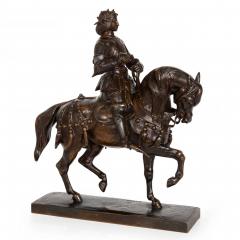
"Charles VII, The Victorious" | Antoine-Louis Barye
-
Description
ANTOINE-LOUIS BARYE
French, 1796-1875
"Charles VII, The Victorious"
Sand-cast dark-brown over medium-brown patinated bronze | signed "BARYE", cold-stamped underside "43" "00" and punched initials "ch"
Item # 403GPP07S
An exceedingly rare and most fine model of Antoine-Louis Barye's Charles VII, The Victorious, the sculpture is characterized by an unusual delicacy and attention to the smallest details. It depicts the French king slightly removed from the realm of this world and the air of a fairy-tale is present in the depiction; the strikingly youthful form atop his mount while outfitted in his full armor, his head crowned in the laurel wreath that nods in the motif towards victory and glory. The pony is regal with a mane pulled in long well-kempt strands that disappear beneath the straps. Notably the pony is not armored, but rather is posed in parade trappings, the image perhaps depicting Charles VII (French, 1403-1461) at his coronation at Reims Cathedral in 1429.
It is interesting how Barye deviated from traditional equestrian portrayals in this model. Emphasizing the king's youth, he depicts Charles VII in what initially appears to be larger than natural proportions compared to his ride; but Barye chose to portray him on a pony rather than a horse.
After the death of his two older brothres, Charles VII became Dauphin at fourteen and in 1422 he became King Charles VII of a split France, recognized only south of the Loire River. Joan of Arc met him in 1429, coming to his summer residence in Chinon to convince him to be coronated in Reims, a territory where he was not recognized as king. His coronation would be the last major event of the 100 Years War.
His reign was marked by his battles against the English with the aid of Joan of Arc, his restructuring of the French army, the expansion of commerce and the heavy taxation of the populace. Barye's decision to depict Charles VII as a handsome young man, rather than being rather plain and somewhat unattractive features as he is historically documented might indicate some artistic license and perhaps even idealization of the subject.
Barye's inspiration might have been drawn from ancient works like the marble bas-relief Calvary Riders in the Parthenon Frieze or the Equestrian Statue of Marcus Aurelius on the Capitoline Hill of Rome, which he studied in depth. One of Barye's sketches of Robert Malatesta, Duke of Rimini, from the Louvre, show his very clear integration of aspects of the Duke's posture and armor into Charles VII's representation - this sketch remains in the collection of the Walters. Other elements, like the laurel crown, possibly trace back to other historical sculptures, such as Lemot's Henry IV Equestrian. The design Barye employed in the narrow straps that resemble suspenders converging in a single cluster of studs on the hindquarters is well documented in his drawings of Horse Trappings held in the permanent collection of the Louvre.
A rather early work in Barye's ouevre, the earliest iteration known is the proof executed in bronze by Honoré Gonon in the lost-wax method with a gilded patina that was applied by Barye himself with a date on it of 1836 that was presented to the Consul of Great Britain in 1865. It is possible that early workings for this model were presented at the 1833 Salon as no. 5237 under a different title, but to date this has not been confirmed.
The modeling reflects a Romantic fascination with legendary and historical figures, and in creating this sculpture Barye engaged with traditions from both antiquity and Renaissance bronzes. His careful detailing includes the horse's mane and trappings, the sword, the perfect articulation of the details of his armor and chain-mail and the saddle. Unlike many of Barye's equestrian works, which were destined for monumental statues before being reduced for sale to collectors, this model was always intended to be only a small sculpture and was offered in only one size.
The sculpture underwent several iterations, with the final version dating around 1840, each showing slight modifications in the horse's mane, the harness, and the base's dimensions. The earliest version is of the king without his laurel crown and a more heavy baton.
Interestingly and quite unlike Barye's other models, it is likely that more casts of this model are épreuves from Barye's lifetime than posthumous casts, for after 1880 the popular interest in Romantic statues of this type, particularly of the figure Charles VII under the Third Republic, had dwindled so entirely that it almost entirely ceased to be cast. Many Barbedienne casts show part gilding on the edges and highlights.
As is the case with many posthumous casts of Barye's work, the weight and dimension of the model were enlarged slightly by some of the foundries that cast it. Poletti & Richarme question whether this might be to overcome critics of Barye's models referring to them simply as "paperweights".
The present cast is exceedingly light in composition and execution with a delicate and well-preserved patina. This presents as a dark and nearly black patina applied over a medium-brown cognac hue patina, the upper layer relieved to show the nuance of the underlying brighter tones both through time/gentle handling and intentionally by the foundry. The texture and details are exquisitely represented and are largely the result of capture directly from the mold with little cold-tooling evident. The signature for BARYE is gingerly raised around the edges. Note Charles VII is missing his baton.
While there is no foundry mark and the model shows every indication of being a lifetime cast, the use of cylindrical slotted bolts is typical on many Barbedienne casts we see from the 1880s and despite not being marked by Barbedienne may suggest their involvement either during Barye's lifetime or shortly thereafter in casting this example. Market results: Sotheby's, London, 11 July 2001, lot 229, achieved 8400 GBP [conversion at 1.41 the time of sale for approximately $ 11,800 USD] Artcurial, Paris, 9 November 2021, lot lot 144, achieved 10,000 euros [conversion at 1.155 the time of sale for approximately $ 11,550 USD]
Christie's, New York, 25 April 2003, lot 53, achieved $ 15,535 USD Sotheby's New York, 6 June 2001, lot 303, achieved $11,400 USD Sotheby's, London, 23 November 2010, lot 62, achieved 9,375 GBP [conversion at 1.56 the time of sale for approximately $ 14,600 USD]
Sotheby's, London, 3 July 2012, lot 130, achieved 10,000 GBP [conversion at 1.55 the time of sale for approximately $ 15,500 USD, an F. Barbedienne cast]
Christie's, New York, 25 May 1994, lot 134, achieved $ 11,500 USD
Artist Listings & Bibliography: Antoine-Louis Barye: Sculptor of Romantic Realism, Benge, 1984, ill. 142, discussion p. 148-149 Barye: Catalogue Raisonne des sculptures, Poletti & Richarme, 2000, p.72-73 The Barye Bronzes: A Catalogue Raisonne, Pivar, 1990, cat. no. F8, ill. pg. 74 Untamed: The Art of Antoine-Louis Barye, Johnston & Kelly, 2006, p. 141, ill. 45 [lengthy discussion of an example of the present model held in the Walters Gallery] The Romantics to Rodin, French Nineteenth Century Sculpture from American Collections, Fusco & Jansen, 1980, p. 132-133, no. 20 [lengthy discussion on the present model] Bronzes by Antoine-Louis Barye, The Bernard Black-Hugues Nadeau Collection, Parke-Bernet Galleries, Inc., December 3 1971, p. 32-33, lot 48, achieved $ 3,000 USD
Measurements: 11 3/4" H x 3" D (base) x 9 1/4" W (base) Condition Report:
Missing the baton for his raised arm. Trace wear to what appears to be an original patina throughout, including rubbed wear to the raised elements to reveal the more autumnal hue of bronze. Exceedingly beautiful. Ready to place. -
More Information
Documentation: Signed Period: 19th Century Styles / Movements: Traditional Dealer Reference #: 403GPP07S Incollect Reference #: 836146 -
Dimensions
W. 9.25 in; H. 11.75 in; D. 3 in; W. 23.5 cm; H. 29.85 cm; D. 7.62 cm;
Message from Seller:
Silla, Ltd. is a family-owned antique gallery located at 117 W Burd St., Shippensburg, PA 17257, specializing in 19th and early 20th century bronze sculptures and unique period furniture. For more information or to schedule a visit, contact us at sales@sillafineantiques.com or call 717.708.9017.
More Listings from SILLA View all 376 listings
-
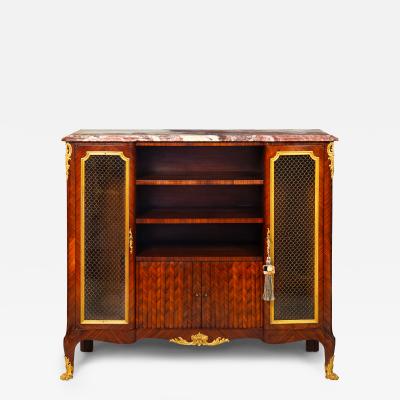
French Louis XV Style Kingwood Marble Top Bibliotheque Cabinet
-
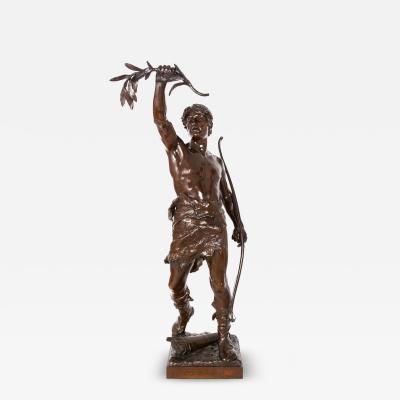
A Fine 36” H French Antique Bronze Sculpture “Victory” by Eugene Marioton
-
Fine Pair of American Classical Mahogany Card Tables, Massachusetts ca. 1820
-
Pair of English Regency Rosewood Bookcase Cabinets att. John McLean c. 1820
-
Seascape Painting of American Clipper Ship “Red Cloud” by Henry Scott
-
Neoclassical Simulated Bamboo Giltwood Console Pier Table, 20th century

-
18th Century Finely Carved Boxwood Corpus Christi on Stand
-
18th Century American Chippendale Walnut Blanket Chest circa 1780s
-
Fine Maritime Seascape Painting of American Clipper Ships by Henry Scott
-
Rare Fine French Empire Mahogany Bed by Jacob-Desmalter ca. 1805-15
-
Rare American Federal Mahogany Cylinder Desk, Baltimore or Annapolis ca. 1800
-
19th Century Pair of French Louis XVI Style Two-Light Wall Sconces Candelabra
-
German Gilt Bronze Corpus Christi after Guglielmo della Porta, 17th century
-
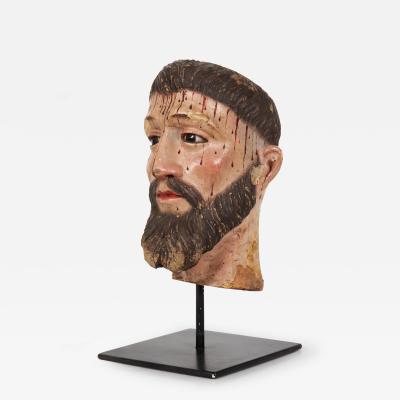
Spanish Polychromed Carved Head of Christ as Ecce Homo, early 18th century