












Offered by:
H&S Fine Art and Antiques
by appointment only, based in San Francisco, Bay Area
San Francisco, CA , United States
Call Seller
Showrooms
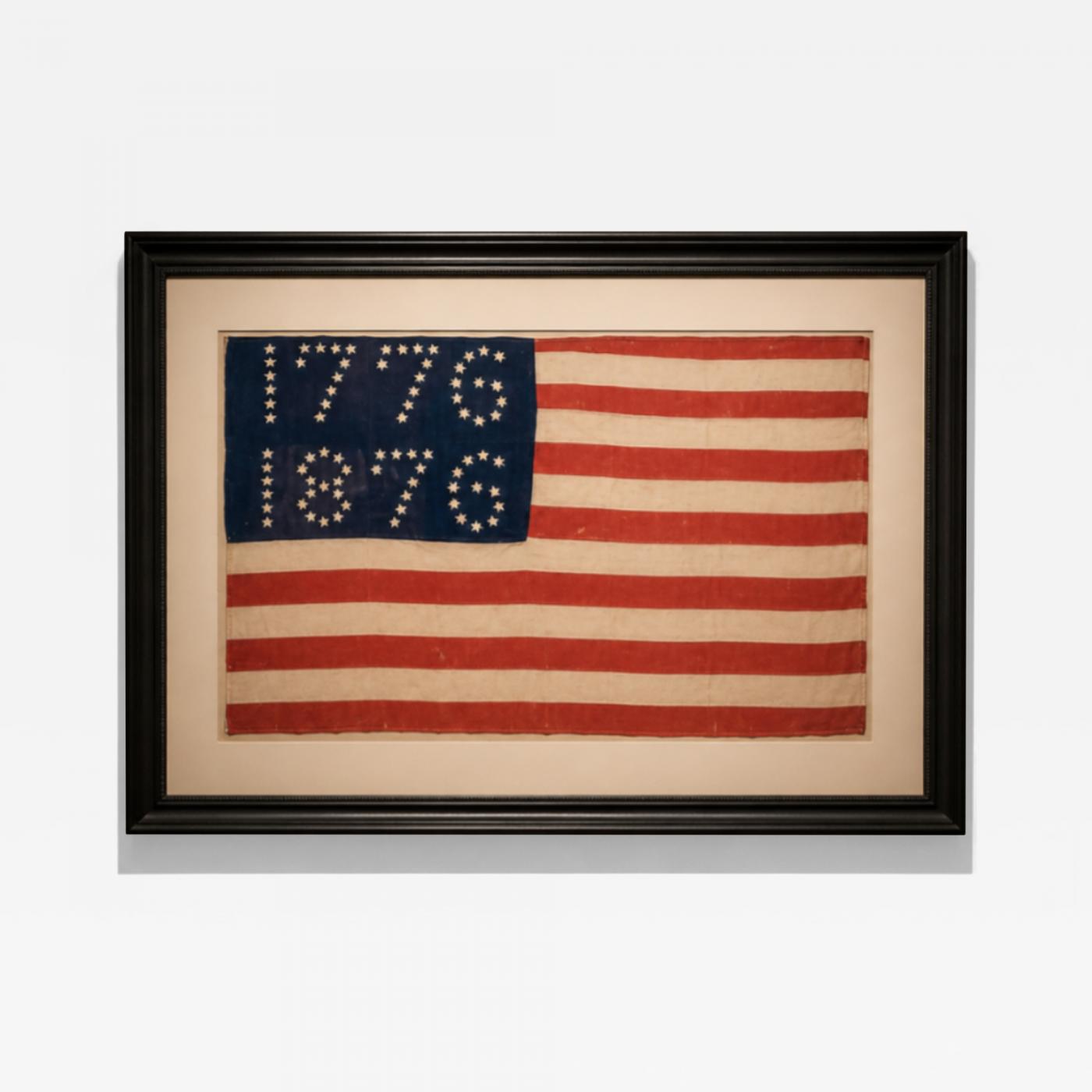
American Centennial Celebration Flag Stars Forming “1776–1876”
-
Description
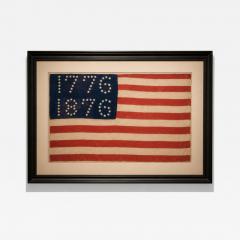
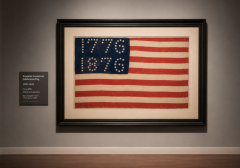
American Centennial Celebration Flag
Stars Forming “1776–1876” Printed wool-and-cotton textile
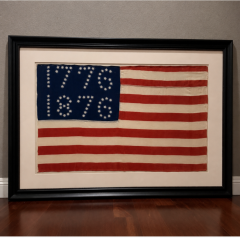
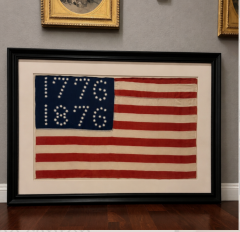
Stars arranged numerically to form “1776 / 1876” within the canton
Thirteen red and white stripes
Conservation mounted and framed: 60 × 43 inches, flag 45 ¾ x 28 inches
Historical Context: The American Centennial of 1876: In 1876, the United States marked the one-hundredth anniversary of the Declaration of Independence with an extraordinary outpouring of patriotic imagery. Flags, banners, medals, prints, ceramics, textiles, and commemorative objects transformed the familiar symbols of the American republic into expressions of national history.
The centerpiece of the celebration was the Centennial International Exhibition in Philadelphia, America's first official world's fair. Congress had sanctioned the exhibition specifically to commemorate the hundredth anniversary of American independence. Opening on May 10 and closing November 10, 1876, the enormous exposition occupied Fairmount Park and attracted approximately ten million visitors
The scale was unprecedented. More than 200 buildings occupied the grounds, and thirty-seven countries participated. Twenty-six American states erected their own pavilions. Coming only eleven years after the end of the Civil War, the Centennial also provided an opportunity to present the United States publicly as a reunited and increasingly industrialized nation.
Patriotic objects bearing the dates 1776 and 1876 became ubiquitous symbols of the celebration. The Smithsonian's National Museum of American History preserves numerous surviving Centennial objects, including souvenir flags and medals incorporating precisely this pairing of dates.
The Flag:
The present flag belongs to one of the most visually inventive categories of American Centennial flags.
Instead of arranging the stars in conventional rows or a medallion, its maker transformed the canton into a piece of patriotic typography. 1776 above 1876. The result is remarkable because the stars simultaneously function as individual symbols of the United States and as components of a much larger image. From across a room, the viewer perceives the two dates. At closer range, the dates dissolve into constellations of individual stars. This transformation between symbol, number and pattern is one of the great strengths of the design. .Of particular visual importance are the sharply pointed stars. Comparable surviving flags employ distinctive ten-pointed stars, rather than the conventional five-pointed stars familiar on the national flag.
Understanding the Star Count
One of the fascinating characteristics of nineteenth-century American flags is that makers did not always follow the star count that modern viewers might expect.
Colorado became the 38th state on August 1, 1876, during the Centennial year. Flag makers were already anticipating Colorado's admission, and Centennial-period flags survive with a remarkable variety of star counts and arrangements.
That distinction is important.
The canton should therefore not necessarily be interpreted as an attempt to represent a hypothetical 81-state Union. Instead, the stars are functioning simultaneously as national emblems and typographic elements. The designer subordinated strict numerical convention to visual effect.
A Flag as Folk Design:
Although unmistakably patriotic, this object can also be understood within the history of American folk and vernacular design.
Before flag designs became as standardized as they are today, nineteenth-century makers demonstrated considerable freedom in arranging stars. Stars appeared in circles, wreaths, medallions, Great Stars, ovals, crosses and other geometric configurations. The Centennial encouraged even greater experimentation. Here, the maker essentially converted the canton into a commemorative inscription without introducing ordinary lettering. The vocabulary remains entirely that of the American flag: blue field and white stars. Yet the stars themselves communicate the nation's history. The design therefore succeeds at several levels:
1776 represents the founding generation and the Declaration of Independence.
1876 represents a century of national development.
The stars represent the expanding Union, and the thirteen stripes preserve the traditional reference to the original colonies.
It is both flag and historical proclamation.
Material and Manufacture:
Comparable examples have been identified as printed on a thin textile combining wool and cotton, an unusual choice compared with the cotton and silk commonly encountered in nineteenth-century parade flags.
The printing process also permitted an exceptionally complicated canton to be reproduced—something that would have been extraordinarily laborious if every small pointed star had been individually appliquéd.
The slight irregularities visible in the textile today—the undulations of the fabric, minor losses and variations in coloration—are consistent with the character of a nineteenth-century textile and contribute substantially to its historical presence.
They should be understood as part of the object's material history rather than disguised through excessive restoration.
Historical Significance:
The importance of this flag extends beyond its rarity as an unusual star configuration.
It belongs to a moment when Americans were consciously looking backward at their revolutionary origins while simultaneously contemplating what the country had become.
The nation of 1876 was dramatically different from that of 1776.
It had survived a devastating Civil War, abolished slavery constitutionally, expanded across the continent, undergone rapid industrialization, and grown from thirteen former colonies into a continental republic approaching forty states.
The Centennial Exposition was intended in part to demonstrate that transformation to the world.
Consequently, the dates appearing on this flag should not be understood simply as decoration. 1776 / 1876 was itself a national statement.
Curator's Note:
Few nineteenth-century American flags unite historical meaning and graphic invention as successfully as the Centennial “1776–1876” design.
At first encounter, the eye recognizes the dates. Only afterward does one perceive that the numerals have been constructed from constellations of individual stars. The effect is simultaneously monumental and remarkably simple: the vocabulary of the national flag has been transformed into a declaration of historical memory.
The flag was created at an extraordinary moment in American history. In 1876, a nation only eleven years removed from Civil War celebrated the centenary of a revolution that had begun thirteen colonies on the path toward independence. The Philadelphia Centennial Exhibition presented an image of technological progress, national expansion and renewed confidence to millions of American and international visitors.
Against that background, “1776” and “1876” carried significance far beyond anniversary dates. Together they represented a century-long narrative Americans were actively constructing about themselves.
Today the flag has acquired another layer of meaning. In America's 250th anniversary year, the viewer encounters not merely a commemoration of 1776, but a surviving record of how Americans in 1876 chose to commemorate 1776.
Its irregular textile surface, softly aged stripes and extraordinary star-filled canton preserve that moment with unusual immediacy. Rather than merely depicting American history, the flag is itself an artifact of America's continuing effort to remember and reinterpret its national past. -
More Information
Origin: United States Period: 19th Century Materials: Printed wool-and-cotton textile Condition: Good. faded slightly small holes, thinning, to red stripes and around bottom edge where white stripe connects to white underneath 1876. top edge of the flag folded. Creation Date: 1876 Styles / Movements: Folk Art, Americana, Traditional Patterns: Stripes & Solid, Textured, Traditional Incollect Reference #: 879114 -
Dimensions
W. 60 in; H. 43 in; W. 152.4 cm; H. 109.22 cm;
Message from Seller:
H&S Fine Art and Antiques is a distinguished gallery based in the San Francisco Bay Area, specializing in American folk art, decorative and modern art, as well as Oriental antiquities. With a keen eye for craftsmanship, historical richness, and aesthetics, we offer a carefully curated collection for collectors and enthusiasts alike. By appointment only. Contact us at h.s.fineartandantiques@gmail.com for inquiries.
More Listings from H&S Fine Art and Antiques View all 68 listings
-
PRANCING HORSE ATTRIBUTED TO J. WHITTICKER, CIRCA 1860.
-
LARGE BLUE AND WHITE UNDERGLAZE PORCELAIN TEAPOT.
-
Manner of Joseph Alexander Ames (1816–1872) Portrait of Abraham Lincoln
-
George “Angelo” Crowhurst (1795–1839) Attrib. Lady in a Blue Dress.
-
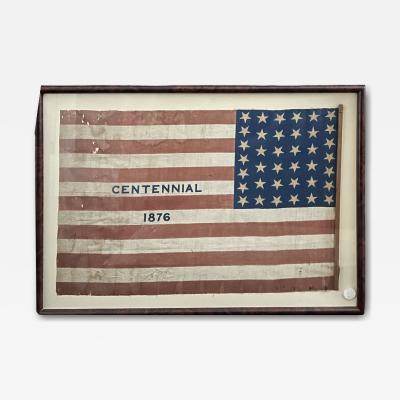
38 STAR ANTIQUE FLAG,COLORADO STATEHOOD, CIRCA 1876.
-
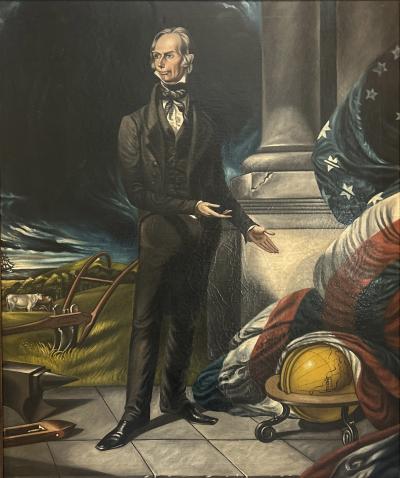
Henry Clay, American School, after John Neagle Circa 1845–1860.
-
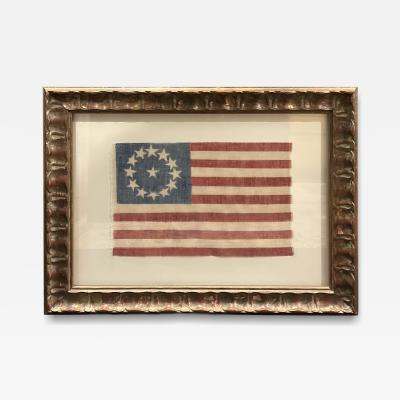
A RARE THIRTEEN STAR AMERICAN PARADE FLAG,CIRCA 1875-1895.
-
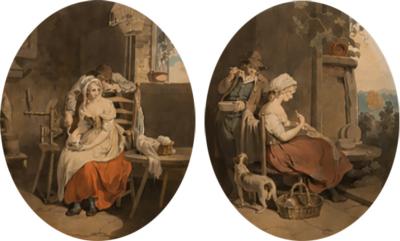
Francis Wheatley, R.A. Industry and Idleness, 1786.
-
American Carved and Painted whirligig soldier.
-
A Carved Gilded Wooden Eagle, possibly Maine, 19th century.
-
A Carved whirligig of a policeman ( 1910-1920).

-
A Watercolor, Pen and Ink Drawing of George Washington on Horseback
-
WASHINGTON, MARTHA HANDMADE BRUSSELS LACE RIDING VEIL
-
Marc Chagall (1887-1985). Etude pour Jacob. Pen and india ink on tracing paper.