











Showrooms
17th C The Ring of Polycrates, Tyrant of Samos, Circle of Antonio Molinari
-
Description
17th C The Ring of Polycrates, Tyrant of Samos, Circle of Antonio Molinari (Venise, 1655–1704)
17th C
Oil on canvas
unframed: 170 x 120 cm; 66 7/8 x 47 1/4 in
6085
Copyright The Artist
POA
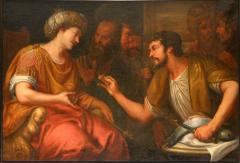
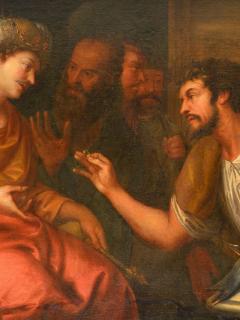
This ambitious composition illustrates the ancient episode of The Ring of Polycrates, drawn from Herodotus. In the story, the king of Samos, blessed with continuous success, is advised by his ally Amasis of Egypt to sacrifice what he holds most dear in order to ward off misfortune. Polycrates thus throws his ring into the sea, only for it to return shortly after inside the belly of a fish that is offered to him. The tale is often read as a meditation on the fickleness of fate.
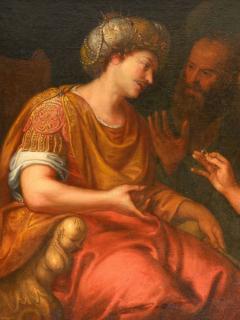
At the center, Polycrates is depicted as a young ruler magnificently dressed in an oriental garment with rich gold embroidery and a pearl-studded turban, seated on a carved throne adorned with a sphinx—a symbol of authority and enigma. His demeanor, both serene and condescending, enhances the tragic irony of the narrative.
The scene skillfully combines the expressive pathos of the figures with a theatrical structure inherited from late Venetian classicism. The lighting carves out the groups of characters with an intensity that borders on Caravaggesque, while the warm palette and sensual modeling evoke the style of Antonio Molinari, a major figure in Venetian history painting bridging the triumphant Baroque and the emerging Rococo.
Although this painting may be attributed to Molinari’s circle, certain qualities of execution—particularly in the rendering of faces, textures, and chiaroscuro effects—suggest the hand of a talented painter active in Venetian or Central European circles who had assimilated his style. The narrative tension, the elegance of the figures, and the attention to ornamental detail also recall works by Gaspar de Crayer or Jacob Backer, though authorship cannot be definitively assigned to them.
Bibliography & Comparable Works
The Clemency of Scipio, Antonio Molinari, Cambi Casa d’Aste
The Adoration of the Golden Calf, Hermitage Museum
Salvator Rosa and the Tradition of Ancient History in Baroque Painting, exhibition catalog, Rome, 2010
Antonio Molinari, The Clemency of Scipio, Venice Museum
Gaspar de Crayer, David Before Saul
Jacob Backer, Ancient Histories, Rijksmuseum
Cette composition ambitieuse illustre l’épisode antique de L’anneau de Polycrate, tiré d’Hérodote, où le roi de Samos, comblé de succès, est conseillé par son allié Amasis d’Égypte de sacrifier ce qu’il a de plus précieux afin de conjurer le sort. Polycrate jette alors son anneau à la mer, qui lui revient peu après dans le ventre d’un poisson offert. L’histoire est souvent lue comme une méditation sur l’inconstance du destin.
Au centre, Polycrate est figuré sous les traits d’un jeune souverain magnifiquement vêtu d’un habit oriental aux riches broderies dorées et turban perlé, assis sur un trône sculpté ornementé d’une sphinge – symbole d’autorité et d’énigme. Son attitude à la fois sereine et condescendante accentue l’ironie tragique du récit.
La scène mêle avec efficacité le pathos expressif des figures à une structure théâtrale héritée du classicisme vénitien tardif. La lumière découpe les groupes de personnages avec une intensité presque caravagesque, tandis que la palette chaude et la sensualité du modelé évoquent la manière d’Antonio Molinari, grand représentant de la peinture historique à Venise entre le baroque triomphant et le rococo naissant.
Bien que cette toile puisse être attribuée à l’entourage de Molinari, certaines qualités de facture – notamment dans le rendu des visages, des textures et des effets de clair-obscur – suggèrent la main d’un peintre de talent actif dans les cercles vénitiens ou d’Europe centrale ayant assimilé son style. La tension narrative, l’élégance des figures et le souci du détail ornemental rappellent également certains travaux de Gaspar de Crayer ou Jacob Backer, sans que l’on puisse formellement leur en attribuer la paternité.
Bibliographie & œuvres comparables
La Clémence de Scipion, Antonio Molinari, Cambi Casa d’Aste
L’Adoration du veau d’or, Musée de l’Ermitage
Salvator Rosa et la tradition de l’histoire antique dans la peinture baroque, catalogue d’exposition, Rome, 2010
Antonio Molinari, La Clémence de Scipion, Musée de Venise
Gaspar de Crayer, David devant Saül
Jacob Backer, Histoires antiques, Rijksmuseum
Deze ambitieuze compositie beeldt het antieke verhaal uit van De ring van Polycrates, ontleend aan Herodotus. In dit verhaal wordt de koning van Samos, die uitzonderlijk veel succes kent, door zijn bondgenoot Amasis van Egypte aangeraden om afstand te doen van wat hem het dierbaarst is, om zo het noodlot af te wenden. Polycrates werpt dan zijn ring in zee, maar deze keert kort daarna terug in de buik van een vis die hem wordt aangeboden. Het verhaal wordt vaak gelezen als een overpeinzing over het wispelturige karakter van het lot.
In het midden is Polycrates afgebeeld als een jonge heerser, prachtig gekleed in een oosters gewaad met rijke gouden borduursels en een met parels bezette tulband. Hij zit op een gebeeldhouwde troon, versierd met een sfinx – een symbool van autoriteit en mysterie. Zijn houding, zowel sereen als neerbuigend, versterkt de tragische ironie van het verhaal.
De scène combineert op effectieve wijze het expressieve pathos van de figuren met een theatrale opbouw, die is geïnspireerd op het laat-Venetiaanse classicisme. Het licht snijdt de groepen personages uit met een intensiteit die bijna Caravaggio-achtig is, terwijl het warme palet en de sensuele modellering doen denken aan de stijl van Antonio Molinari, een belangrijk vertegenwoordiger van de Venetiaanse historiestijl tussen de triomferende barok en het opkomende rococo.
Hoewel dit doek mogelijk uit de kring rond Molinari komt, suggereren bepaalde kwaliteiten in de uitvoering – met name in de weergave van gezichten, texturen en clair-obscureffecten – de hand van een getalenteerde schilder die actief was in Venetiaanse of Midden-Europese kringen en die zijn stijl had geassimileerd. De narratieve spanning, de elegantie van de figuren en de aandacht voor ornamentale details roepen ook herinneringen op aan werken van Gaspar de Crayer of Jacob Backer, zonder dat men hen formeel het auteurschap kan toeschrijven.
Bibliografie & Vergelijkbare Werken
De Genade van Scipio, Antonio Molinari, Cambi Casa d’Aste
De Aanbidding van het Gouden Kalf, Hermitage Museum
Salvator Rosa en de traditie van de antieke geschiedenis in de barokschilderkunst, tentoonstellingscatalogus, Rome, 2010
Antonio Molinari, De Genade van Scipio, Museum van Venetië
Gaspar de Crayer, David voor Saul
Jacob Backer, Antieke Verhalen, Rijksmuseum
Diese ambitionierte Komposition illustriert die antike Episode Der Ring des Polykrates, überliefert von Herodot. Der König von Samos, vom Glück überhäuft, wird von seinem Verbündeten Amasis aus Ägypten gewarnt, das Kostbarste, was er besitzt, zu opfern, um das Schicksal zu besänftigen. Daraufhin wirft Polykrates seinen Ring ins Meer, doch kehrt dieser kurze Zeit später im Bauch eines geschenkten Fisches zurück. Die Geschichte wird häufig als eine Reflexion über die Unbeständigkeit des Schicksals interpretiert.
Im Zentrum der Szene erscheint Polykrates als junger Herrscher, prachtvoll gekleidet in ein orientalisches Gewand mit reichen goldenen Stickereien und einer mit Perlen besetzten Turban, sitzend auf einem kunstvoll geschnitzten Thron, der mit einer Sphinx – Symbol für Autorität und Rätselhaftigkeit – verziert ist. Seine gelassene und zugleich überhebliche Haltung verstärkt die tragische Ironie der Erzählung.
Die Szene verbindet wirkungsvoll den expressiven Pathos der Figuren mit einer theatralischen Komposition, die vom spätvenezianischen Klassizismus inspiriert ist. Das Licht modelliert die Figurengruppen mit einer Intensität, die fast an Caravaggio erinnert, während die warme Farbpalette und die sinnliche Modellierung an die Handschrift Antonio Molinaris denken lassen – ein bedeutender Vertreter der venezianischen Historienmalerei zwischen triumphierendem Barock und aufkommendem Rokoko.
Auch wenn das Gemälde dem Umkreis Molinaris zugeschrieben werden kann, deuten bestimmte malerische Qualitäten – besonders in der Ausarbeitung der Gesichter, Texturen und Hell-Dunkel-Effekte – auf die Hand eines talentierten Künstlers hin, der im venezianischen oder mitteleuropäischen Raum tätig war und den Stil Molinaris verinnerlicht hatte. Die erzählerische Spannung, die Eleganz der Figuren und die Sorgfalt für ornamentale Details erinnern zudem an Werke von Gaspar de Crayer oder Jacob Backer, ohne dass eine eindeutige Zuschreibung möglich wäre.
Literatur & Vergleichbare Werke
Die Milde des Scipio, Antonio Molinari, Cambi Casa d’Aste
Die Anbetung des Goldenen Kalbes, Eremitage-Museum
Salvator Rosa und die Tradition der antiken Geschichte in der barocken Malerei, Ausstellungskatalog, Rom, 2010
Antonio Molinari, Die Milde des Scipio, Museum von Venedig
Gaspar de Crayer, David vor Saul
Jacob Backer, Antike Geschichten, Rijksmuseum
Provenance
Private Collection Belgium -
More Information
Period: Pre 18th Century Creation Date: 17th Century Styles / Movements: Traditional Incollect Reference #: 817577 -
Dimensions
W. 66.93 in; H. 47.24 in; W. 170 cm; H. 120 cm;
Message from Seller:
Spectandum, a by-appointment gallery in Leuven, Belgium, can be reached at contact@spectandum.com 32475648678. The gallery specializes in Natural History, Ethnography, European works of art, antiquities, and rare curiosities sourced from around the world.
More Listings from Spectandum View all 172 listings
-
Two vintage Danish Safari chair in tan leather by Kaare Klint for Rud Rasmussen

-
Chinese wooden Rice box with handpainted decoration
-
21st C., Expressionism, Animal Painting, Auzoux's Troglodytes Gorilla's

-
18th C Pallas Athéna with lance, shield, helmet and breastplate. Anonymus

-
17th C, Baroque, Hunting Scene, Wild Boar Hunt

-
Counter top Cigar store Northern American Indian statue, Unknown artist
-
Early 20th C, DRC, Selection of three Bark cloth Beaters

-
Collection of 6 Antique Chinese Opium Boxes enameled with decorative patterns

-
Anthropomorph Vase
-
Ejagham skincovered Antilope Crest Mask
-
17th C, Baroque, Saint, Italian School, Wooden Sculpture of Saint Anthony
-
17th C portrait of an Ottoman Elite Woman, Venetian School
-
Wooden sculpture of a Dancing Tengu, Late Edo–Meiji Period, Japan
-
Bwende Standing Statue with scarified body, DRC