











Listings / Fine Art / Photographs / Marine

Offered by:
Arader Galleries
1016 Madison Avenue
New York City, NY 10075 , United States
Call Seller
215.735.8811
Showrooms
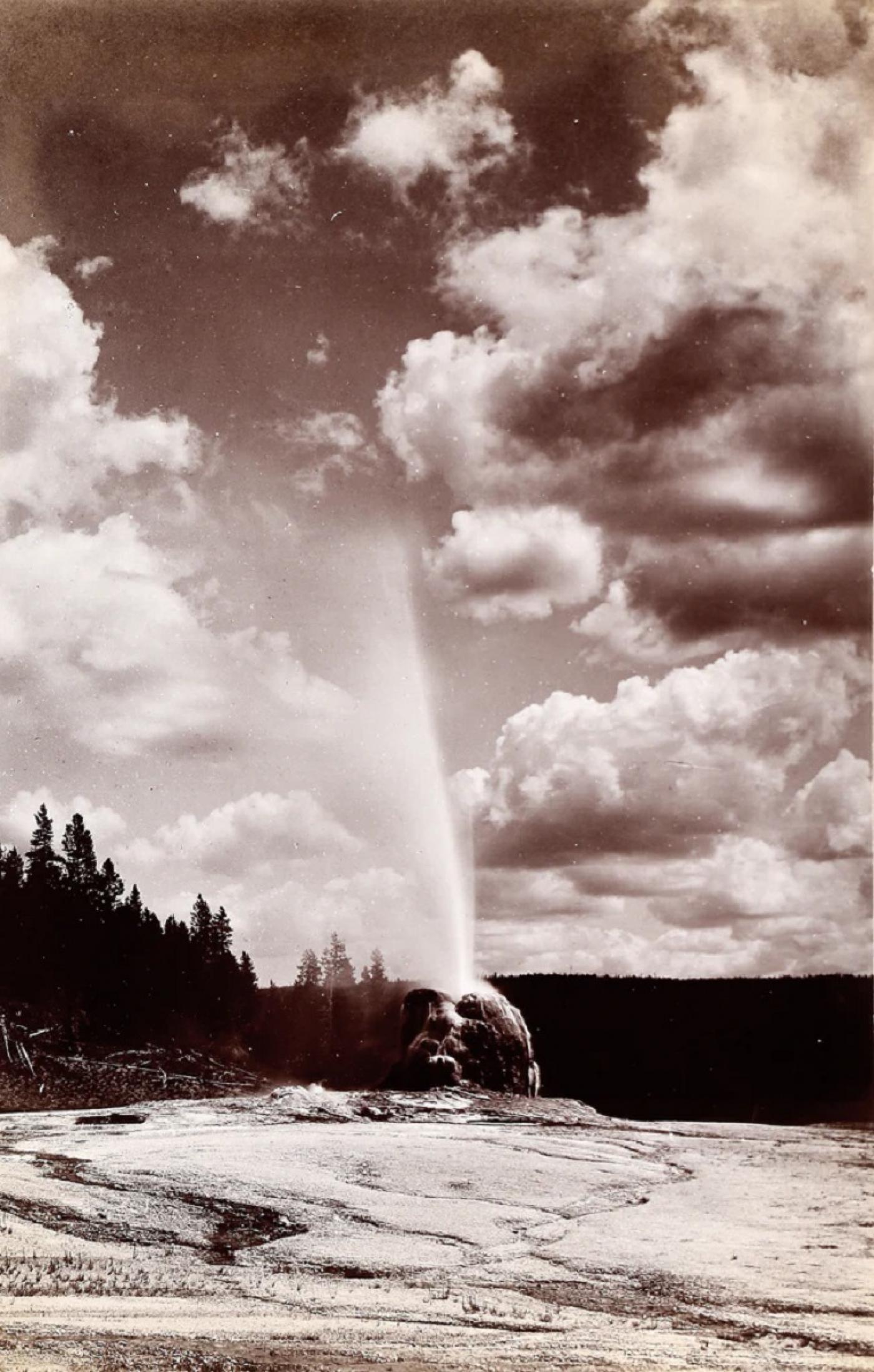
FRANK JAY HAYNES (1853-1921), LONE STAR GEYSER
-
Description
Frank Jay Haynes (1853-1921)
Lone Star Geyser
YELLOWSTONE NATIONAL PARK
Number 43 penciled lower left-hand corner
Fine albumen print, mounted on archival matte
Photograph size: 8 x 5 in.
Matte board size: 14 x11 in.
Provenance: from the library of William E. Hofman, his sale Christie's 3rd December, 2010, lot 343
A magnificent view of the Grand Canyon from Inspiration Point in Yellowstone National Park by the park's official photographer Frank Jay Haynes.
The Grand Canyon of the Yellowstone is the first large canyon on the Yellowstone River downstream from Yellowstone Falls in Yellowstone National Park. Charles W. Cook first viewed the canyon after traveling west from the Lamar Valley on September 20, 1869: "I was riding ahead, the two pack animals following, and then Mr. Folsom and Mr. Peterson on their saddle horses. I remembered seeing what appeared to be an opening in the forest ahead, which I presumed to be a park, or open country. While my attention was attracted by the pack animals, which had stopped to eat grass, my saddle horse suddenly stopped. I turned and looked forward from the brink of the great canyon, at a point just across from what is now called Inspiration Point. I sat there in amazement, while my companions came up, and after that, it seemed to me that it was five minutes before anyone spoke" (Cook. The Valley of the Upper Yellowstone-An Exploration of the Headwaters of the Yellowstone River in the Year 1869. Norman, OK: University of Oklahoma Press. p. 31).
A year later the Washburn expedition arrived on the scene and Lt. Gustavus C. Doane described the canyon: "As we approached the Grand Cañon a dull roaring sound warned us that the falls were near at hand. ...I had descended the cañon at a point where the creek joined the river, precipitated into a gorge just above its juncture in a lovely cascade of three falls, in the aggregate 100 feet in height. This was named Crystal Cascade, and the stream Cascade Creek. In the bed of the gorge were to be found an infinite variety of volcanic specimens, quartz, feldspar, mica, granites, lavas, basalts, composite crystals; in fact, everything, from asbestos to obsidian, was represented by fragments in the bed of this stream. There were also beautiful clay stone specimens, of which we afterward learned the origin. At the foot of the gorge and on the margin of the Yellowstone stood a high promontory of concretionary lava, literally filled with volcanic butternuts. Many of these were loose, and could be taken out of the rock with the hand; broken open they were invariably hollow, and lined with minute quartz crystals of various tints. This formation is rare, but occurs frequently in the great basin. From the outer point of this promontory can be seen the foot of the upper fall of the Yellowstone, and I climbed to the summit to obtain a view" (The report of Lieutenant Gustavus C. Doane upon the so-called Yellowstone Expedition of 1870, presented to the Secretary of War, February 1871).
Yellowstone, was the world's first national park, and "is situated mainly in Wyoming and extends into Montana and Idaho. It was established in 1872 by Congress, primarily because of its geysers, but also because of its remarkable assemblage of wildlife and unusual natural features. The "national park idea" pioneered at Yellowstone eventually spread worldwide. In the United States, Mackinac Island National Park (now a Michigan state park) was established in 1875 and Sequoia and Yosemite National Parks in 1890. (Yosemite had been a California state park since 1864.) Yellowstone remains the "mother park" in the U.S. national park system, which by the 1990s included 376 sites.
The celebrated photographer Haynes was first hired as the official photographer of the Northern Pacific Railroad and "given his own travelling studio in a converted rail car, Haynesproduced numerous famous images of the railroad's construction projects and of sites along its route. He held that position for nearly three decades. He also was appointed in 1884 as Yellowston's official photographer and sold materials from a store in the park itself. He retired in 1916. His images of Yellowstone are among his more important and dramatic imagery" (see Dorothy Sloan, Western Americana,10/18/2006, lot 254).
"Boasting about three-quarters of the world's geysers (of which Old Faithful is the most famous) and over half of the thermal features, it also has one of the globe's most spectacular canyons, one of North America's most celebrated waterfalls, and more than 225 permanent waterfalls higher than fifteen feet. It has the premier wildlife sanctuary (and the top three trout-fishing streams) in the continental United States. Unmatched in the variety and number of its megafauna, the park shelters the world's largest concentration of elk and is one of the last remaining strongholds of the grizzly bear in the coterminous states. It is the only site in the United States (and one of only two in the world) where a wild bison herd has survived continuously since ancient times. At the center of the largest relatively intact ecosystem in the North Temperate Zone, its hundreds of lakes, creeks, mountains, and valleys survive in essentially pristine condition. As in all major parks, Yellowstone's administrators debate the appropriate forms of intervention to protect this delicate ecosystem and strive to balance the competing claims of public access and wilderness preservation" (see Aubrey L. Haines, The Yellowstone Story, 1996; James Pritchard, Preserving Yellowstone's Natural Conditions: Science and the Perception of Nature, 1999). -
More Information
Documentation: Documented elsewhere (similar item) Period: 19th Century Condition: Good. Styles / Movements: Other Incollect Reference #: 665291 -
Dimensions
W. 5 in; H. 8 in; W. 12.7 cm; H. 20.32 cm;
Message from Seller:
Founded in 1971, Arader Galleries is the leading dealer of rare maps, prints, books, and watercolors from the 16th to 19th centuries. Visit us at 1016 Madison Avenue, NYC, or contact us at 215.735.8811 | loricohen@aradergalleries.com |
More Listings from Arader Galleries View all 1340 listings
-
PHILADELPHIA DRESSING TABLE (INV. 0338)
-
PHILADELPHIA RACKET-BACK SIDE CHAIR (INV. 0023)

-
PHILADELPHIA DRESSING TABLE (INV. 0327)

-
DELAWARE VALLEY DRESSING TABLE (INV. 0331)
-
NEW YORK MARLBOROUGH LEG SIDE CHAIR (INV. 0017)

-
NORTHERN DELAWARE OR SOUTHEASTERN PENNSYLVANIA HIGH CHEST OF DRAWERS

-
DROP-LEAF OR DINING TABLE, NEWPORT, RHODE ISLAND, 1780-95 (INV. 0348)

-
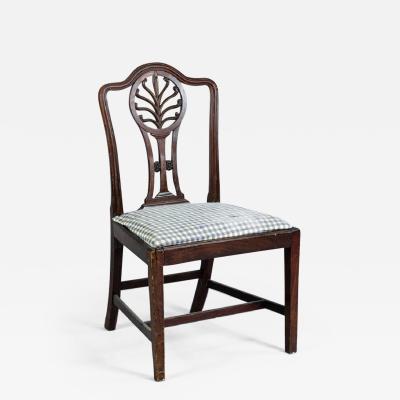
ENGLISH NEOCLASSICAL SIDE CHAIR (INV. 0026)
-
PENNSYLVANIA WALNUT TALL CHEST ON FRAME (Inv. 320)

-
VERY FINE AND RARE CHIPPENDALE CARVED AND FIGURED MAHOGANY DESK-AND-BOOKCASE

-
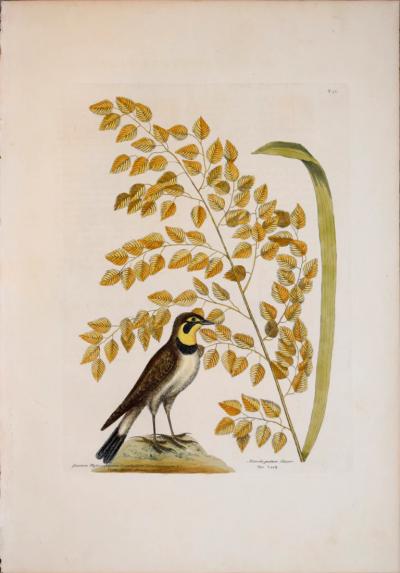
MARK CATESBY (1683-1749), T32 THE LARK, THE SEA-SIDE OAT
-
PHILADELPHIA SIDE CHAIR (INV. 0033)

-
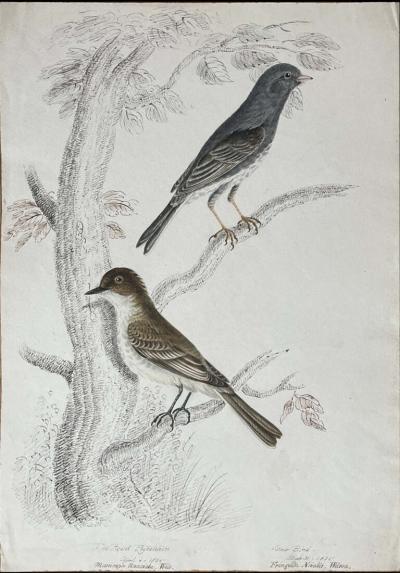
THE PEOWIT FLYCATCHER APRIL 4 1836 MUSCICAPA NUNCIOLA WILS./
-
UNTITLED [UNIFINISHED YELLOW BIRD]

