












Offered by:
Arthur T. Kalaher Fine Art
28E Jobs Lane
Southampton, NY 11968 , United States
Call Seller
631.204.0383
Showrooms
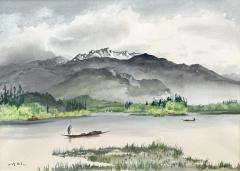
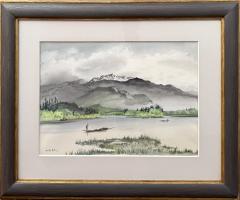
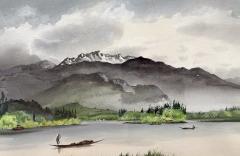
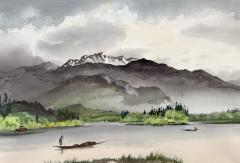
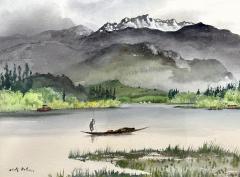
“Lake Atitlan, Guatemala”
-
Description
Original watercolor and gouache on archival paper artwork of Lake Atitlan in Guatemala. Signed by the artist Adolf Arthur Dehn lower left. Condition is excellent. Circa 1955. The artwork is housed under glass in a gold inner and outer edge trim with grey/black main colored wood gallery frame. Overall framed measurements are 35 by 42.5 inches. Provenance: A Long Island. New York estate.
Biography • Adolf Dehn (1895-1968)
Adolf Dehn was born in Waterville, Minnesota on November 22, 1895. As a young boy he began to sketch farm animals and by age nine dazzled the townsfolk attending the Waterville festival with a large drawing of a train. Being the "first artist of Waterville," he received a scholarship to the University of Minnesota, but against his parents' wishes he decided to attend the Minneapolis School of Art in the fall of 1914.
After volunteering for duty in an Asheville, North Carolina hospital during the First World War, he received an honorable discharge and in July 1919 Dehn took a train straight to New York. By 1920 he was studying under Boardman Robinson, who, along with Kenneth Hayes Miller, instructed Dehn in the rudiments of lithography. In 1921, Dehn's work was included as part of a group show of graphic design at New York's Weyhe Gallery. This was followed by a one man exhibition at Weyhe Gallery in 1923.
After this exhibition's success, Adolf Dehn decided to go to Europe to study art with an emphasis on lithography and printmaking. He worked almost entirely in black and white during the first two decades of his student and professional life. In Europe Dehn traveled extensively through Germany, France and England. Dehn eventually settled in Vienna in 1924, only to return to the United States after the economic crash of 1929. The prints Dehn made in Europe between 1928 and 1932 were exhibited in several one man exhibits beginning in 1935, 1939 and 1940 at the Weyhe Gallery. For these exhibitions Dehn had over ninety prints from which to select, many of which are still considered among his greatest works. In these prints Dehn had dared to do things technically that no artist had done before with ink washes, crayon, scrubbing, scumbling, and razor blading. Half of the prints were satires, while the rest were park scenes and landscapes.
In 1930 Dehn established his studio in New York at 20 East 15th Street, which he kept until 1954. During this period Dehn focused on New York City subjects as he rediscovered the parks, waterfront, restaurants and Harlem jazz clubs with John Dos Passos, Yasuo Kuniyoshi and Reginald Marsh. As an artist of the Depression-age, Dehn was aided by his commercial art contributions to The New Yorker, Vogue, Ringmaster, and The New York Times.
In 1937 Adolf Dehn's career took an important turn. He discovered that he liked working in watercolor: its fluidity was suitable to either deliberate or spontaneous efforts. In the beginning Dehn was a little insecure about his brush-drawn landscapes and his colors, as he had only worked in black and white up to that point in his career. Dehn's fear quickly subsided, however, at the American Artists' Congress show of 1937 when one of his paintings was the only picture sold in the show.
In 1939 Adolf Dehn was awarded his first Guggenheim Fellowship. This grant gave him the opportunity to travel extensively throughout the United States and Mexico. During these trips he drew, painted and recorded the varied terrain and picturesque landscapes as subjects for his work. Dehn also used this fellowship money in 1940 to spend some time in Colorado Springs, where he proceeded to teach at the Colorado Springs Fine Arts Center for three years. Life magazine reproduced many of Dehn’s watercolors from his Guggenheim travels across America in their August 11, 1941 issue. In 1941 Dehn joined the Associated American Artists Gallery. During the 1940s Dehn was a frequent summer visitor to the artist colony in Woodstock, New York, and participated in activities and exhibitions of the Woodstock Artists Association.
In 1941 when America entered the war against Japan and Germany, Dehn was forty-six, too old to be a soldier. Seeking a way to help the Allied cause, Dehn created a series of paintings for the U.S. Navy depicting the training, patrol and warfare of the air arm of the Navy. Some of Dehn's watercolors for Standard Oil of New Jersey were also used to illustrate the necessity of oil during wartime. Immediately after the war Dehn embarked on a period of large-scale print making using old and new sketches to create 13 x 17 inch prints. As a result of this project Dehn began to paint scenes of Central Park and the New York waterfront again as he worked on ideas for his print project. In 1948 Dehn spent his first winter in Key West, Florida. This led to his agreeing to teach at the Norton Museum School in West Palm Beach, Florida in the winter of 1951. Both winters in Florida produced some Florida subject works.
Dehn's first instructional book, Watercolor Painting, was published in 1945, followed by How to Draw and Print Lithographs (1950) and Watercolor, Gouache and Casein Painting (1955). Dehn was commissioned to write these books as he was recognized as one of the masters of watercolor and lithography. He was awarded another Guggenheim Fellowship in 1951 that granted him the opportunity to travel to new places, such as Haiti, Cuba and the Caribbean. Dehn added the Yucatan and Guatemala to his travels in 1955. Dehn's watercolors, shown at Milch Gallery in New York in 1957, attracted commissions from corporations which also sent him on assignments in the US and abroad.
In 1961, at the age of 65, Dehn's success was recognized by the National Academy of Design and he was made an Academician in honor of his forty years of significant achievements. In 1965 Dehn was elected to membership in the National Institute of Arts and Letters.
Adolf Dehn died of a heart attack in New York City on May 19, 1968. The Columbus Gallery of Fine Arts, Columbus, Ohio held a major memorial exhibition organized by the museum's director and Dehn's good friend, Mahonri Sharp Young. Between 1969 and 1970 the exhibition traveled to six other museums: The Butler Institute of American Art, Amon Carter Museum, Colorado Springs Fine Art Center, Wichita Art Museum, the Kansas Museum, and Springfield Museum.
In the 1980s a traveling exhibition of Dehn's work was held at the Hunter Museum of Art, Roanoke Museum of Fine Arts, Canton Art Institute, Midwestern Museum of American Art, the Sheldon Swope Art Gallery, and the Lakeview Museum of Art. -
More Information
Documentation: Signed Origin: United States, Minnesota Period: 1950-1979 Materials: Watercolor and gouache on archival paper Condition: Excellent. Professionally matted and framed Creation Date: Circa 1955 Styles / Movements: Modernism, Contemporary Incollect Reference #: 885130 -
Dimensions
W. 28 in; H. 20 in; D. 1 in; W. 71.12 cm; H. 50.8 cm; D. 2.54 cm;
Message from Seller:
Arthur T. Kalaher Fine Art, located in Southampton, NY, offers a curated selection of traditional and contemporary works, including pieces by the Peconic Bay Impressionists and the estate of Nahum Tschacbasov. For inquiries, contact the gallery at (631) 204-0383, by cell at (941) 284-5588, or via email at arthurkalaher1@icloud.com.
More Listings from Arthur T. Kalaher Fine Art View all 365 listings
-
“Untitled”
-
“Nasturtiums in Blue Vase”
-
“Alone at Night, I Dance”
-
“The Pantheon, Paris”
-
“Siesta”
-
“Cottage in Tenerife”
-
“Market Scene Strasbourg, Paris”
-
“The Sun Bathers”
-
“Ciryscape”
-
“Standing Female Nudes”
-
“Along the Seine, Paris”
-
“La Madeleine, Paris“
-
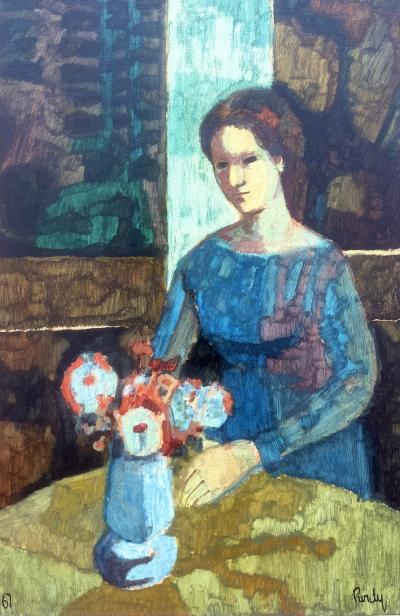
“Woman in Blue with Flowers”
-
“Pietra Dura Old Mill with Figure”