








Offered by:
H&S Fine Art and Antiques
by appointment only, based in San Francisco, Bay Area
San Francisco, CA , United States
Call Seller
Showrooms
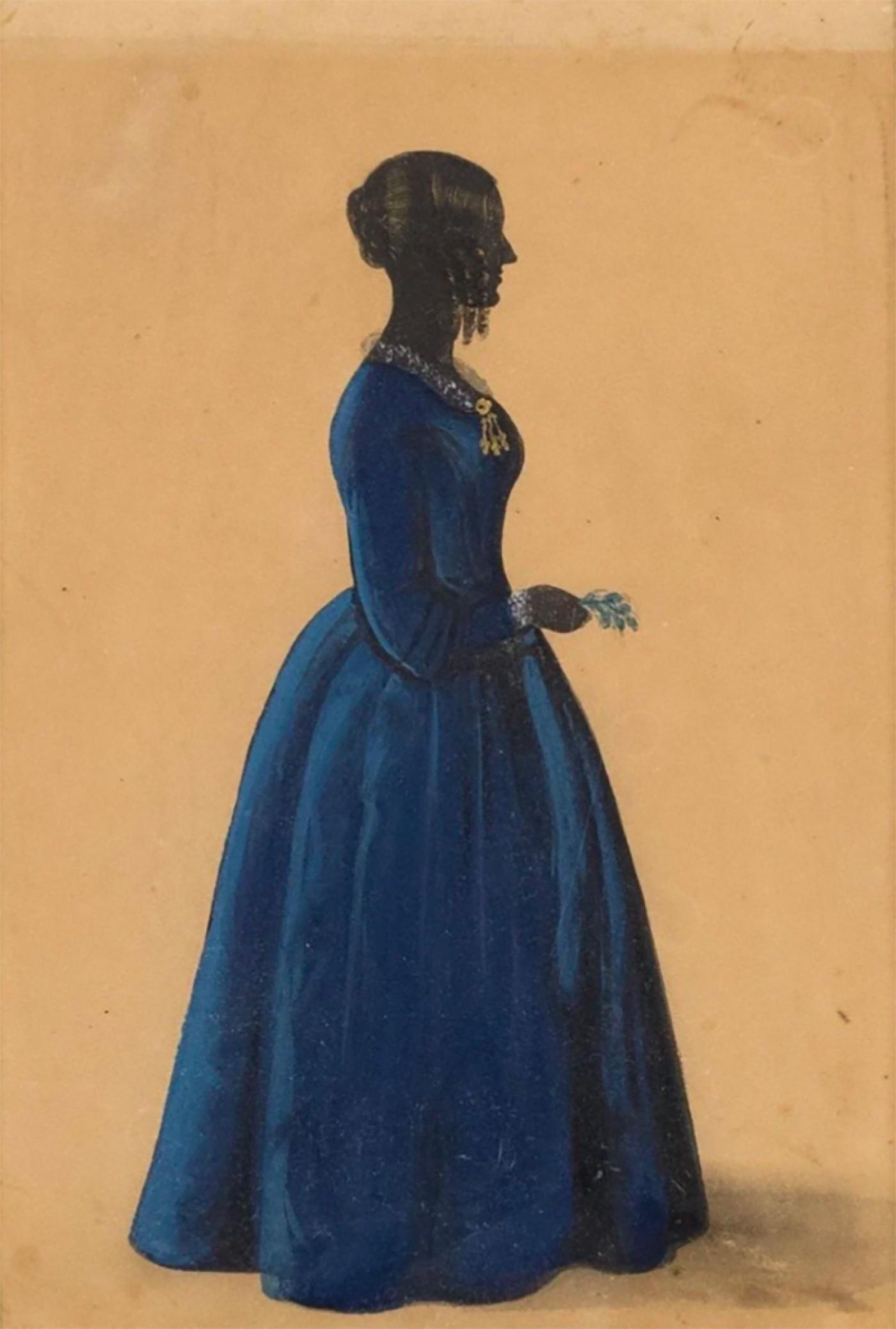
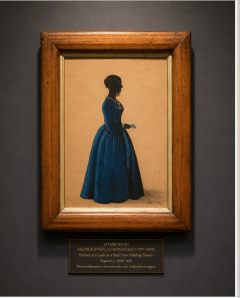
George “Angelo” Crowhurst (1795–1839) Attrib. Lady in a Blue Dress.
-
Description
Holding Flowers.
George “Angelo” Crowhurst (1795–1839) Attrib.
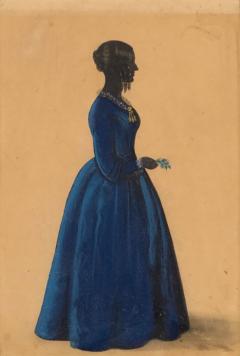
Full-Length Profile Portrait of a Lady in a Blue Dress Holding Flowers. England, probably circa 1830–1838
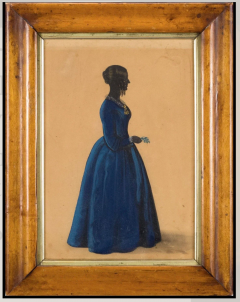
Painted and colored silhouette of a lady in blue dress, on paper. Image 9.5” x 6.5”, Frame 13” x 10”
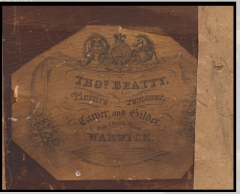
Period molded wood frame with gilt inner liner; reverse bearing the label of Thomas Beatty/Beattie, Carver and Gilder, Warwick.
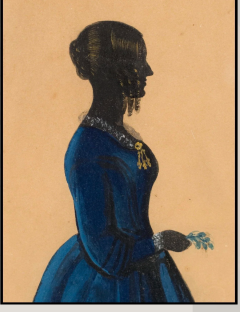
This refined full-length portrait belongs to the sophisticated tradition of British silhouette portraiture that flourished during the late Georgian and early Victorian periods. Although silhouettes had originated as relatively inexpensive alternatives to painted miniature portraits, by the 1820s and 1830s accomplished profilists were expanding the medium considerably, combining black profile work with watercolor, bodycolor, metallic heightening, painted clothing, jewelry, accessories, and carefully observed details of fashionable dress. The present portrait is an especially striking example of that development. A fashionable woman stands in strict profile against an otherwise unembellished warm-toned ground. Her figure is elongated and elegant, the waist tightly defined and the skirt expanding below in a broad triangular form. The sitter wears an unusually vivid blue dress, with lighter details at the neckline and sleeves, jewelry at the neck, and a small floral sprig held delicately before her. The restrained background allows the blue costume to dominate the composition.
Rather than functioning simply as clothing, the dress becomes the central visual mass of the picture. That characteristic is important to both the dating of the work and its attribution. Britain and the silhouette tradition, circa 1820–1830
By the beginning of the nineteenth century, silhouette portraiture had become firmly established in Britain. Professional artists known as “profilists” worked in London, Bath, Brighton, seaside resorts, fairs, and fashionable public rooms, where a sitter could obtain an accurate likeness more quickly and affordably than through traditional oil or miniature portraiture.
Mechanical devices such as the physiognotrace could assist artists in recording the outline of a sitter’s profile, but the most accomplished practitioners went well beyond mechanical tracing. Clothing, hair, hands, jewelry, military uniforms, furniture, flowers, and other attributes could be added by hand.
This is the artistic environment into which George Crowhurst entered. George Crowhurst arrives in Brighton
Modern archival research has substantially clarified Crowhurst's biography.
George Crowhurst was born in Sussex in 1795 and by 1823 was working in Brighton as a writing master. Around 1827–28, he appears to have shifted his professional activity toward profile portraiture. Current specialist research records him as active as a profilist approximately 1828–1838, with known working addresses at 4 Pool Lane, 11 Old Steine, and 40 Old Steine, Brighton.
Brighton was an ideal place for such a portraitist. It was fashionable, socially active, and filled with wealthy seasonal visitors. A profilist could therefore reach clients who might not have been permanent local residents.
Crowhurst worked in several techniques, including cut silhouettes, painted silhouettes, colored profiles, bust-length portraits, full-length figures, and even conversation pieces. Specialist research records his use of paper, card, ivory, and “London Board,” and notes his use of a physiognotrace for establishing profiles. https://www.profilesofthepast.org.uk/artist/crowhurst-george-angelo?utm_source
The significance of 40 Old Steine
Crowhurst's association with 40 Old Steine is particularly important. The address had earlier been used by another profilist, George Atkinson. Crowhurst subsequently occupied it and continued working there into the 1830s. https://www.profilesofthepast.org.uk/research/crowhurst-george-angelo-recent-research-april-2022?utm_source
Attribution between the two artists can sometimes be difficult. Recent scholarship specifically warns that Crowhurst's bust-length profiles can resemble Atkinson's closely enough that unsigned works should be attributed cautiously. https://www.profilesofthepast.org.uk/research/crowhurst-george-angelo-recent-research-april-2022?utm_source
Crowhurst’s own advertisement: the key to the blue dress
One of the most important pieces of documentary evidence for understanding this portrait is Crowhurst's surviving printed trade label.
A labeled double silhouette of George IV and Frederick, Duke of York, now in the National Portrait Gallery, preserves Crowhurst's advertisement from 40 Old Steine, Brighton.
The label states that he offered profiles finished in: black, bronze, blue-tint, cameo and colours.
It also advertised the copying of profiles and the supply of frames for profiles and miniatures. https://www.profilesofthepast.org.uk/mckechnie/crowhurst-george-angelo-mckechnie-section-2?utm_source
The blue dress is not merely an unusual decorative choice that happens to resemble Crowhurst's work. Blue-tint was a technique Crowhurst explicitly advertised to his clients.
Crowhurst’s “blue-tint” technique
Silhouette scholars have devoted particular attention to what Crowhurst meant by “blue-tint.”
Sue McKechnie's foundational research describes Crowhurst silhouettes employing pale blue bodycolor, Chinese white, bronzing, black, and other painted effects. A silhouette of the Duke of York, for example, is described as painted against black with areas of Chinese white and pale blue bodycolor—a treatment McKechnie believed may correspond to the “blue-tint” advertised on Crowhurst's trade label
Later Silhouette Collectors Club research also discusses Crowhurst's blue-tint work and notes the use of color and Chinese white in women's clothing as well as gold for necklaces and earrings. https://www.profilesofthepast.org.uk/scc/crowhurst-george-angelo-scc-newsletter-march-1996?utm_source
That technical vocabulary is especially relevant to our portrait because we see:
the deep blue dress, dark profile, light neckline details, jewelry, painted accessories, floral element, and an intentionally modeled ground shadow beneath the sitter.
Taken together, these features correspond unusually well with the documented range of techniques Crowhurst offered.
Thomas Beatty/Beattie Carver and Gilder Warwick.
The label is particularly valuable because the framing trade was closely connected to picture dealers, miniature painters, and profilists. A “carver and gilder” was not simply somebody who repaired frames; such craftsmen supplied carved moldings, gilded picture frames, looking-glass frames, and related decorative work.
The frame-maker has been documented in Warwick during approximately the late 1820s through mid-1830s, precisely the period in which Crowhurst was working.
What matters is that the frame itself is chronologically compatible with the portrait rather than obviously later.
The surviving old paper remnants, oxidized hardware, old label and overall construction seen on the reverse further support the appearance of a long-standing period assembly.
Museum comparison: Metropolitan Museum of Art
The Metropolitan Museum of Art owns a full-length Crowhurst silhouette titled Silhouette of an Unknown Young Boy, Full Length to the Left. The Met describes the medium as: pen and ink, brush and gray wash, and gouache (bodycolor). on a sheet measuring approximately 9 15/16 × 5 15/16 inches. It entered the museum through the Glenn Tilley Morse Collection.
Metropolitan Museum — Unknown Young Boy by George Crowhurst
The comparison is useful because it establishes Crowhurst as an artist of full-length works, not merely bust profiles. Pay particular attention to the amount of open space surrounding the figure, the simplified ground, the elongated proportions, and the careful distinction between figure and background. Those compositional principles are also present in our lady.
National Portrait Gallery comparison
The National Portrait Gallery in London owns Crowhurst's double full-length silhouette of Frederick, Duke of York and King George IV.
This example is exceptionally important because it retains Crowhurst's trade label advertising his portraits in black, bronze, blue-tint, cameo, and colors. https://www.profilesofthepast.org.uk/mckechnie/crowhurst-george-angelo-mckechnie-section-2?utm_source
Specialist literature
The principal scholarly reference remains:
Sue McKechnie, British Silhouette Artists and Their Work, 1760–1860, 1978.
McKechnie's work remains foundational to British silhouette scholarship and contains substantial discussion of George Crowhurst, his labeled works, his trade addresses, techniques, blue-tint portraits, and stylistic characteristics.
The Crowhurst material has been made accessible through the Profiles of the Past research project. McKechnie — George Crowhurst, Section One
Attribution assessment
The attribution rests on a convergence of evidence rather than one decisive mark.
The format is consistent with Crowhurst's documented full-length portrait work.
The date, approximately 1830–38, falls squarely within his actual period of activity.
The blue costume is unusually significant because Crowhurst specifically advertised “blue-tint” portraits.
The gold and light-colored embellishments correspond with techniques described in silhouette literature.
he flowers and colored accessories fit Crowhurst's broader practice of expanding the conventional black silhouette through painted detail.
The period frame and frame-maker's label appear chronologically compatible with a 1830s date.
Against that evidence must be weighed the absence of a Crowhurst signature or trade label.
Because Crowhurst's work sometimes resembles that of George Atkinson and other contemporary profilists, specialist scholarship cautions against making absolute attributions from style alone. https://www.profilesofthepast.org.uk/research/crowhurst-george-angelo-recent-research-april-2022?utm_source Therefore the academically responsible attribution remains: Attributed to George “Angelo” Crowhurst (1795–1839).
Curator’s Note
Full-Length Portrait of a Lady in a Blue Dress represents a moment when silhouette portraiture was evolving beyond its traditional identity as a monochromatic likeness. Against an austere ground, the sitter's brilliant blue gown transforms the dark profile into an unexpectedly vivid image of fashion and individuality.
The work's possible association with Brighton profilist George Crowhurst is particularly compelling. Crowhurst advertised portraits executed not only in black and bronze but also in “blue-tint” and colors, and surviving examples demonstrate his willingness to combine traditional profile portraiture with bodycolor, metallic highlights, Chinese white, and carefully painted details. The present sitter's blue costume, jewelry, light collar, floral sprig, and full-length format all belong naturally within that artistic vocabulary. https://www.profilesofthepast.org.uk/scc/crowhurst-george-angelo-scc-newsletter-march-1996?utm_source
The portrait is equally revealing as an artifact of the 1830s. Its tightly fitted bodice, narrow waist, broad skirt, arranged hair, jewelry, and delicately held flowers construct an image of fashionable femininity during the closing years of the Georgian era and the beginning of the Victorian age.
The reverse of the object contributes another layer to its history. Its period frame retains the label of a Warwick carver and gilder, together with old backing remnants and later auction documentation. These physical traces connect the portrait not only to its sitter and artist but also to the network of craftsmen, framers, dealers, collectors, and auctioneers through whose hands the object has passed for nearly two centuries.
Seen today, the portrait's appeal lies in the tension between simplicity and sophistication. Its essential structure is nothing more than a solitary profile against an empty field, yet the unexpected sweep of intense blue gives the sitter presence far beyond the modest scale of the work. It is at once portrait, fashion document, decorative object, and surviving record of Britain's highly developed nineteenth-century silhouette tradition.
For H&S, I would present this as a scholarly object first and a decorative object second. The strongest story is not simply that it is attractive. It is that the blue itself leads us directly into Crowhurst's documented practice, and that museum examples and specialist literature allow the attribution to be discussed intelligently and transparently rather than simply asserted. -
More Information
Origin: England Period: 19th Century Materials: oil on paper Condition: Fair. good overall Creation Date: 1830-38 Styles / Movements: Impressionism, Realism, Folk Art Incollect Reference #: 878840 -
Dimensions
W. 10 in; H. 13 in; W. 25.4 cm; H. 33.02 cm;
Message from Seller:
H&S Fine Art and Antiques is a distinguished gallery based in the San Francisco Bay Area, specializing in American folk art, decorative and modern art, as well as Oriental antiquities. With a keen eye for craftsmanship, historical richness, and aesthetics, we offer a carefully curated collection for collectors and enthusiasts alike. By appointment only. Contact us at h.s.fineartandantiques@gmail.com for inquiries.
More Listings from H&S Fine Art and Antiques View all 68 listings
-
American Centennial Celebration Flag Stars Forming “1776–1876”
-
Henry Clay, American School, after John Neagle Circa 1845–1860.
-
John Vivolo (American, 1886–1987) Two Production Bosses
-
Francis Wheatley, R.A. Industry and Idleness, 1786.
-
Manner of Joseph Alexander Ames (1816–1872) Portrait of Abraham Lincoln
-
38 STAR ANTIQUE FLAG,COLORADO STATEHOOD, CIRCA 1876.
-
A RARE THIRTEEN STAR AMERICAN PARADE FLAG,CIRCA 1875-1895.
-
A Carved whirligig of a policeman ( 1910-1920).
-
A Carved Gilded Wooden Eagle, possibly Maine, 19th century.
-
A Watercolor, Pen and Ink Drawing of George Washington on Horseback
-
PRANCING HORSE ATTRIBUTED TO J. WHITTICKER, CIRCA 1860.
-
LARGE BLUE AND WHITE UNDERGLAZE PORCELAIN TEAPOT.
-
Marc Chagall (1887-1985). Etude pour Jacob. Pen and india ink on tracing paper.
-
WASHINGTON, MARTHA HANDMADE BRUSSELS LACE RIDING VEIL