







Offered by:
Martell Gallery
859 NE 125 Street
North Miami, FL 33161 , United States
Call Seller
786.803.8286
Showrooms
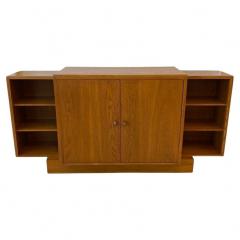
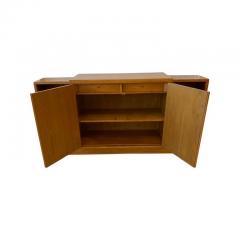
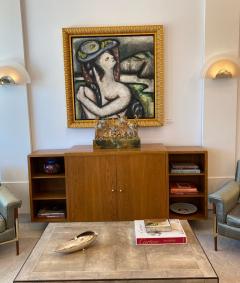
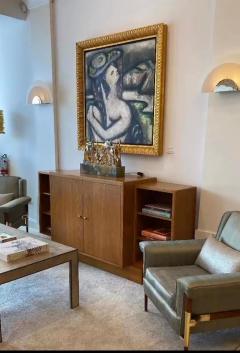
Art Deco Sideboard/Cabinet by Jacques Émile Ruhlmann
-
Description
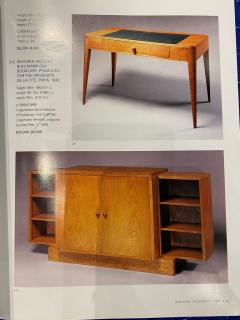
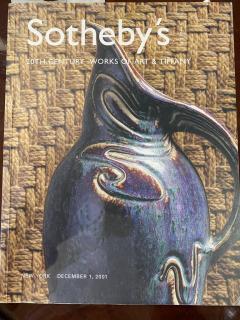
A rare and fully documented oak sideboard by Émile-Jacques Ruhlmann (1879–1933), one of the most celebrated names in French Art Deco design. This example was produced in 1930 for the Maison d'Étudiante (women's student residence) at the Cité Internationale Universitaire de Paris, and is published in the Sotheby's New York sale 20th Century Works of Art & Tiffany, December 1, 2001, as lot 212.
The piece exemplifies the leaner, more architectural idiom Ruhlmann developed toward the end of his career for institutional and semi-public commissions, moving away from the exotic veneers and inlay of his celebrated 1920s luxury interiors toward honest, well-figured oak and a strongly geometric silhouette — while losing none of the proportion and precision for which his workshop was renowned. A central cabinet, fitted with two paneled doors on turned wood pulls, is stepped forward on a low plinth base and flanked by two projecting open bookcase sections, each with adjustable shelves. Behind the cabinet doors, two small fitted drawers sit above a single adjustable shelf. The stepped, telescoping massing of the case — solid at the center, open at the sides — is a hallmark of the period's architectural furniture and reads equally well as a room-dividing bookcase or a functional sideboard.
Ruhlmann was, by 1930, the pre-eminent French ébéniste of his generation, having established his reputation with the celebrated Hôtel du Collectionneur pavilion at the 1925 Exposition Internationale des Arts Décoratifs et Industriels Modernes — the exhibition from which the term "Art Deco" derives. This sideboard represents a lesser-known but historically important facet of his output: furniture designed for the progressive student housing of the Cité Universitaire, made to serve real daily use while still carrying his unmistakable command of proportion and line. A period photograph of a Maison d'Étudiante room, illustrating a closely related case piece in situ with its original desk and bed, documents the ensemble as installed.
Location: Madrid
White-glove shipping available worldwide. Contact for quote.
Émile-Jacques Ruhlmann, eminent designer of the French Art Deco tradition, stands as a unique figure of the era. Without formal training in furniture design or construction, he was able to shop his designs to the most fashionable homes of Paris, and his work is now displayed in revered institutions such as the Metropolitan Museum of Art and the Brooklyn Museum. Eschewing the traditional French modes of design, as well as Art Nouveau, which were in vogue in his time, in favor of foreign influences and unusual mediums, Ruhlmann was able to carve a place for himself in the pantheon of twentieth century design.
Ruhlmann was born in Paris to parents of Alsatian extraction in 1879. His parents made their living by running a contracting company which specialized in mirrors, gilding, and stained glass. Upon his father’s death in 1907, Ruhlmann assumed leadership of the business, creating relationships which would later be of use to him in his distinguished career as a furniture designer.
Ruhlmann became involved seriously in furniture design in 1910, after furnishing an apartment for himself and his new bride. By 1919, after the close of the First World War, he and his friend Pierre Laurent established Ruhlmann et Laurent (or REL), their own interior design firm. Dissatisfied with the trends of design current in France at the time, Ruhlmann looked toward pre-war Viennese design, as well as eighteenth century aesthetics for his inspiration. Ruhlmann understood that his innovations would not be understood, appreciated, or even available to the vast majority of people. Seeking to make a trend, Ruhlmann was conscious of the fact that he would need to appeal to the elite.
Using the finest materials, such as amboyna burl, Macassar ebony, and Brazilian rosewood for construction, and ivory for details, Ruhlmann was able to create distinct, stand out, one of a kind pieces. The hallmarks of these early works were their almost imperceptible curves and elegantly subtle uses of ivory.
Never having been formally trained in furniture construction himself, Ruhlmann contracted out all of his cabinet making until 1923, when he established his own workshop for the firm. By 1927, he employed over sixty master craftsmen of every stripe—cabinetmakers, finishers, upholsters, and draftsmen. Though not an expert in the execution of design, he was insistent that his craftsmen keep at it until achieving perfection.
Ruhlmann became terminally ill in 1933. Fearing that the quality of the firm’s productions would suffer after his death, he willed it that the company would complete only the orders in progress. After that, Ruhlmann ordered the operation be dissolved.
Some of Ruhlmann’s notable projects and commissions include his showing at the 1925 International Exhibition of Decorative and Industrial Arts, his decoration of the meeting hall of the Paris Chamber of Commerce in 1926-7, his work on the ocean liner Île-de-France in 1927, and the interior of the Marignan cinema in 1928. -
More Information
Documentation: Documented elsewhere (similar item) Origin: France Period: 1920-1949 Materials: Oak Wood Condition: Good. Wear consistent with age and use Styles / Movements: Modern, Contemporary, Art Deco Book References: lInauguration de la Maison d'Etudiante, S.B.H.M. de Logement feminin, inaugural booklet, 1 February 1930 Catalog References: Sotheby's Dealer Reference #: A1627 Incollect Reference #: 606220 -
Dimensions
W. 78 in; H. 38.5 in; D. 19.5 in; W. 198.12 cm; H. 97.79 cm; D. 49.53 cm;
More Listings from Martell Gallery View all 225 listings
-
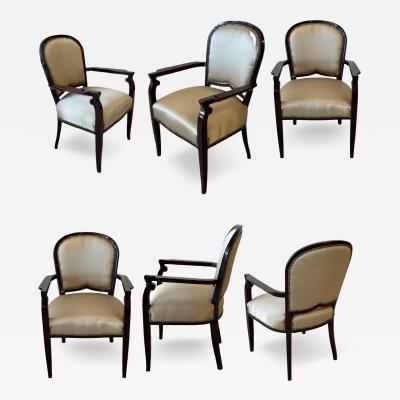
Set of six French Art Deco dining armchairs by Jules Leleu.
-
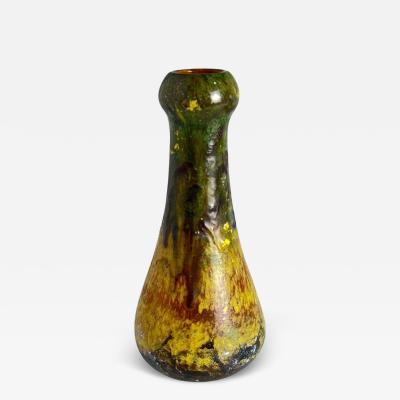
Art Deco Melted Colors Glass Vase by Charles Schneider
-
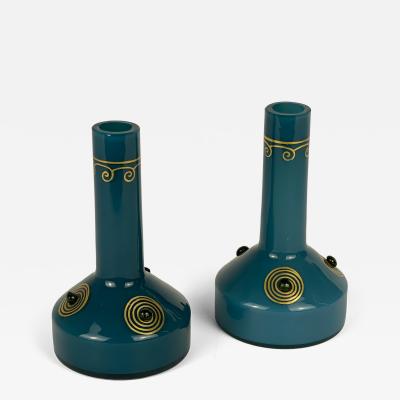
Art Deco Bulb Glass Vases, Teal Art Glass, Austria, Early 20th Century
-
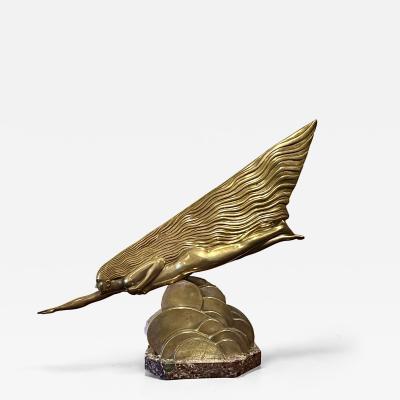
La Comete Art Deco sculpture
-
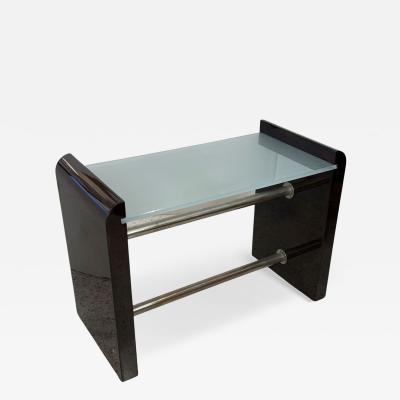
Art Deco Side Table by Jacques Adnet
-
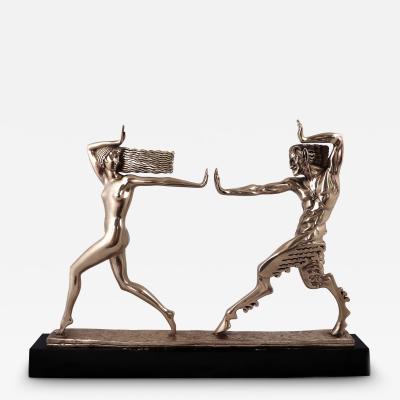
Nymph & Faun Sculpture
-
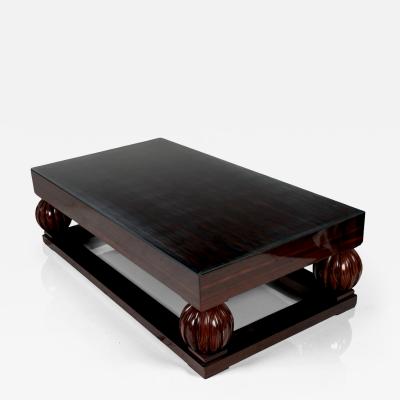
Ruhlmann-Style Macassar Ebony Coffee Table
-
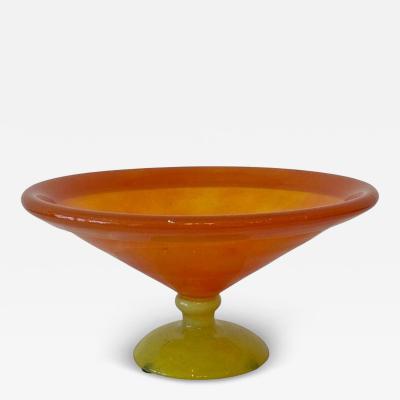
Art Deco Tazza by Charles Schneider, Red Tango Glass, France, 1928
-
Entry/Dinning Table by Raymond Subes

-
Art Deco Purple Glass Vase by Charles Schneider, France, 1926

-
Decó Vase by Le Verre Francais

-
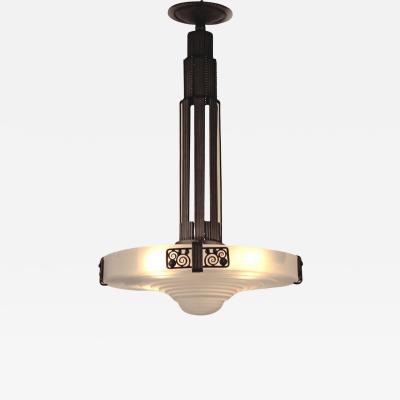
French Art Deco Pendant Chandelier, Wrought Iron & Frosted Glass, 1928
-
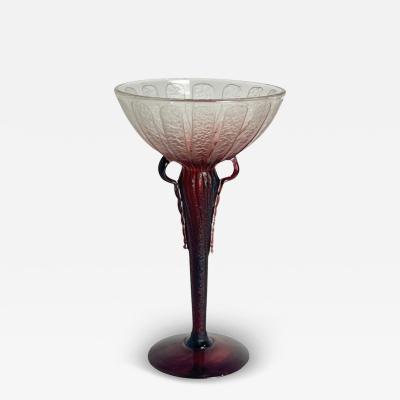
Art Deco Purple Glass Vase by Charles Schneider, France, 1928
-
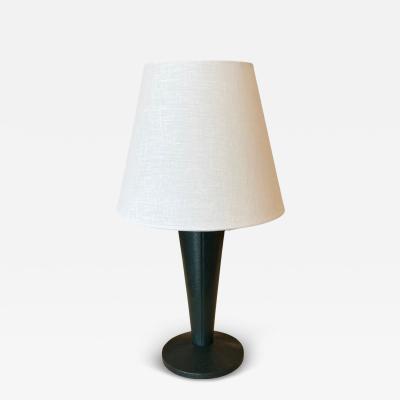
Art Deco Table Lamp in Hermes Green Leather, Manner of Jacques Adnet, 1940