








Listings / Fine Art / Prints / Architecture



Offered by:
Arthur T. Kalaher Fine Art
28E Jobs Lane
Southampton, NY 11968 , United States
Call Seller
631.204.0383
Showrooms
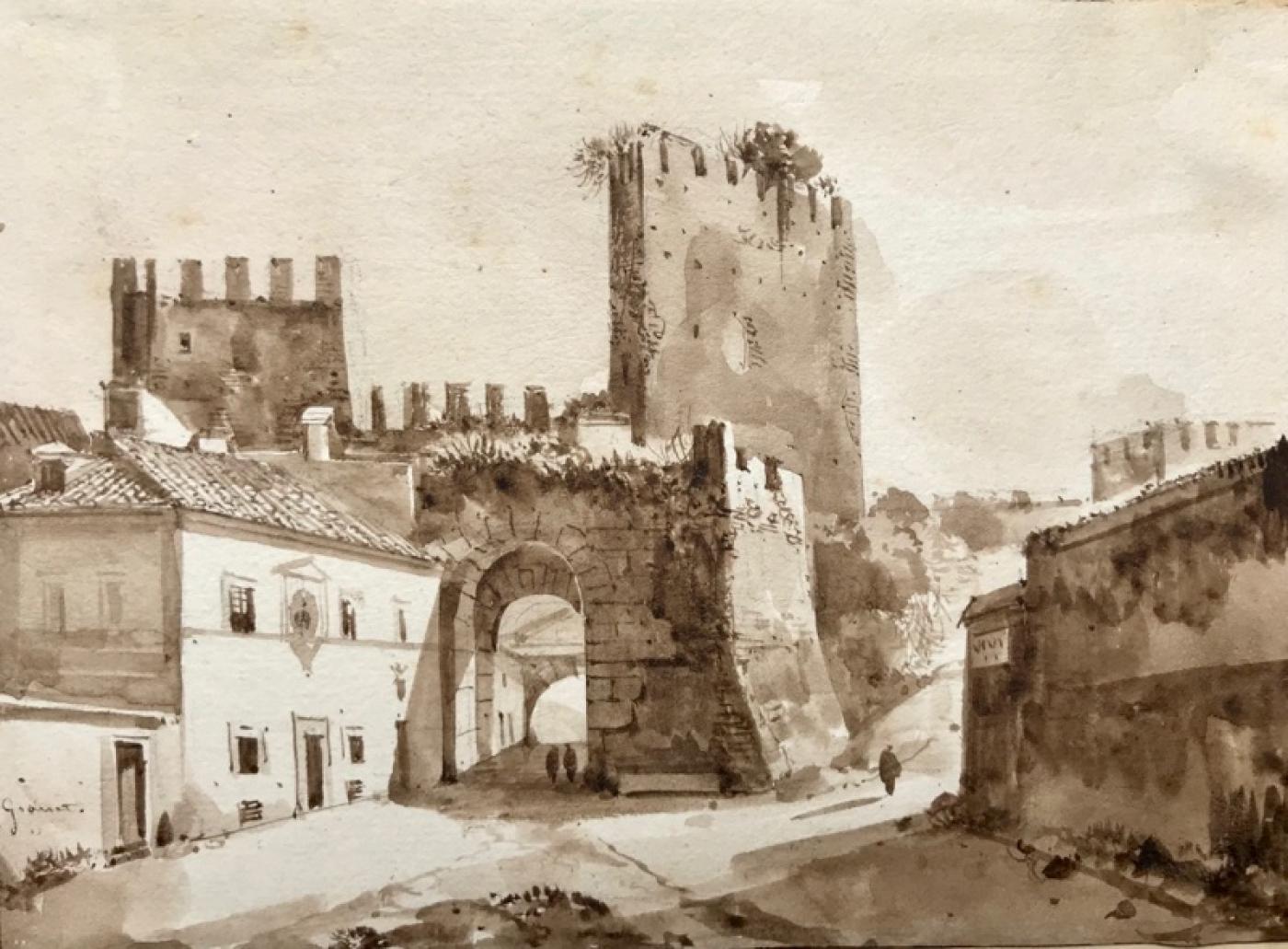
"View of Porta San Paolo, Rome"
-
Description
Brown ink and wash drawing with touches of watercolor and gouache by the French artist, Francois-Marius Granet. Signed lower left. Condition: Good. Provenance: Christie’s London sale 1993. Matted but unframed.
The Porta San Paolo (San Paolo Gate) is one of the southern gates in the 3rd-century Aurelian Walls of Rome, Italy. The Via Ostiense Museum (museo della Via Ostiense) is housed within the gatehouse. It is in the Ostiense quarter; just to the west is the Roman Pyramid of Cestius, an Egyptian-style pyramid, and beyond that is the Protestant Cemetery.
The original name of the gate was Porta Ostiensis, because it was located of the beginning of via Ostiense, the road that connected Rome and Ostia where functioned as its main gate. Via Ostiense was an important arterial road, as evidenced by the fact that upon entering the gate of the same name, the road split, with one direction leading to the famous Emporium, the great market of Rome.
The gatehouse is flanked by two cylindrical towers, and has two entrances, which had been covered by a second, single-opening gate, built in front of the first by the Byzantine general Belisarius (530s–540s).
The structure is due to Maxentius, in the 4th century, but the two towers were heightened by Honorius. Its original — Latin — name was Porta Ostiensis, since it opened on the way to Ostia. Later, it was renamed to the Italian Porta San Paolo, because it was the exit of Rome that led to the Basilica of St. Paul Outside the Walls.
In 549, Rome was under siege; the Ostrogoths of Totila entered through this gate, because of the treason of the Isaurian garrison. On 10 September 1943, two days after the armistice between the Allies and Italy had been agreed, Italian military and civil forces tried to block German seizure of the city, with 570 casualties.
Born in Aix-en-Provence, François-Marius Granet studied in the 1790s with Jean-Antoine Constantin and Jacques-Louis David, before travelling briefly to Rome in 1802. He returned to Italy and spent a further 21 years there as a member of a community of French artists, which included Jean-Auguste Dominique Ingres, François-Xavier Fabre, Pierre-Athanase Chauvin (1774-1832) and Nicolas-Didier Boguet (1755-1839). He was famous for his paintings of church and convent interiors.
In 1824 Granet went back France to become a curator at the Louvre. He was later director of the Museum of French History at Versailles, a post he kept until the Revolution of 1848. He bequeathed to the town of Aix his own collection, which is now housed in the Musée Granet.
So wrote the painter Jacques-Louis David of his one-time pupil François-Marius Granet. The son of a master mason, Granet learned drawing by copying his father's print collection before enrolling as a student at the free drawing academy in his hometown of Aix-en-Provence. In 1796 he traveled to Paris, where he studied Dutch and Flemish paintings in the Musée du Louvre. Before being accepted into David's studio, Granet earned his living painting mural decorations in private apartments. While with David, he developed an interest in medieval and royalist subjects--themes that would later dominate his work--but he soon had to leave for lack of funds. In Rome from 1802, Granet earned his living selling drawings of ancient monuments and painting biographical events from the lives of famous artists. Nearly twenty years later he reached the height of his success when he was awarded the Cross of the French Legion of Honor and the ribbon of the Order of Saint Michael. In 1826 he became a curator at the Louvre and later worked at Versailles. -
More Information
Documentation: Signed Period: 19th Century Materials: Ink, watercolor and gouache on paper Condition: Good. Several tiny light foxing spots in sky Creation Date: Circa 1815 Styles / Movements: Old Master, Realism Incollect Reference #: 313330 -
Dimensions
W. 5.5 in; H. 4 in; D. 0.25 in; W. 13.97 cm; H. 10.16 cm; D. 0.64 cm;
Message from Seller:
Arthur T. Kalaher Fine Art, located in Southampton, NY, offers a curated selection of traditional and contemporary works, including pieces by the Peconic Bay Impressionists and the estate of Nahum Tschacbasov. For inquiries, contact 631.204.0383 or visit arthurkalaherfineart.com.