











Byron Botker
American
The landscape of space-age American West Coast industrial design was heavily defined by Byron Botker, a mid-century modernist designer who achieved legendary status for mastering the artistic application of heavy, oversized tubular metal. Emerging as a prominent creative voice in the 1970s, Botker subverted traditional, delicate wireframe furniture trends by scaling up the structural footprint of steel furniture. Operating in close alignment with the California-based Landes Manufacturing Company, his portfolio brilliantly managed to bridge rigid, graphic architectural geometry with the relaxed, low-slung lounge culture sweeping the United States during the era.
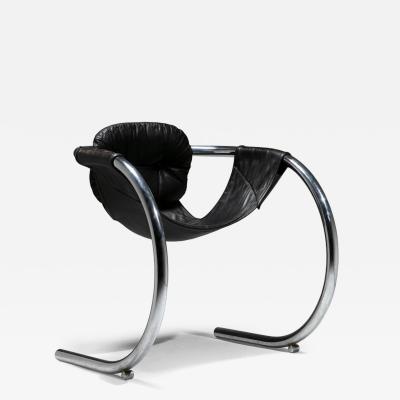
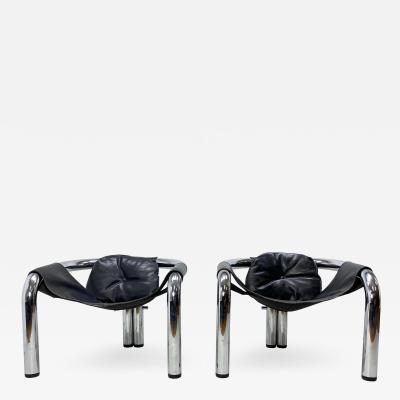
Botker’s definitive masterpiece is the widely celebrated "Palo Alto" furniture series, developed circa 1970. The defining signature of this line—most notably seen in the Palo Alto lounge chair and matching sofas—is a massive, continuous sweeping U-shaped frame constructed from thick, polished tubular steel. Rather than treating the metal frame merely as an under-seat support, Botker elevated the thick chrome into a prominent visual element that commanded attention from every angle. Within these bold metal loops, seats were suspended via heavy leather or heavy canvas slings, topped with thick, tufted button cushions to ensure maximum lounge comfort without compromising on a clinical, purely graphic silhouette. Distributed internationally to high-end European design hubs, including exclusive Milanese distribution via Lyda Levi, the Palo Alto collection cemented Botker's reputation for making industrial materials feel inherently luxurious and accessible.
Beyond his iconic space-age seating and chrome dining sets, Botker also applied his architectural eye to American mid-century lighting design. Collaborating with the prominent Modeline Lamp Company, he designed highly structural table lamps that paired sculpted, hourglass-shaped walnut bases with towering, fourteen-inch milk glass cylinder shades. This unique intersection of warm, organic California woodwork and clinical, geometric illumination mirrored his furniture philosophy of balancing contrasting elements. Today, original, un-restored fabric and leather Botker pieces are considered holy grails for mid-century collectors, continuously setting high records at specialized decorative arts auctions as quintessential documents of 1970s structural minimalism.
Botker’s definitive masterpiece is the widely celebrated "Palo Alto" furniture series, developed circa 1970. The defining signature of this line—most notably seen in the Palo Alto lounge chair and matching sofas—is a massive, continuous sweeping U-shaped frame constructed from thick, polished tubular steel. Rather than treating the metal frame merely as an under-seat support, Botker elevated the thick chrome into a prominent visual element that commanded attention from every angle. Within these bold metal loops, seats were suspended via heavy leather or heavy canvas slings, topped with thick, tufted button cushions to ensure maximum lounge comfort without compromising on a clinical, purely graphic silhouette. Distributed internationally to high-end European design hubs, including exclusive Milanese distribution via Lyda Levi, the Palo Alto collection cemented Botker's reputation for making industrial materials feel inherently luxurious and accessible.
Beyond his iconic space-age seating and chrome dining sets, Botker also applied his architectural eye to American mid-century lighting design. Collaborating with the prominent Modeline Lamp Company, he designed highly structural table lamps that paired sculpted, hourglass-shaped walnut bases with towering, fourteen-inch milk glass cylinder shades. This unique intersection of warm, organic California woodwork and clinical, geometric illumination mirrored his furniture philosophy of balancing contrasting elements. Today, original, un-restored fabric and leather Botker pieces are considered holy grails for mid-century collectors, continuously setting high records at specialized decorative arts auctions as quintessential documents of 1970s structural minimalism.
new
Byron Botker
Black Leather "Palo Alto" Chair by Byron Botker for Landes - Lyda Levi
H 27 in W 26 in
$ 2,856

Sold

 Loading...
