










Offered by:
Thomsen Gallery
8 East 67th Street
New York City, NY 10065 , United States
Call Seller
212.288.2588
Showrooms
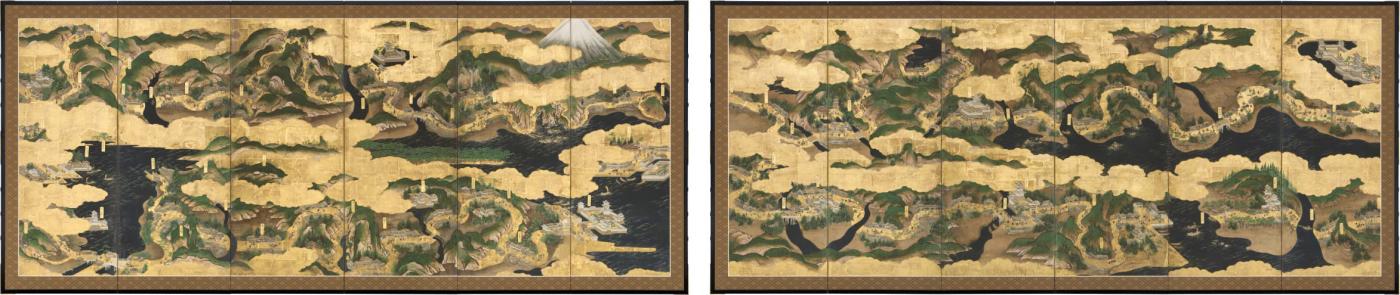
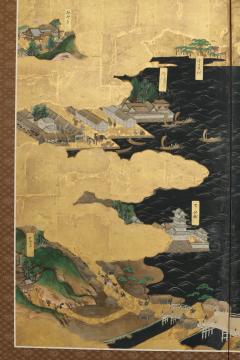
Places Along the Tokaido, ca 1620
-
Description
Pair of six-panel folding screens; ink, mineral colors, gofun, gold, and gold leaf on paper
Each screen 47 x 110½ in. (119.5 x 280.5 cm)
T-3690
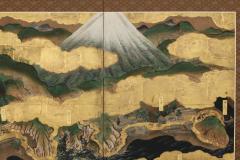
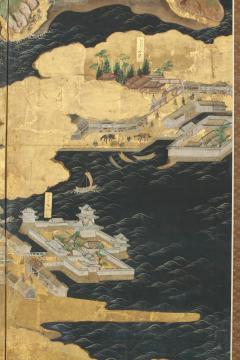
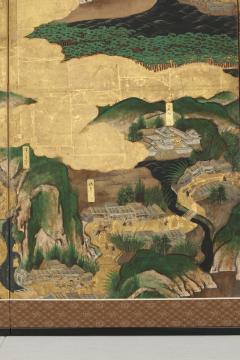
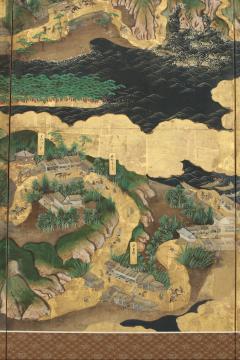
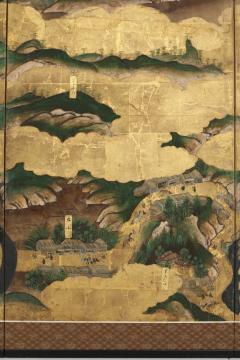
In the top right-hand corner of the right-hand screen we see Edo Castle, seat of shogunal power, and its moat. The Nihonbashi Bridge in the center of Edo, traditionally treated as the starting point of the Tōkaidō, is omitted but Shinagawa, the first station, is shown in the center of the first panel. The route skirts Edo Bay, with a variety of travelers going in both directions, crosses the Tama River at the Rokugō Bridge and continues to Totsuka (5), on the third panel of the screen. In order to prevent the rapid deployment of hostile troops, the shogunate forbade the construction of bridges at several points where they would have made life easier for travelers, starting with the Banyū River, as the Sagami River is known at the point where it flows into Sagami Bay. There we see passengers on a ferry, with others waiting on either bank, while at the Sakawa River crossing, on the fourth panel, travelers wade across to reach Odawara (9), site of a famous castle which still stands today. Although Mount Fuji would have been clearly visible in good weather, even from the Banyū River crossing, the artist placed it four panels further to the left so as to allow space for no fewer than 20 places, nearly a third of the total, that offer a view of Japan’s most famous peak. From Odawara the Tōkaidō climbs steeply through the Hakone Pass, from which travelers would also have been able to see the twin peaks of Mount Futagoyama (labeled on the screen’s fourth panel) and perhaps make a detour to visit a remote rural shrine, labeled Gongen no yashiro.
After passing through Hakone (10), the road continues on the fifth panel to Mishima (11) with its great Shinto shrine, then continues across the neck of the Izu Peninsula and back to the coast of Suruga Province by way of the stations at Numazu, Hara, and Yoshiwara (12–14), all of them depicted and labeled on the final panel of the right-hand screen. The start of the left-hand screen shows the ferry over the Fujikawa River, after which travelers reach the station at Kanbara (15) under Mount Fuji. The next two stations, Yui (16) and Okitsu (17), are omitted but the artist shows a man and his horse laboring over the Satta Pass which connects the two, while other travelers admire the raging seas of Suruga Bay. Further west the road reaches Ejiri (18) on the third panel, then crosses two rivers, the first by bridge and the second, the Abekawa River, by ferry; sights along the way include Fuchū (Sunpu) Castle (19) and Suruga Town, while far to the north a label identifies another isolated shrine. The picturesque long pine-clad beach of Miho no Matsubara is not labeled but can be seen in the center of the panel. Having completed the crossing of the Abekawa River, travelers reach the stations at Fujieda (22) on the fourth panel and Shimada (23) on the fifth; at the top of the fourth panel, well away from the Tōkaidō, is Mount Utsunoyama with its narrow, creeper-choked pass best known from a description in the tenth-century poetic narrative Ise monogatari (The Ise Stories). From Shimada, the composition draws us on to the Oikawa River crossing, later made famous by Hiroshige’s print of the following station, Kanaya (24). The road then ascends Sayo no Nakayama, one of the Tōkaidō’s more difficult passes, to reach Nissaka (25) in the center of the sixth and final panel, while another label marks the Kōzanji Temple in the mountains to the north.
Our imaginary journey continues at the lower half of the first panel of the right-hand screen. Skipping the station at Kakegawa (26), the artist takes us to Fukuroi (27) and Mitsuke (28). During the rainy season, Edo-period travelers might have had to stay there several days waiting for the waters of the turbulent Tenryūgawa River to subside before they could board a ferry to the station and castle at Hamamatsu (29). The artist depicts Hamamatsu as being located on a virtual island formed by golden clouds, the sea, and two branches, Dai (Greater) and Shō (Lesser) of the Tenryūgawa River. From there we proceed in orderly sequence to Shirasuka (32) and Futagawa (33) on the third panel, Yoshida (34) Castle and Bridge on the fourth panel, Akasaka (36) on the fifth panel, and Okazaki (38) on the sixth panel; one of the two labels for Okazaki identifies the province as Mikawa. The last place marked on the right-hand screen is Kasadera, close to the center of the present-day city of Nagoya and not far from the Atsuta Shrine at the start of the left-hand screen. Depicted in considerable detail, this important religious center was especially venerated as the home of the sword known as Kusanagi no tsurugi, one of the Three Sacred Treasures of Japan.
From here one senses that the artist is impatient to bring us closer to our destination and take us on a leisurely sightseeing tour closer to Kyoto. We seem to hurry through Kuwana (42), Yokkaichi (43), Ishiyakushi (44), and the nearby temple familiarly known as Yakushimidō, all on the second panel, and then proceed on the third panel to Kameyama (46) and Seki (47) and over the Suzuka Pass to Tsuchiyama (49) and the Suzukagawa River at the fold between the fourth and fifth panels. Two other more remote places are shown on the fourth panel: Mount Fudesuteyama (near the center), a peak also featured in Hiroshige’s depiction of another station, Sakanoshita (48), in his Kyōka Tōkaidō series of 1840–1842, and Sugano (at the bottom) a spot still known today for its magnificent pines. The final two panels are dominated by Lake Biwa, the last great natural feature before the more than 300-mile-long road reaches its Kyoto terminus. We cross the Suzukagawa River to reach Kusatsu (52) and finally Ōtsu (53) at the top left of the lake, but our attention is drawn to six local attractions. Above Ōtsu is the great temple of Miidera, one of the canonical Ōmi hakkei (Eight Views of Lake Biwa), and clockwise around the lake are the great pine at Karasaki, another of the Eight Views; Kagamiyama (nowadays called Kamiyama or Mikamiyama), a small conical peak sometimes known as the “Fuji of Lake Biwa”; the Yokota ferry near the station at Minakuchi (50); Zeze Castle; and finally at bottom left Ishiyamadera Temple, where Murasaki Shikibu is said to have composed the great novel Genji monogatari (The Tale of Genji) at the beginning of the eleventh century. -
More Information
Period: Pre 18th Century Creation Date: 1620 Styles / Movements: Asian, Traditional Incollect Reference #: 557327 -
Dimensions
W. 110.5 in; H. 47 in; W. 280.67 cm; H. 119.38 cm;
Message from Seller:
Thomsen Gallery, now located at 8 East 67th Street, New York City, NY 10065, specializes in important Japanese paintings, folding screens, hanging scrolls, ceramics, ikebana bamboo baskets, lacquerware, and contemporary works by select artists. Owned and directed by Erik and Cornelia Thomsen, the gallery brings decades of expertise in Japanese art to a global clientele, including private collectors and major museums. For inquiries, contact them at 212-288-2588 or info@thomsengallery.com.
More Listings from Thomsen Gallery View all 214 listings
-
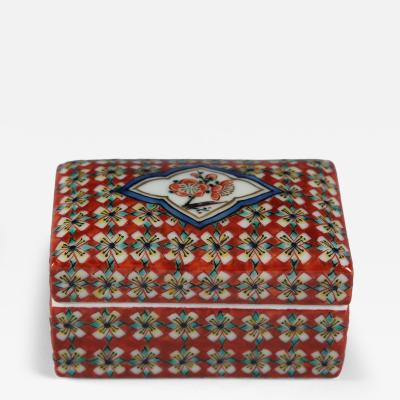
Fine-Patterned Rectangular Incense Box, 1997
-
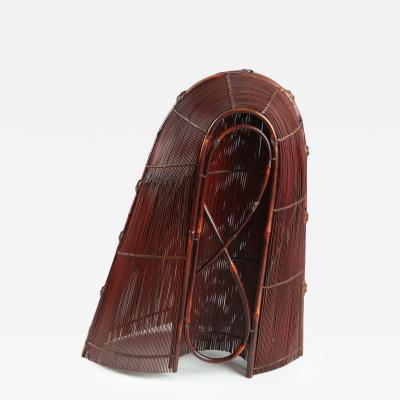
Bamboo Sculpture (T-3719)
-
Vase, 1970s
-
Tossed Mushrooms, 2001
-
Rectangular Box Entitled "Time and Space", ca 2000
-
Square box (T-3541)

-
Wajima-Lacquer Flower-Arrangement Stand (T-4884)

-
Gyokurin Bamboo, 1813
-
Rooster on a Lantern (T-3258)

-
Three Fishes, 1978
-
Four-Sided Vase, 1990s
-
Six Zen Calligraphies, 1910s-1930s
-
Yin and Yang 2, 2015
-
Cranes and Lilies, 1920s

