









George Henry Smillie
American, 1840 - 1921
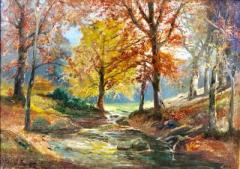
Like many 19th-century painters, George Smillie's (1840-1921) artistic training began with the study of engraving, with his father James Smillie of New York City. He studied painting with James McDougal Hart, from whom he inherited the Hudson River School tradition of attention to the detail of nature. Smillie made painting trips throughout New England and northern New York and in 1871 he and his brother, James D. Smillie, made a sketching trip to the Rockies and Yosemite. He exhibited at the National Academy, the Boston Art Club, the Philadelphia Centennial Exposition, the Boston Athenaeum, the Corcoran Gallery, the Art Institute of Chicago, the American Water Color Society, the New York Etching Club, Salmagundi Club, Brooklyn Art Association, and the Pennsylvania Academy of Fine Arts. Although later in his career he adopted a lighter, looser technique that approached Impressionism, he is best remembered for his landscape paintings in the Hudson River style.
Biography courtesy of Roger King Gallery of Fine Art, www.antiquesandfineart.com/rking
Biography courtesy of Roger King Gallery of Fine Art, www.antiquesandfineart.com/rking
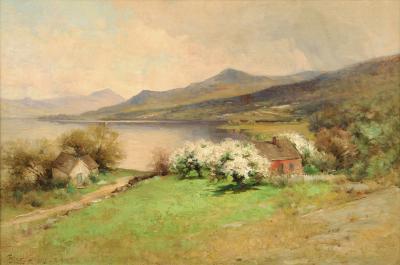
George Henry Smillie was a significant figure among American Landscapists of the last century. His career began before the Civil War and ended after the First World War. Trained in the manner of the Hudson River School, Smillie eventually loosened his brushstroke and heightened his palette to produce works which paralleled the interests of the American Impressionists. But he never abandoned the firm compositional structure of his formative years.
He made trips to many parts of the country, including one to the Rocky Mountains which provided him with material for many paintings. It is for his scenes of the farms and shoreline of Long Island and New England, however, that he is best known.
Mr. Smillie was born in New York City in 1840. His father, James Smillie, was a well known engraver, and as a boy George studied under him. He also studied painting with James McDougal Hart, an important landscape painter of the period. Two older brothers, James, Jr. and William, also became artists and engravers.
In 1871, Smillie made a trip to the Rocky Mountains and the Yosemite Valley of California, to sketch and paint. He used the material he gathered for years afterward for oils and watercolors. Most of his paintings were mountain landscapes, but some also included the Indians then native to the two regions.
Smillie also traveled to Florida to paint, but for most of his life he lived and worked in the New York City area. In 1881, He married Nellie Jacobs, a genre painter who had been a student of his brother James, and for many years the three shared a studio in suburban Bronxville. He died in Bronxville in 1921.
Exhibited:
New York Etching Club, 1884
Salmagundi Club, 1883
American Art Association, New York City, 1885, Prize
Saint Louis Expo, 1904, Medal
American Art Society, Philadelphia, 1907, Medal
Public Collections:
Corcoran Gallery of Art, Washington, D.C.
Metropolitan Museum of Art, New York City
Oakland Museum, California
Rhode Island School of Design, Providence
Memberships:
American Watercolor Society
National Academy of Design
Biography courtesy of Roughton Galleries, www.antiquesandfineart.com/roughton
He made trips to many parts of the country, including one to the Rocky Mountains which provided him with material for many paintings. It is for his scenes of the farms and shoreline of Long Island and New England, however, that he is best known.
Mr. Smillie was born in New York City in 1840. His father, James Smillie, was a well known engraver, and as a boy George studied under him. He also studied painting with James McDougal Hart, an important landscape painter of the period. Two older brothers, James, Jr. and William, also became artists and engravers.
In 1871, Smillie made a trip to the Rocky Mountains and the Yosemite Valley of California, to sketch and paint. He used the material he gathered for years afterward for oils and watercolors. Most of his paintings were mountain landscapes, but some also included the Indians then native to the two regions.
Smillie also traveled to Florida to paint, but for most of his life he lived and worked in the New York City area. In 1881, He married Nellie Jacobs, a genre painter who had been a student of his brother James, and for many years the three shared a studio in suburban Bronxville. He died in Bronxville in 1921.
Exhibited:
New York Etching Club, 1884
Salmagundi Club, 1883
American Art Association, New York City, 1885, Prize
Saint Louis Expo, 1904, Medal
American Art Society, Philadelphia, 1907, Medal
Public Collections:
Corcoran Gallery of Art, Washington, D.C.
Metropolitan Museum of Art, New York City
Oakland Museum, California
Rhode Island School of Design, Providence
Memberships:
American Watercolor Society
National Academy of Design
Biography courtesy of Roughton Galleries, www.antiquesandfineart.com/roughton
The younger brother of James Smillie, George Henry Smillie became a well-known landscape painter at the end of the nineteenth century. After studying with James McDougal Hart, Smillie established a studio in New York City, from which he made frequent painting trips to the Adirondack Mountains, White Mountains, Rockies, and Yosemite. His style loosened as his career progressed, evolving from a traditional Hudson River School mode to a lighter, more impressionistic manner. Smillie's work was exhibited at the National Academy of Design, the Boston Athenaeum, and the Brooklyn Art Association. Today, his paintings are featured in such collections as The Metropolitan Museum of Art, The Brooklyn Museum of Art, and The Corcoran Museum of Art.
Biography courtesy of Questroyal Fine Art, LLC, www.antiquesandfineart.com/questroyal
Biography courtesy of Questroyal Fine Art, LLC, www.antiquesandfineart.com/questroyal


Sold
 Loading...
