





Albert Bierstadt
American, 1830 - 1902

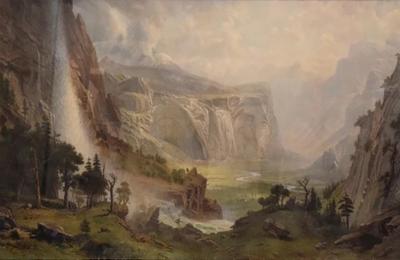
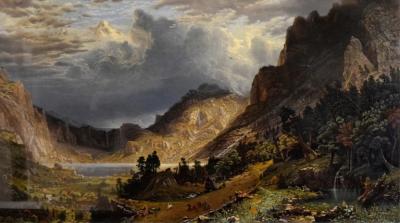
Likely the most famous and financially successful late 19th-century painter of the American western landscape, Albert Bierstadt created grandiose, dramatic scenes of the Rocky Mountains and Sierra Nevadas that lured many people to visit those sites. He was also one of the first artists to use a camera to record landscape views. His oil paintings, many of them huge, were the ultimate expression of the popular 19th-century Romanticism. Bierstadt was born in Solingen, near Dusseldorf, Germany, and sailed as a baby with his family who settled in New Bedford, Massachusetts. In 1853, he returned to Dusseldorf where he studied at the Royal Academy with landscape painters Andreas Aschenbach and Karl Friedman Lessing. It was there he learned much attention to detail, respect for composition and skilled drawing. During this period, he traveled extensively in Europe, especially Italy, with Whittredge and Gifford. In 1857, he returned to the United States and painted the White Mountains of New Hampshire, and in 1858, exhibited for the first time at the National Academy of Design in New York. That same year, representatives of the Boston Atheneum purchased his painting, The Portico of Octavia, Rome. In January 1859, he heard a lecture in New Bedford on the American West by Bayard Taylor, a famous traveler and lecturer, and this exposure stirred an interest that played a large part in his future career. A year later he joined a western military expedition led by Colonel Frederick W. Lander to survey wagon routes in the Rocky Mountains and Wyoming. From sketches and artifacts such as buffalo hides and Indian items, he painted in the famous 10th St. studio western scenes including landscapes, Indians, and wildlife in the traditional style he had learned in Europe. His second trip West was with his friend, Fitz Hugh Ludlow, whose wife Rosalie Osborne, Bierstadt would subsequently marry in circumstances that 'titilated' New York society. For Bierstadt, the Yosemite paintings were such a sensation that he became immediately famous. In 1871, he returned to California and stayed for three years, exhibiting in local galleries and with the San Francisco Art Association. In the 1860s and 70s, he earned the highest prices ever achieved by an American painter, and the US Congress allotted $20,000 for one of his paintings. In 1867, he had a grand tour of Europe and England including a special audience with Queen Victoria. His painting, Among the Sierra Mountains, California, was exhibited at the Royal Academy of London. He received the Chevalier of the Legion of Honor by Napoleon III and the Order of the Stanislaus from the Czar of the Russias.
Albert Bierstadt Paintings
Albert Bierstadt Paintings
Albert Bierstadt was like most painters of the Rocky Mountains in the nineteenth century, he was foreign born. He was born in 1830 in Soligen, near Dusseldorf, Germany and died in New York in 1902. He and his family emigrated to the United States when he was two years old. He grew up in Bedford, Mass.
In 1853, Bierstadt returned to Dusseldorf to study under the landscape painters Andreas Aschenbach and Karl F. Lessing. Under the influence of the Dusseldorf school, and in the company of his fellow painters Emmanuel Leutze and Thomas Worthington Whittridge, Bierstadt learned attention to detail, the respect for drawing and the numerous tricks and effects of technique which he utilized for the rest of his life. He traveled though Germany, Switzerland and Italy during his four years of European study, and produced some competent and pleasing picturesque old world scenes. After his return to the United States in 1857, did he travel and paint in the White Mountains of New Hampshire. He also began to employ a camera, not used by artist of the time. It was not until 1858 that he discovered the subject matter which he would make his own.
In that year, Bierstadt joined a survey expedition to the American West led by Col. F. W. Lander. He made numerous studies, working swiftly, of the spectacular Western scenery, Indians and wildlife. He patiently set to work in his studio to produce paintings of the West which filled a seemly insatiable hunger of the American and European public.
Public Collections:
Brooklyn Museums, New York
Capital Building, Washington, D.C.
The Hermitage, St. Petersburg, Russia
High Museum, Atlanta, GA
Metropolitan Museum of Art, New York
Museum of Fine Art, Boston
St. Johnsbury Athenaeum, VT
Dallas Museum of Art, Dallas, TX
Amon Carter, Fort Worth, Texas
Gilcrease, Tulsa
Biography courtesy of Roughton Galleries, www.antiquesandfineart.com/roughton
In 1853, Bierstadt returned to Dusseldorf to study under the landscape painters Andreas Aschenbach and Karl F. Lessing. Under the influence of the Dusseldorf school, and in the company of his fellow painters Emmanuel Leutze and Thomas Worthington Whittridge, Bierstadt learned attention to detail, the respect for drawing and the numerous tricks and effects of technique which he utilized for the rest of his life. He traveled though Germany, Switzerland and Italy during his four years of European study, and produced some competent and pleasing picturesque old world scenes. After his return to the United States in 1857, did he travel and paint in the White Mountains of New Hampshire. He also began to employ a camera, not used by artist of the time. It was not until 1858 that he discovered the subject matter which he would make his own.
In that year, Bierstadt joined a survey expedition to the American West led by Col. F. W. Lander. He made numerous studies, working swiftly, of the spectacular Western scenery, Indians and wildlife. He patiently set to work in his studio to produce paintings of the West which filled a seemly insatiable hunger of the American and European public.
Public Collections:
Brooklyn Museums, New York
Capital Building, Washington, D.C.
The Hermitage, St. Petersburg, Russia
High Museum, Atlanta, GA
Metropolitan Museum of Art, New York
Museum of Fine Art, Boston
St. Johnsbury Athenaeum, VT
Dallas Museum of Art, Dallas, TX
Amon Carter, Fort Worth, Texas
Gilcrease, Tulsa
Biography courtesy of Roughton Galleries, www.antiquesandfineart.com/roughton
Albert Bierstadt was the most esteemed and widely-known painter of the American West during the second half of the nineteenth century. His paintings reveal a uniquely romantic vision of what was then considered the exotic "other" half of the country. Born in Germany, Bierstadt was brought to the U.S. as a child but returned to Dusseldorf to study art in 1853. There, he developed his heroic view of nature, dramatic use of light, and meticulous attention to detail. He made his first expedition out west nine years later, setting the course for his entire career. Bierstadt exhibited throughout the United States and Europe, garnering huge prices for his paintings and winning countless prices. Today, his work is featured in every major museum, including The White House, the Whitney Museum of American Art, The Metropolitan Museum of Art, and the Smithsonian American Art Museum.
Biography courtesy of Questroyal Fine Art LLC, www.antiquesandfineart.com/questroyal
Biography courtesy of Questroyal Fine Art LLC, www.antiquesandfineart.com/questroyal