







Arthur Fitzwilliam Tait
American, 1819 - 1905
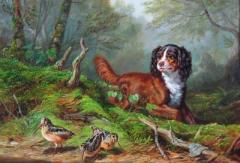
Arthur Tait became America's first important sporting artist. Born in Liverpool England, he came to America in 1850. Although he settled in New York City, Tait spent much of his time in the Adirondack Mountains painting landscapes, wildlife, and sportsmen. His specialty, however, was medium-sized, moderately priced animal paintings such as this which made his extremely successful during his lifetime.
Arthur Fitzwilliam Tait, A British born landscape artist, was one of the nineteenth century's most popular painters. A good story-teller on canvas, Tait was able to instill in his genre paintings a strong sense of drama and conflict.
Although he never traveled further West than Chicago, he acquired a reputation as a frontier artist, painting scenes of hunters and wildlife, mainly from his experiences in upstate New York. The Quail and Young (date unknown, Corcoran Gallery of Arts), is a typical example.
Tait was born in 1819 in Liverpool, and schooled in Lancaster. By his mid-teens, he was working at Agents, an art dealer in Manchester. In his spare time, he taught himself how to paint by copying works at the Royal Institute.
During these years, he was able to assist George Catlin with his traveling Indian gallery in England and Paris. Tait was impressed with Catlin's interpretation of the American West; it provided the impetus for his own immigration to the United States in 1850.
Tait worked out of New York City, but spent considerable time in the Adirondack Mountains, becoming a proficient marksman and woodsman. Using this rugged setting as a background, Tait focused much of his art on capturing the drama of a man against nature. His style, which combined misty, atmospheric landscape settings with detailed renderings of human figures, reminds one of that of George Caleb Bingham.
The period 1850 to 1860 was a prolific time for Tait. His paintings were accepted by Easterners as definitive views of life on the frontier. Currier and Ives reproduced much of his work, making him one of the most popular artists of the period.
These genre paintings were not his only source of success. Tait mastered still lifes of dead game, influencing a whole generation of artists, beginning with William Michael Harnett 25 years later. He also did barnyard landscapes, a pastoral departure from his frontier scenes.
Tait's style did not change from 1860 until death in 1905; he continued to work in the style which he had found successful.
Memberships:
National Academy of Design
Public Collections:
Addison Gallery of American Art, Andover, Massachusetts
Adirondack Museum, Blue Mountain Lake, New York
Amon Carter Museum of Western Art, Fort Worth, Texas
Corcoran Gallery of Art, Washington, D.C.
Denver Art Museum
Metropolitan Museum of Art, New York City
Museum of the City of New York
R.W./ Norton Art Gallery, Shreveport, Louisiana
Philadelphia Museum of Art
Yale University Art Gallery, New Haven, Connecticut
Biography courtesy of Roughton Galleries, www.antiquesandfineart.com/roughton
Although he never traveled further West than Chicago, he acquired a reputation as a frontier artist, painting scenes of hunters and wildlife, mainly from his experiences in upstate New York. The Quail and Young (date unknown, Corcoran Gallery of Arts), is a typical example.
Tait was born in 1819 in Liverpool, and schooled in Lancaster. By his mid-teens, he was working at Agents, an art dealer in Manchester. In his spare time, he taught himself how to paint by copying works at the Royal Institute.
During these years, he was able to assist George Catlin with his traveling Indian gallery in England and Paris. Tait was impressed with Catlin's interpretation of the American West; it provided the impetus for his own immigration to the United States in 1850.
Tait worked out of New York City, but spent considerable time in the Adirondack Mountains, becoming a proficient marksman and woodsman. Using this rugged setting as a background, Tait focused much of his art on capturing the drama of a man against nature. His style, which combined misty, atmospheric landscape settings with detailed renderings of human figures, reminds one of that of George Caleb Bingham.
The period 1850 to 1860 was a prolific time for Tait. His paintings were accepted by Easterners as definitive views of life on the frontier. Currier and Ives reproduced much of his work, making him one of the most popular artists of the period.
These genre paintings were not his only source of success. Tait mastered still lifes of dead game, influencing a whole generation of artists, beginning with William Michael Harnett 25 years later. He also did barnyard landscapes, a pastoral departure from his frontier scenes.
Tait's style did not change from 1860 until death in 1905; he continued to work in the style which he had found successful.
Memberships:
National Academy of Design
Public Collections:
Addison Gallery of American Art, Andover, Massachusetts
Adirondack Museum, Blue Mountain Lake, New York
Amon Carter Museum of Western Art, Fort Worth, Texas
Corcoran Gallery of Art, Washington, D.C.
Denver Art Museum
Metropolitan Museum of Art, New York City
Museum of the City of New York
R.W./ Norton Art Gallery, Shreveport, Louisiana
Philadelphia Museum of Art
Yale University Art Gallery, New Haven, Connecticut
Biography courtesy of Roughton Galleries, www.antiquesandfineart.com/roughton
Arthur F. Tait taught himself artistic skill by copying paintings from the Royal Academy Institute of Manchester, England. He became a specialist in sporting, animal and frontier scenes. During his teen years Tait worked for a Manchester art dealer, which also helped increase his artistic knowledge. He became more interested in frontier life when he assisted George Catlin with his traveling Indian Gallery. In 1850 Tait moved to New York City and also established a camp in the Adirondack Mountains. He used this camp as a basis for many of his paintings. Tait became extremely popular due to the lithographs of his sport and frontier scenes. He was also known for still lifes of dead game hanging on a wall. Tait worked with Louis Maurer to create a series of Indian and Western paintings. He died in 1905.
Biography courtesy of The Caldwell Gallery, www.antiquesandfineart.com/caldwell
Biography courtesy of The Caldwell Gallery, www.antiquesandfineart.com/caldwell


 Loading...
