



Showrooms
"Chasse Au Lapin" | Pierre-Jules Mene
-
Description
PIERRE-JULES MENE
French, 1810-1879
"Chasse au Lapin" (Dogs Hunting a Rabit)
Sand-cast and patinated bronze
Naturalistic base with cast signature "P.J. MÊNE"
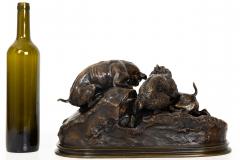
Cast circa 1870 (Mêne-Cain atelier) 8 3/4" H x 15 1/4" W x 7 15/16" D Essay
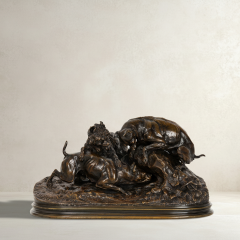
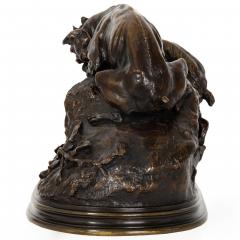
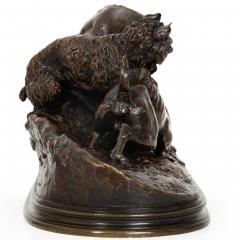
This exquisite bronze hunting group captures a trio of dogs excitedly congregating around a small hollow within which a rabbit is presumably hiding. It is one of Mene’s most popular hunting scenes, the dogs more playful and inquisitive than actually partaking on a serious hunt - tongues are wagging and tails are tense as the more brave of the terriers probes his nose under the outcropping. It fully displays the intelligence and curiosity of these animals.
The present casting was almost certainly executed in the Mêne-Cain atelier, operated jointly between Mêne and his son-in-law Auguste Cain during the last years of his life. After his death, the foundry continued to be operated by Auguste Cain through the end of his life. It was then operated under the careful oversight of Julie Mêne by Auguste Cain's sons, Henri and Georges Cain, until around 1908 when the production was turned over to Susse Freres in Paris. The cast exhibits incredible attention to detail in even the most minute elements - typical of the work in both Mêne's personal atelier and that operated jointly with Cain, the intricate modeling of textures in the underlying wax is faithfully cast through to the bronze with utmost fidelity. Individual hairs, claws, muscles and elements throughout the base are beautifully rendered in the unforgiving metal. The underside shows the typical joinery of this period with slotted screws affixing all of the smaller elements into the base with more limited use of bolts and peened ends.
The work was first presented as a wax model at the Exposition Universelle of 1855, then again at Salon in 1872 as a bronze model. It is catalogued in Mene’s catalog as No. 24 with original dimensions of 20 cm height, 37 cm length and 18 cm depth and an original cost of 250 francs in bronze and 350 francs finished in silver. Mene's models were eventually purchased by Susse Freres, the foundry that put forth a great number of his pieces in the last quarter of the 19th century. A portion of his models were purchased by Barbedienne and slightly later models of this subject are often found cast by Barbedienne. Examples of this model are held in the permanent collections of the Louvre (Paris), Museum of Marseilles (France), Carnavalet Museum (Paris) and the Musée d’ Orsay. Condition:
A very fine nuanced patina throughout, probably original and well-preserved throughout. Minor handling wear and relief to raised elements, including the spines of the dogs, tips of their ears and edges of the base rim. Pin-prick holes in a few spots due to the thinness of the casting (these are quite hard to find without a flashlight). Carefully cleaned and sealed in conservator's wax - a very fine presentation, ready to place. Biography
Pierre-Jules Mêne was one of the most accomplished animal sculptors of the 19th century and a central figure in the development of the Animalier school in France. Born in Paris on March 25, 1810, into a family of artisans, Mêne was introduced to metalworking by his father, a skilled metal turner. This early exposure to technical craftsmanship played a pivotal role in shaping Mêne’s later expertise as both a sculptor and a founder.
Entirely self-taught as a sculptor, Mêne developed a strong command of drawing and modeling through private study and observation. His sculptures are distinguished by their naturalism, intimate scale, and expressive fidelity to the anatomy and motion of animals. Rather than mythological or exotic beasts, Mêne favored domestic and farm animals—primarily horses, dogs, cattle, and sheep—capturing them in candid, often playful poses that resonated with contemporary collectors. Large game subjects, which featured prominently in the work of Antoine-Louis Barye, were notably absent from Mêne’s oeuvre.
Mêne debuted at the Paris Salon in 1838 and exhibited regularly in the decades that followed. In contrast to many of his contemporaries, he established his own foundry early in his career, around 1837, allowing him full artistic control over the production and finishing of his bronzes. This independence yielded works of exceptional technical quality, with finely chased surfaces and well-considered patinas. His mastery of the lost-wax casting process, executed without reliance on outside founders, gave his workshop a competitive edge in both artistry and efficiency. In 1852, Mêne expanded his atelier to accommodate the growing demand for the work of his son-in-law, the sculptor Auguste Cain.
One of Mêne’s most celebrated works is L’Accolade, a spirited equestrian group depicting two horses nuzzling, which became one of the most popular bronze editions of the period. His work was not only widely collected in France but also enjoyed considerable commercial success in Britain, where his models were cast under license by Coalbrookdale and Falkirk ironworks to serve the English market. These partnerships helped solidify his presence internationally.
Mêne’s achievements were recognized with numerous awards: he received first-class medals at the Expositions Universelles in Paris in 1855, 1861, and 1867. In 1861, he was appointed Chevalier of the Légion d'Honneur, the highest civilian distinction in France.
Following his death on May 20, 1879, in Paris, the Mêne foundry continued to operate under the supervision of Auguste Cain for the benefit of Mêne’s family. In the early 20th century, the rights to over 200 of Mêne’s models and more than 100 of Cain’s were sold to the Susse Frères foundry, which issued a joint catalogue of their works and continued limited editions well into the 1900s.
Today, the sculpture of Pierre-Jules Mêne remains highly collectible, though discerning lifetime casts from posthumous editions requires careful expertise. Differences in assembly techniques, surface tooling, and patina treatment can assist in dating, but misattributions remain common. Only those familiar with a wide range of Mêne’s production—across various foundries and decades—can confidently assess period and authenticity.
Mêne’s sculptures are held in major institutional collections, including the Musée d’Orsay and the Louvre in Paris, and continue to be regarded as paragons of 19th-century bronze casting. His ability to merge technical excellence with vivid naturalism places him alongside Fratin and Barye as one of the most important originators of the Animalier movement. References: Pierre-Jules Mene, Catalogue raisonne, Poletti & Richarme, 2007, p. 55, ill. 44 Bronze Sculpture of Les Animaliers, Jane Horswell, 1971, p. 144 Bronzes of the 19th Century: Dictionary of Sculptors, Pierre Kjellberg, 1994, p. 472 (Mene’s catalog reproduced), p. 484 (present model) Animals in Bronze, Christopher Payne, 2002, p. 205, f. D18 Art Bronzes, Michael Forrest, 1988, p. 186, f. 3.67 ref. 503LRP30P -
More Information
Documentation: Signed Period: 19th Century Styles / Movements: Traditional Dealer Reference #: 503LRP30P Incollect Reference #: 836198 -
Dimensions
W. 15.25 in; H. 8.75 in; D. 7.937 in; W. 38.74 cm; H. 22.23 cm; D. 20.16 cm;
Message from Seller:
Silla, Ltd. is a family-owned antique gallery located at 117 W Burd St., Shippensburg, PA 17257, specializing in 19th and early 20th century bronze sculptures and unique period furniture. For more information or to schedule a visit, contact us at sales@sillafineantiques.com or call 717.708.9017.
More Listings from SILLA View all 377 listings
-
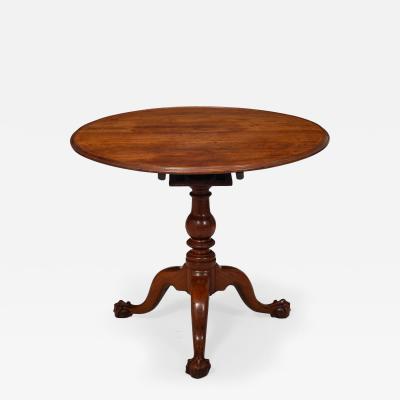
American Chippendale Carved Tilt-Top Ball and Claw Tea Table ca. 1770
-
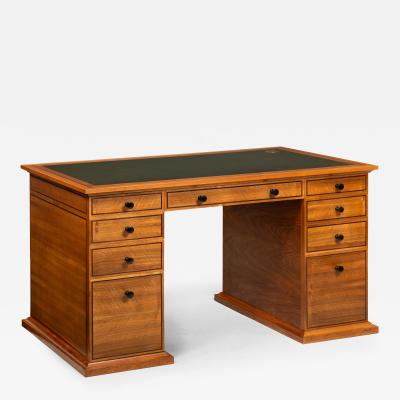
Very Fine English Walnut and Ebony Pedestal Desk by David Linley
-
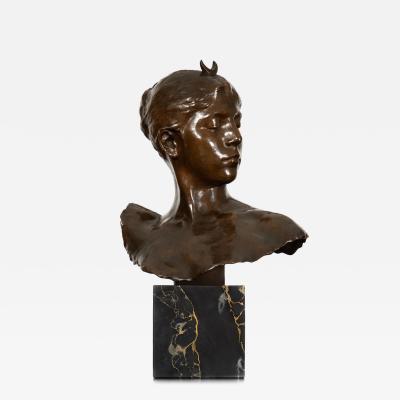
French Antique Bronze Sculpture Bust of Diana by Falguiere ca. 1880
-
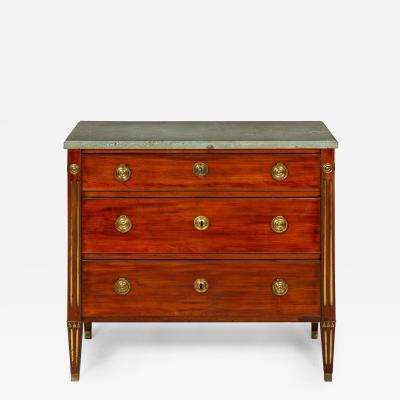
Circa 1790 Swedish Gustavian Marble Top Mahogany Desk Commode Chest
-
Fine Italian Grand Tour Bronze Sculpture of Augustus Prima Porta by Boschetti
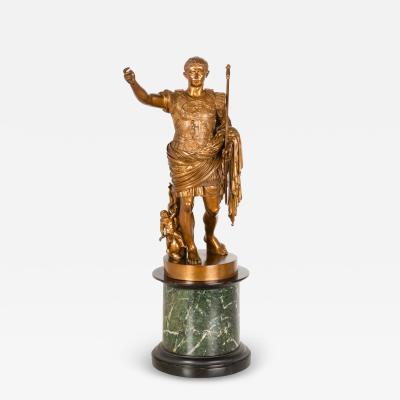
-
French Grand Tour Bronze Sculpture “Two Fates” after Jean-Baptiste Clesinger
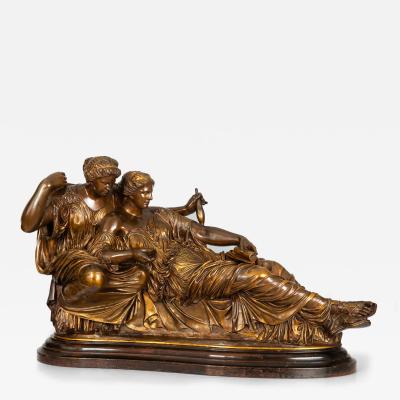
-
French Provincial Antique Cherrywood Writing Table, mid-18th century
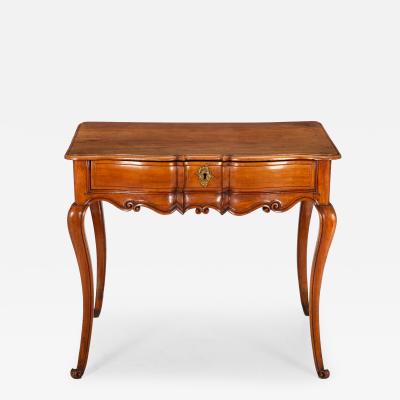
-
Baltic Neoclassical Mahogany, Brass & Leather Writing Desk, late 19th century

-
George III Period Inlaid Mahogany Serpentine Sideboard, English ca. 1790
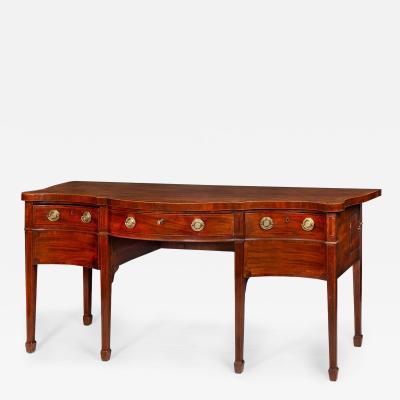
-
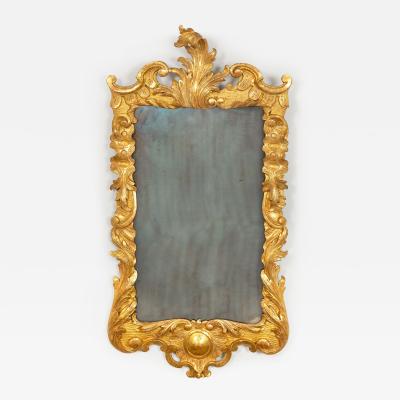
Fine George II Carved Giltwood Wall Mirror, English or Scottish circa 1750
-
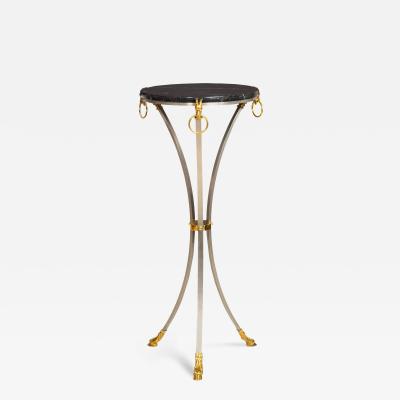
Hollywood Regency Steel Marble Top Pedestal Plant Stand Gueridon Table
-
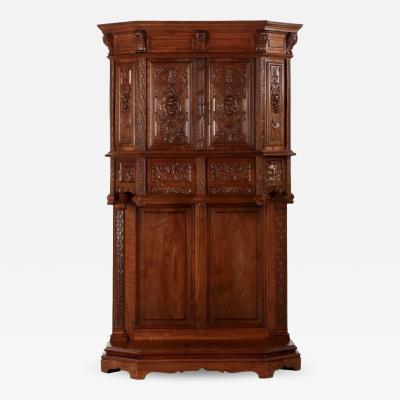
French Gothic Revival Carved Walnut Cupboard, circa 1880
-
Pair of Louis XVI Style Lamps | Entwined Snake Handles

-
English George III Mahogany Gate Leg Card Game Table circa 1770