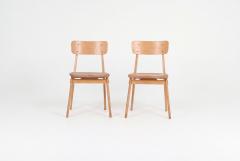
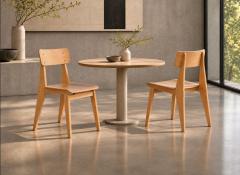
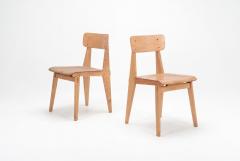
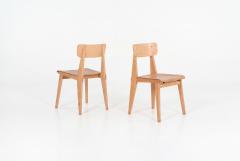
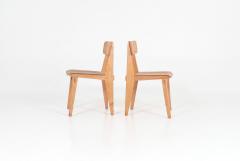
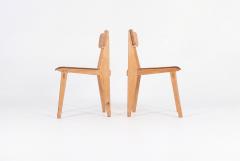
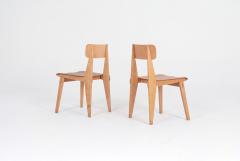
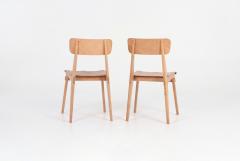
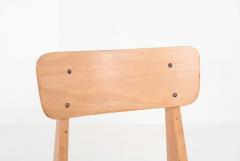
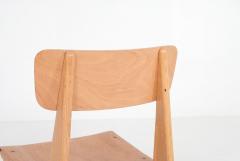
Jean Prouvé, Rare Pair of Chaise Standard Tout Bois, France, 1940's
Wood with steel fasteners.
Dimensions:
31 in. high
16 in. wide
19.5 in. deep
17.25 in. seat height
Each chair with a number to the underside of the seat, “9” and “3,” respectively.
The Chaise Tout Bois (All-Wood Chair) was designed by Jean Prouvé during WWII, when steel – the great designer’s preferred medium – was almost unobtainable in France. Designed at the Ateliers Jean Prouvé in Maxéville, this chair was manufactured by frequent Prouvé-collaborator Établissements Vauconsant in Saint-Nicolas-de-Port. Vauconsant were experts in wood construction, and collaborated on many projects with Prouvé, whose own company specialized in steel fabrication.
In the 1940s and well into the post-war era, Vauconsant worked closely with the Ateliers Jean Prouvé in the manufacture of facade panels and other components for the pre-fabricated, wood-based houses that Jean Prouvé designed, including those created for the re-location of families displaced during WWII. These two chairs were part of the original furniture in one such historic Prouvé-designed and Vauconsant-manufactured house, located in Alsace-Lorraine, which was restored in the 1980s. These chairs spent many decades as part of a group of six such chairs in that house, until they were eventually sold at auction in Nancy, France, Jean Prouvé’s home town.
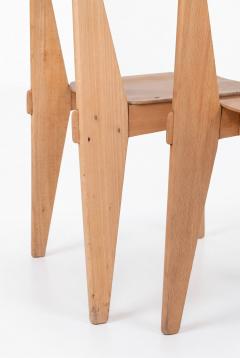
The most famous Prouvé chair, the Chaise Standard, with its distinctive metal frame, was first designed in 1934; Prouvé developed and adapted this popular and iconic form throughout his career. During World War II, Prouvé collaborated with Vauconsant to produce a version of the Standard Chair entirely in wood, due to the scarcity of metal during the war. The most desirable examples of the resulting all-wood Chaise Tout Bois feature a frame of solid wood, with conspicuous through-tenon joinery stabilizing each of the four legs, a beautiful construction detail that emphatically expresses the structural demands specific to wood construction, in contrast with those of sheet steel (which can be welded, thus requiring no joinery). Joinery with through-tenons, while labor-intensive and time-consuming, is also very strong and stable, and the inherent rigidity of a chair so constructed makes stretchers running between the front and rear legs unnecessary, allowing for a purer profile. And a great profile is what distinguishes a Prouve chair.
The Chaise Tout Bois shares its distinctive basic form with that of the steel-frame Chaise Standard. A characteristic common to both chairs is the contrast between the substantial rear legs (which taper to their widest at the mid-point where the vertical leg meets the horizontal tubular member that supports the seat, in accordance with structural demands) and the delicacy of the front legs, which are less load-bearing than the rear legs. This beautiful asymmetry of form clearly expresses the structural demands of each component of the chair, turning structure into sculpture. Honest yet aestheticized expression through structure is a thematic feature of Modernist design, and a central motivation and recurring strategy in the work of Jean Prouvé, in both his architectural and furniture designs.
Prouvé’s sophisticated use of joinery – despite his lifelong specialty being the design and manufacture of welded steel structures – demonstrates that he was no less imaginative and expressive in his designs when constrained by the use of more traditional furniture materials. Prouvé’s famous artist father, Victor Prouvé, founder of the School of Nancy, was an important figure in an early phase of Modernism, and the Chaise Tout Bois – especially this variant with its conspicuous through-tenon joinery – manages to evoke the design language of the Arts and Crafts Movement of the era of Victor Prouvé, in which joinery was intrinsic to the aesthetic of that period’s furniture,a characteristic inspired in part by late-19th century French enthusiasm for traditional Japanese art, design, and architecture.
The several variants of the “Chaise Tout Bois” design, produced from the 1940s through the early 1950s, suggest that both fluctuations in the supply of materials and restless experimentation by Prouvé resulted in occasional modifications to the design. (There is a unique variation, now in a museum in Lorraine, France which has its seat and back made up not of two single units of molded plywood, but of seven parallel slats of bent wood.) Following the war, the ChaiseTout Bois chair continued to be produced for several years, both with and without the beautifully conspicuous through-tenon construction.
The original six chairs in the Prouvé house were “refreshed” with paint (applied by brush) at some point in the past by the original owners. The frames were painted black, and the seats and backs painted in a variety of bright colors. The effect was cheerful, but unoriginal. These two chairs have since been sensitively restored, the paint very gently removed to reveal the original clear-coat finish and wood grain. There is evidence of some wear, but the chairs are strong, stable, and structurally sound and can be put to immediate use.
Provenance:
– private collection, California
– Hotel des Ventes Nabecor, Nancy, France
– pre-fabricated house designed by Jean Prouvé, Alsace, France