









Showrooms
Fine Carved Boxwood 17th Century Jansenist Corpus Christi
-
Description
A JANSENIST CORPUS CHRISTI
Circa second half of the 17-century
17" H x 2 1/2" D x 5 1/2" W
Carved boxwood
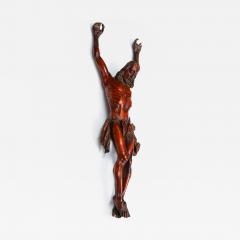
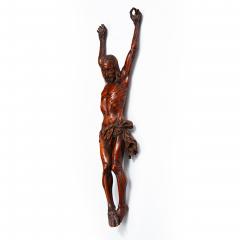
The figure of Christ is represented with the arms rising almost vertically above the head, creating a narrow and markedly elongated Crucifixion type. The position draws the shoulders upward and places particular emphasis on the suspended weight of the body, exposing the rib cage and lengthening the torso. This arrangement became conventionally associated with Jansenism, the restricted span of Christ's arms being interpreted as an expression of salvation reserved for the Elect. The identification is not absolute, however. Raised arm representations of the Crucifixion precede the Jansenist movement and appear prominently in paintings by Peter Paul Rubens during the opening decades of the seventeenth century. (1, 2)
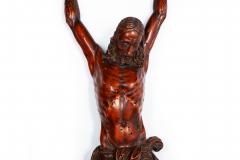
Christ's head is lowered, the heavy eyelids nearly closed, suggesting the moment immediately surrounding death. His hair is centrally parted and descends in long curls beside the neck, framing a short divided beard. No wound is present in the side, perhaps indicating the interval before the piercing of Christ by the lance. A closely related Flemish Corpus of circa 1650 to 1670 associated with the circle of Matthieu van Beveren similarly combines elevated arms, a lowered head and nearly closed eyes with the absence of the side wound, representing the moment between life and death. (2)
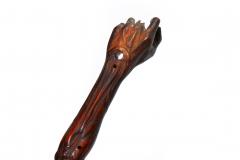
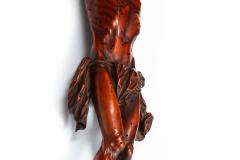
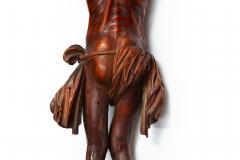
The elongated body is carefully articulated, with prominent ribs and musculature and an unusually detailed vascular system. Veins stand prominently in relief along the forearms and continue across the legs and abdomen. The perizonium is gathered beneath a twisted cord encircling the waist and descends in broad, deeply cut folds around the hips. A single faceted nail secures the superimposed feet in the three nail configuration. The flesh is pulled tightly around the point of attachment, while the pierced hands and remaining fingers convey the tension of the suspended body.
Particular attention was also given to the reverse, which is fully carved rather than merely finished as a secondary surface. The elevated arms pull the scapulae strongly outward, while folds of flesh gather around the shoulders and the spine remains clearly articulated through the center of the back. This careful treatment reinforces the physical effect of suspension that defines the figure from the front.
The conception belongs to a Crucifixion type that circulated widely through European sculpture during the seventeenth century. Rubens's treatments of Christ on the Cross provided an influential early precedent for the raised arms and heavily suspended body. Georg Petel subsequently translated related Rubensian forms into sculpture after encountering Rubens in Antwerp, and variations of the type appear later in Flemish, French, German and Italian works. A large ivory Corpus catalogued by Sotheby's as South German or Italian and dating from the second half of the seventeenth century demonstrates the difficulty of assigning such forms geographically. Sotheby's specifically related its elongated proportions and treatment to Petel while recognizing the international circulation of his influence. (1, 3, 4)
Several details of the present Corpus find parallels among these later seventeenth century works. French examples employ a perizonium similarly retained by a separate cord, including a seventeenth century ivory Christ in the Louvre, whose arrangement the museum associates with French crucifixes of the reign of Louis XIV. A German seventeenth century boxwood Crucifix in the Metropolitan Museum provides another related interpretation of the elongated figure. These comparisons illustrate the broad distribution of individual features and caution against assigning the present carving to a particular regional school solely on the basis of its iconography. (5, 6)
The treatment remains notably restrained. Although the pronounced veins, exposed ribs and taut extremities describe the physical consequences of Crucifixion in considerable detail, the face is quiet and introspective rather than theatrical. The unusually large hands and feet, heavy eyelids and somewhat individualized physiognomy distinguish the carving from often more refined Flemish and Franco Flemish examples.
Condition: Losses to the fingers on both hands, several with tiny pegs in the knuckles where the fingers separately attach. Inactive wormhole pest damage throughout. Otherwise very fine state of preservation.
References:
1. Bayerische Staatsgemäldesammlungen, Alte Pinakothek, Peter Paul Rubens, Christ on the Cross, circa 1615 to 1616, inv. 339: Link
2. Sotheby's, London, Old Master Sculpture and Works of Art, 9 July 2015, lot 172, attributed to Matthieu van Beveren, Antwerp, circa 1670 to 1680. Catalogue note discussing the raised arm type, its conventional association with Jansenism and its derivation from Rubens: Link
3. Deutsche Biographie, "Petel, Georg." Biography documenting Petel's travels through Antwerp, Paris, Rome and Genoa, his work for Rubens and the importance of Rubens to his sculptural development: Link
4. Sotheby's, New York, Old Master Paintings, 31 January 2013, lot 389, A Fine and Large Ivory Corpus, South German or Italian, second half of the seventeenth century. Catalogue note discussing Petel's influence and his relationship with Rubens.
5. Metropolitan Museum of Art, Crucifix, German, probably seventeenth century, polished boxwood, inv. 44.142.3.: Link
6. Musée du Louvre, Christ en croix, French, seventeenth century, ivory, OA 5383.: Link
7. Floris van Wanroij Fine Art, Circle of François Du Quesnoy, A Jansenist Cristo Vivo, boxwood, circa 1660. Catalogued with the assistance of Frits Scholten and discussed in relation to Rubens and Du Quesnoy: Link
ref. 606DLM25Z -
More Information
Period: Pre 18th Century Materials: Boxwood, Carved Styles / Movements: Religious, Traditional Dealer Reference #: 606DLM25Z Incollect Reference #: 886788 -
Dimensions
W. 5.5 in; H. 17 in; D. 2.5 in; W. 13.97 cm; H. 43.18 cm; D. 6.35 cm;
Message from Seller:
Silla, Ltd. is a family-owned antique gallery located at 117 W Burd St., Shippensburg, PA 17257, specializing in 19th and early 20th century bronze sculptures and unique period furniture. For more information or to schedule a visit, contact us at sales@sillafineantiques.com or call 717.708.9017.
More Listings from SILLA View all 388 listings
-
Group of 15 Carved Wood Sculpture Figural Studies or Artist Models, 20th Century
-
Fine Chinese Chippendale Pagoda Carved Giltwood Wall Mirror, English c. 1775

-
Pair of English Copper Ship’s Starboard & Port Ship's Lanterns

-
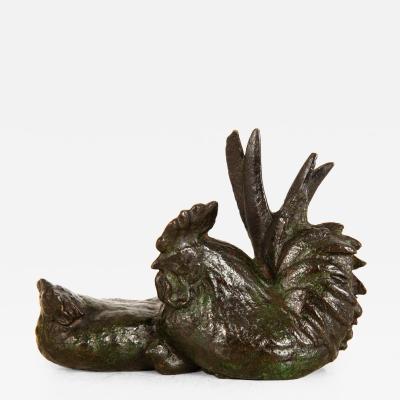
Japanese Meiji Period Bronze Okimono Sculpture of Rooster & Hen
-
Italian Grand Tour Bronze Sculpture “Dancing Faun of Pompeii” after Antique

-
Pair of Wrought-Iron and Leather Savonarola Chairs

-
American Queen Anne Antique Sycamore Flat-Top Highboy, New England c. 1760

-
Regency Rosewood Antique Circular Center Table, English circa 1825

-
Danish Modern Teak Adjustable-Height Desk and Chair, circa 1960s

-
Italian 1860s Grand Tour Carved Marble Sculpture of St. John the Baptist

-
Leather "Safari" Chair | after Wilhelm Kienzle

-
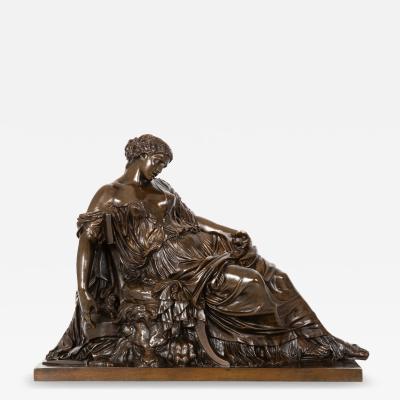
French Bronze Sculpture “Dying Lucretia” (1868) by Jean-Baptiste Clesinger
-
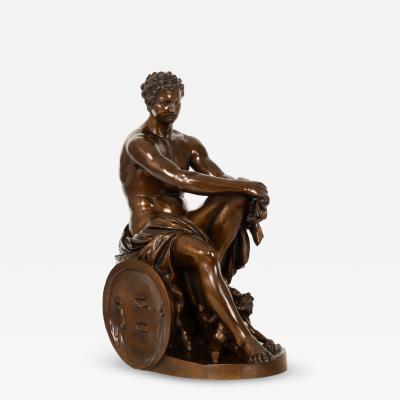
Grand Tour 19th Century Italian Bronze Sculpture Ludovisi Mars after Antique
-
Pair of Faux-Marble Painted Pine Columns, early 20th century