






Restraint and Abundance in a Manhattan Loft
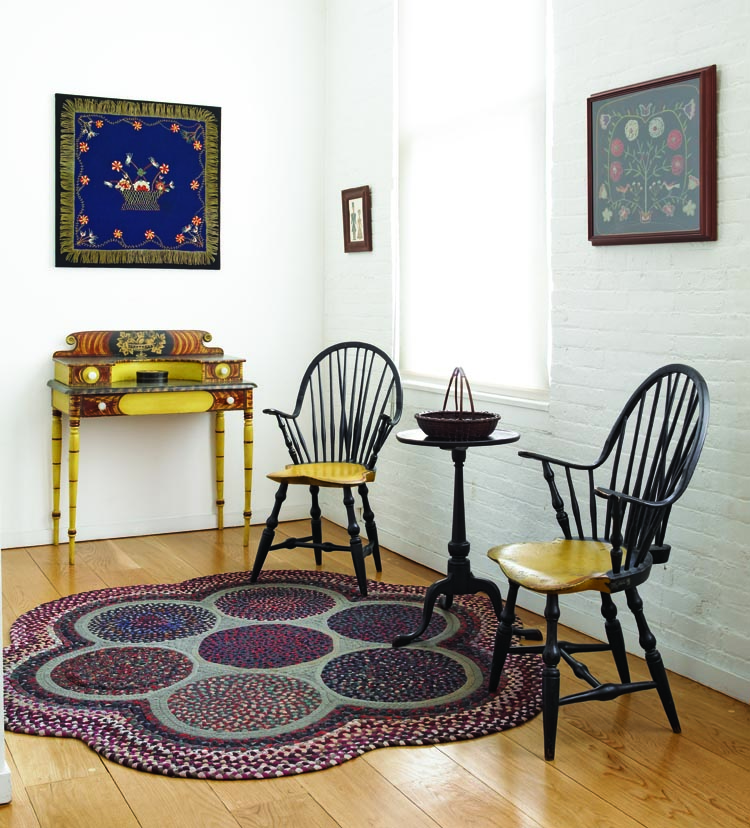
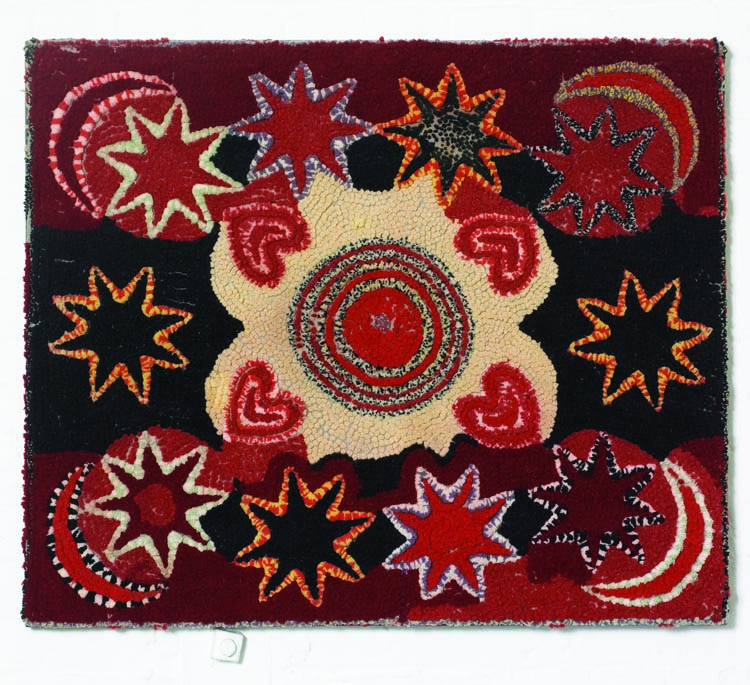
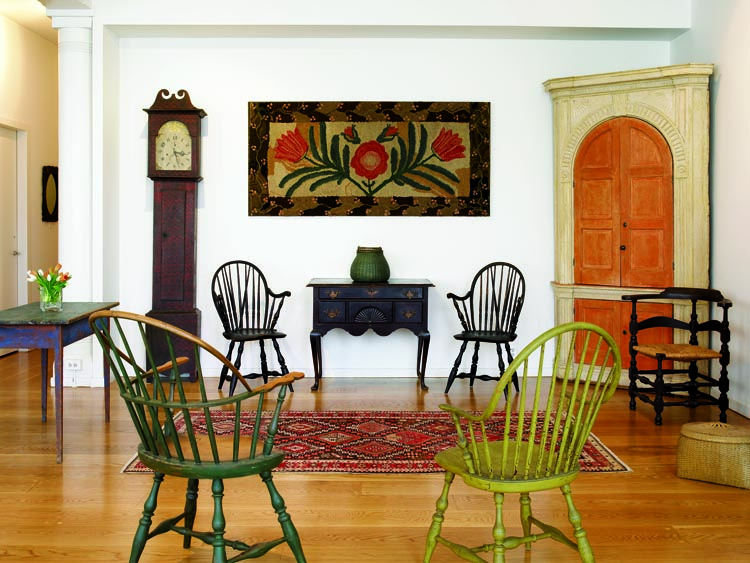
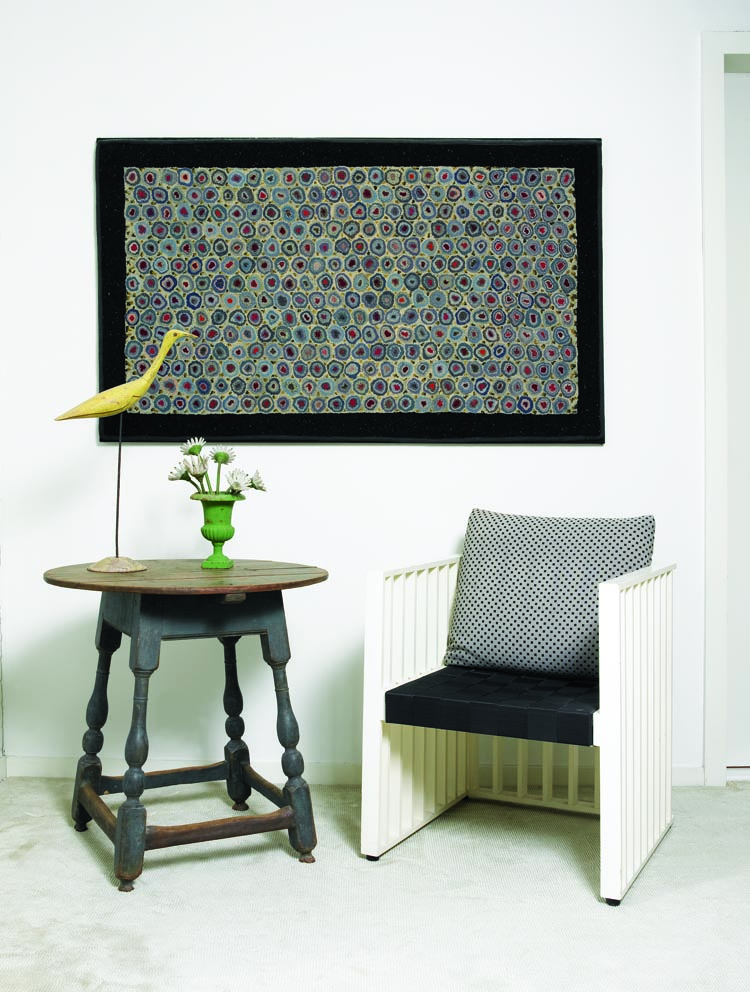
- The collectors like unconventional pieces, such as the pair of late-18th-century Rhode Island braceback Windsor side chairs with vivid yellow seats. Elliott Snyder attributes the circa-1825 stepback dressing table with double-amphitheater back to Martin Bullock (1810–1876) of Newport, New Hampshire. The dressing table was deaccessioned from the Hitchcock Museum in Connecticut. A similar piece is in the New Hampshire Historical Society. The Rhode Island dish-top candlestand dates to circa 1780–90. It is topped with a circa-1900 Taghkanic “friendship” basket. The circular flower hooked rug came from Judith and James Milne Antiques in New York City.
He is analytical, she is intuitive. He is rigorous, she is relaxed. Opposites though they may be, the couple who assembled this collection is of one mind and a single heart when it comes to the New England painted furniture and folk art that fills their loft residence in lower Manhattan. Their mutual love of fine design and surpassing artistry has resulted in a collection that is as exuberant as it is thoughtful.
“They are both passionate about American antiques,” says Elliott Snyder, the Massachusetts dealer who, with his wife, Grace, worked most closely over the past fifteen years with the collectors, who prize imagination and originality over decorative excess.
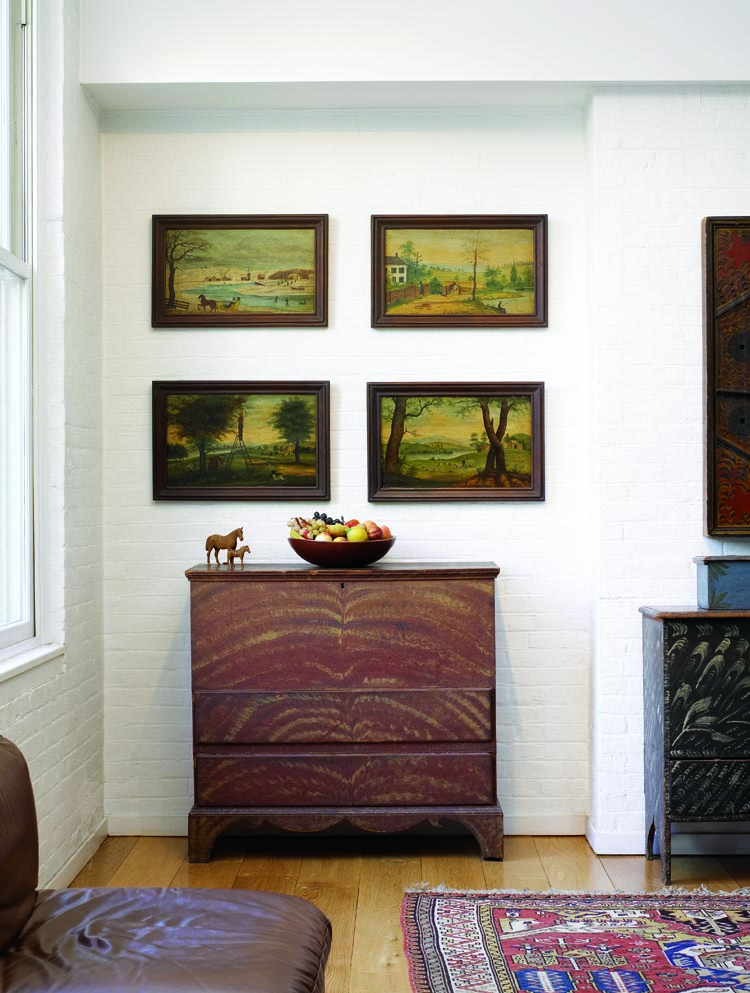
When the couple met, the husband had recently fallen under the spell of American country furniture, having purchased a beguiling lift-top blanket chest in blue-green paint from the late Fae B. Haight, a Lahaska, Pennsylvania dealer. The wife was selling twentieth-century architect-designed furniture from her shop in New York City. “I was a minimalist at heart,” says the wife. Nevertheless, the couple bonded over their love of good design. Their shared preference for a pared-down aesthetic is evident in their refurbished apartment in a former nineteenth-century factory building. Its sunny interior has polished oak floors and white brick-and-plaster walls that provide an understated backdrop for displaying art and antiques.
Antique and modern furniture are arranged in loose, conversational groups to create an informal foyer, living room, sitting room, dining room and kitchen in the large, single-floor space. Small objects, along with some of the couple’s best antique textiles, are tucked into several bedrooms, bathrooms, and a book-lined study.
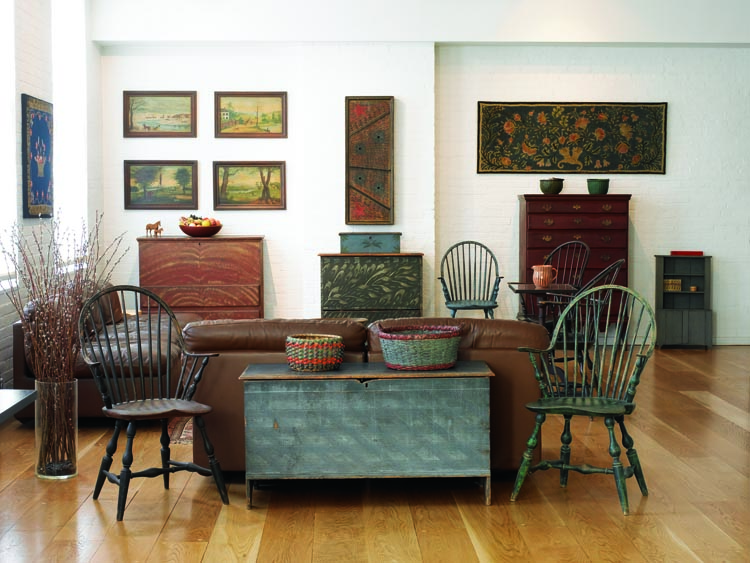
- “We made living with antiques a priority,” says the wife. Postponing renovations to their country house, the couple recently splurged on a circa-1830 pine chest-over-drawer, center rear, possibly from Rhode Island. Above it, a circa-1890 hammer dulcimer in an exuberantly painted case is attributed to Reuben Matheny of Ritchie County, West Virginia. The circa-1800 blanket chest in the foreground features original blue paint and incised decoration. The New York continuous-arm, ca. 1795, Windsor chair is branded “J. Sproson.”
|
|
|
|
|
|
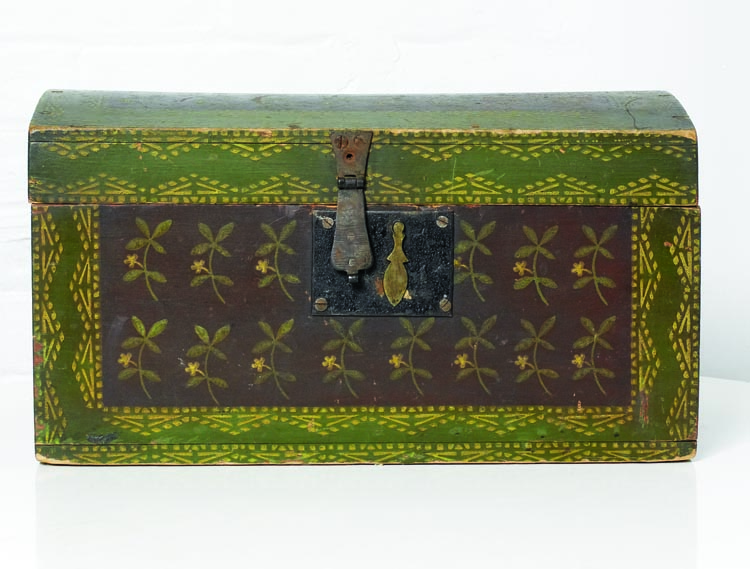
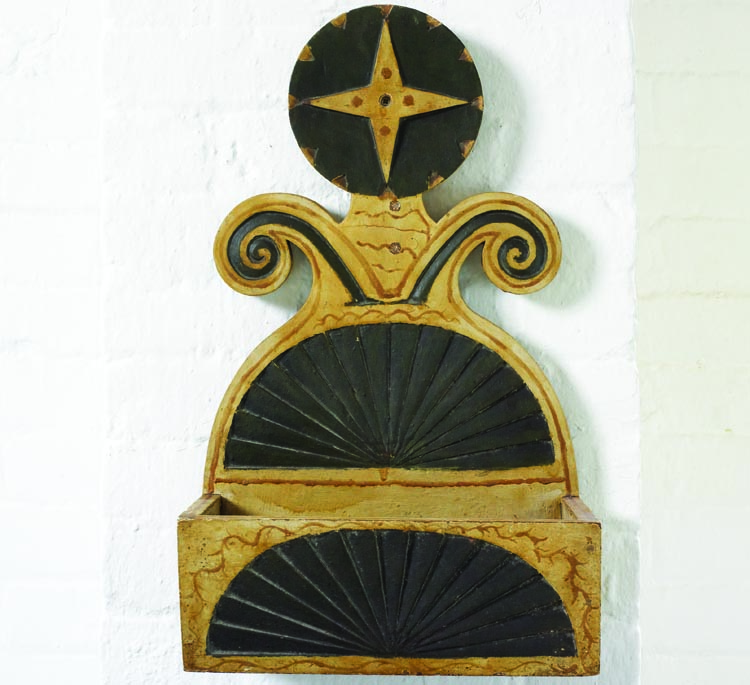
- This dome-top documents box was probably made in Vermont circa 1825. Its decoration may have been inspired by a sprigged Federal-era printed textile or wallpaper.
“This collection is about form and color in wood and fabric. The collectors have great painted furniture and hooked rugs. Their folk art tends to be one of a kind. In pottery, they gravitate to redware over stoneware,” says Elliott Snyder.
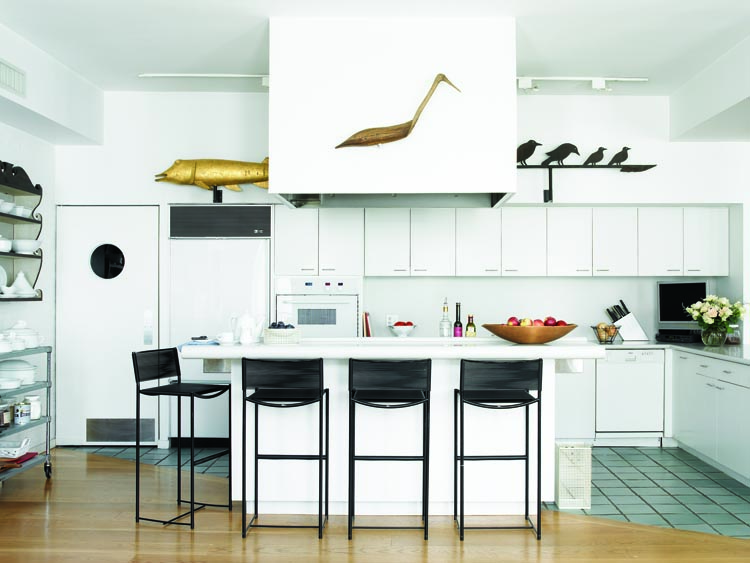
The couple kept a few practical pieces of modern furniture from their former lives, including side tables by Josef Hoffman, loveseats by Scarpa, and chairs by Jacobsen. For entertaining, they commissioned a contemporary metal harvest table and two long benches that, easily pushed against the wall when not in use, blend unobtrusively into the background.
They began collecting American antiques as a couple when they purchased a large, eighteenth-century house in the country in 1991. The intimately scaled rooms of the old dwelling called for small furniture; by contrast, their Manhattan aerie begged for pieces that were big and bold.
“In the beginning, we spent a lot of time visiting shows and shops, talking to dealers, reading books and catalogues, and generally learning our way around,” says the husband. The couple also traveled to dealers’ homes.
“One summer afternoon I was on my lawn tractor when a couple drove up and said that they were interested in antiques. Rather than stop what I was doing, I told them that we had nothing for them and asked them to come back another time,” Elliott Snyder recalls with a laugh. From this inauspicious start a great partnership began.
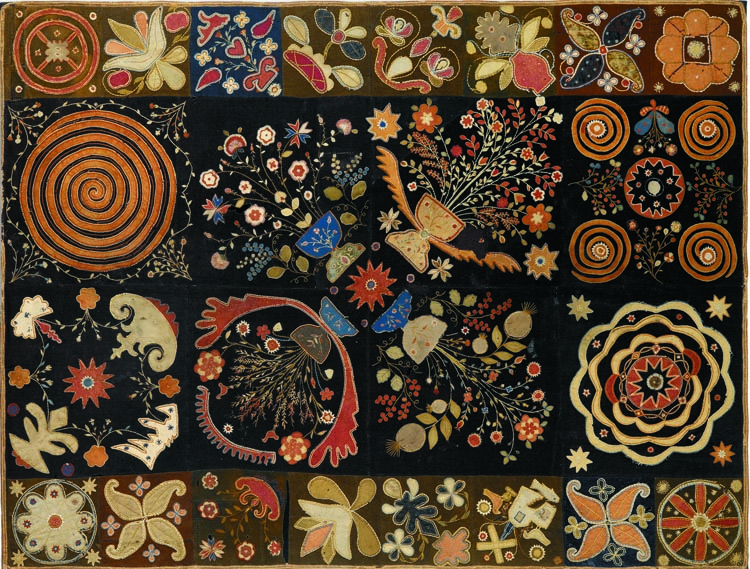
- “It’s one of my favorite pieces. I love the imaginative, freeform design and the color scheme,” Grace Snyder says of the circa 1810–20 pieced and embroidered wool-on-wool with silk applique New England table rug, which hangs over the bed in the master bedroom.
“Elliott understands high country furniture and painted surfaces better than any dealer I know. Seeing a piece through his eyes is a remarkable education. Grace is tremendously knowledgeable about textiles. To a great extent, the Snyders have shaped our taste,” says the husband. Adds the wife, “They taught us to be exacting about form, condition and surface, which has to be original, exciting and something we want to live with.”
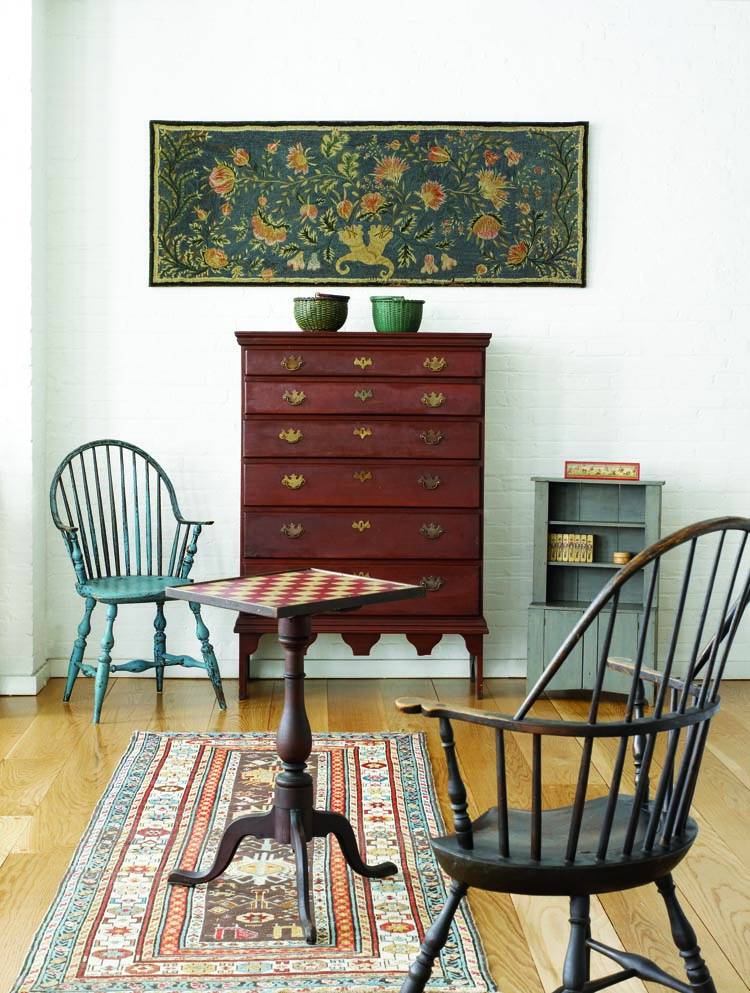
“Grace and I prize imaginative quality,” explains Elliott Snyder. “We’re not looking for pieces that are classic in a predictable way so much as objects that combine exceptional form and condition with artistic inspiration.” Furniture in the couple’s collection that exemplifies these traits include a shapely Connecticut cherry candlestand enlivened by the addition of a painted checkerboard top, and a pair of Rhode Island Windsor side chairs that are black with startling yellow seats.
“For me, the Windsors are perfect specimens of both paint and sculpture,” says the wife. “I don’t like rote decoration or too much symmetry. I prefer freeform design. I want a piece to tell me something about the person who made it.”
The husband and wife buy from leading antiques dealers who they regularly see at the Philadelphia Antiques Show, The American Antiques Show, the ADA-Historic Deerfield Antiques Show, and the Winter Antiques Show. He likes the New Hampshire Antiques Dealers Show. She is dismayed by the crowds, but accompanies him anyway. They also shop at auction, usually asking an expert to bid on their behalf.
|
|
“We’ve learned a great deal from dealers. They are passionate about what they do, know a tremendous amount and are usually willing to share,” says the husband. “We’ve come to trust the people we buy from completely, which has made our collecting decisions much easier,” says the wife. Careful buying has meant that the couple has replaced only a dozen or so pieces over the years.
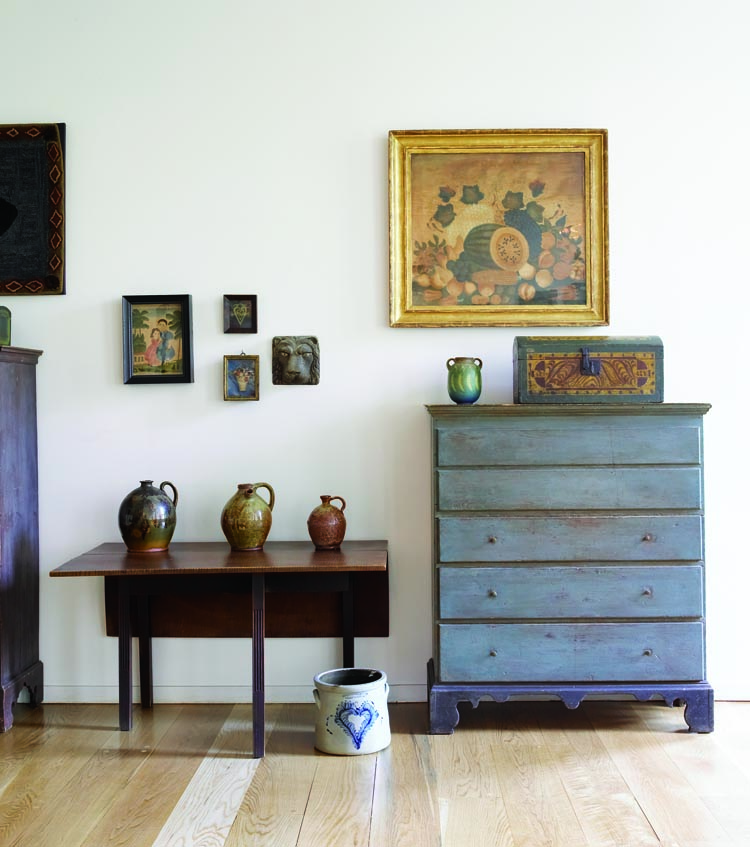
Among their most prized possessions is a circa-1825 step-back dressing table with a rare double-amphitheater back. In the entry, it is among the first pieces visitors see when they enter the collection. Vividly decorated in variety of paint techniques, including faux marble, it relates to a group of similar furniture made in New Hampshire. The dressing table was deaccessioned from the Hitchcock Museum in Barkhamsted, Connecticut. “I’ve seen at least four of these dressing tables, including one in the collection of the New Hampshire Historical Society in Concord, but this one is among the best,” says Elliott, who attributes the piece to Martin Bullock of Newport, New Hampshire.
The rarest object in their collection is in the living room. The embroidered and yarn-sewn rug, probably made in Connecticut between 1780 and 1810, features a double-cornucopia design and is executed in wool in crewel-like stitches on a linen foundation. “It may be the earliest American yarn-sewn rug extant. It predates most yarn-sewn rugs by twenty years,” says Grace Snyder.
|
|
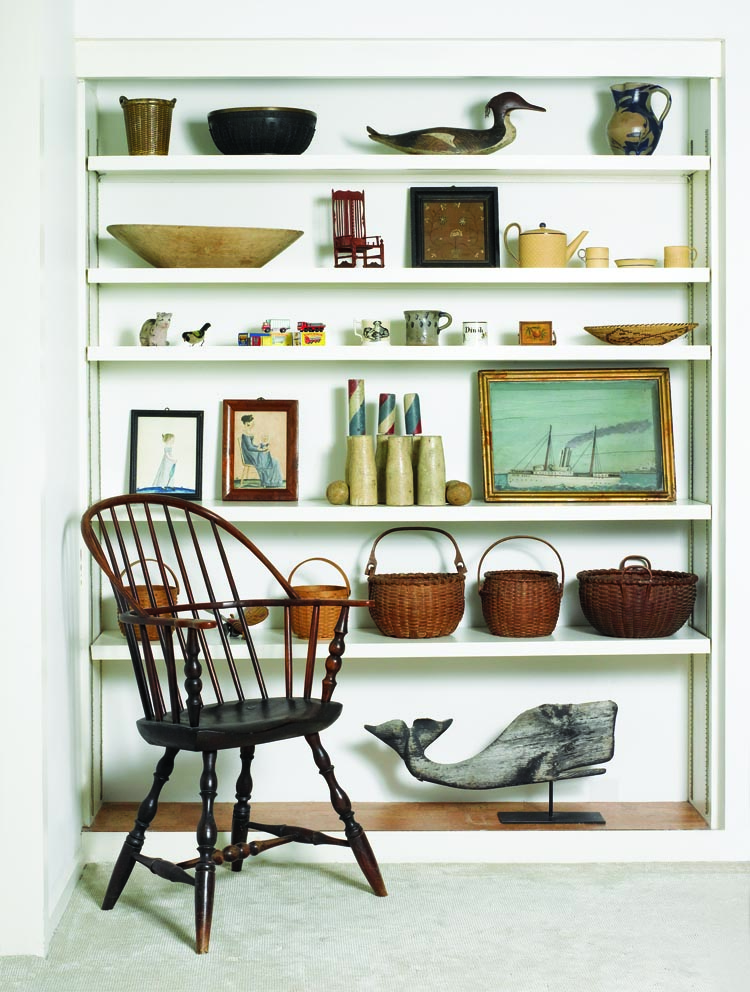
The couple owns an extensive collection of baskets. One of the best is a circa-1850 New England swing-handle example of hickory splint with a wrapped rim and blue-green paint that has oxidized to green. It came from Illinois dealer Barbara Pollack, who displayed it at the 2005 Winter Antiques Show in New York.
“We made living with antiques a priority. We are in it for the long term,” says the wife. Proof of the couple’s commitment is their recent splurge on a lift-top blanket chest at Skinner in Bolton, Massachusetts. Painted with white, feather-like splashes and a sheaf of wheat on a blue-grey ground, the chest, at once striking and severe, would melt the heart of even the most devout modernist. “We blew the budget for our renovation project in the country with it,” confesses the wife.
“Great collectors continue to acquire, learn, and develop their eye, as this couple has,” says Elliott. He adds, “These are people who spend a lot of time with their collection. They think about it, talk about it, read about it, move it around. They have amassed a first-rate collection in a short time.”