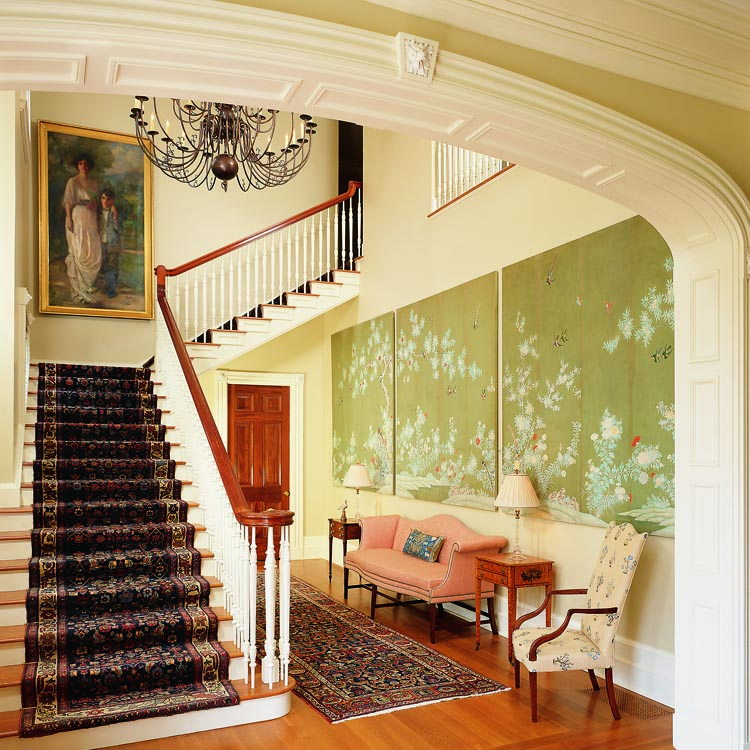
- A family portrait of the Virginia-born wife’s grandfather and great-grandmother greets visitors from the top of the stairs. The couple commissioned 100 banisters in the style of Samuel McIntire, their favorite carver, to support the stair rail. The husband discovered the Dutch chandelier in Argentina. Mounted as three panels, the hand-painted Chinese wallpaper came from Taylor Williams Antiques. The two circa 1890 Bidjar stair runners are from Oriental Rugs, Ltd., in Old Lyme, Ct., as is the circa 1900 Kurdish rug by the sofa. Wayne Pratt Antiques supplied the nineteenth century New York camelback sofa and the Boston Federal work table, right, attributed to John and Thomas Seymour.
In an homage to their life on a lushly planted point overlooking Long Island Sound, not far from the American impressionist art colony of Cos Cob, a well-traveled couple have filled their stately neoclassical-style residence with New England furniture and Connecticut paintings. Unexpectedly, the blue-chip assortment of American art is spiced with exotic relics from Latin America and Asia.
“My eye travels,” explains the wife, who studied at the Inchbald School of Design in London. An accomplished stylist with a love of antiques, she believes that mixing and matching is the key to creating rooms that are both comfortable and interesting.
“It’s like a sea captain’s house, built to accommodate all the treasures we’ve brought back,” she says of their eclectically furnished, four-story clapboard home. Michael Dwyer, a New York architect admired for his rigorous classicism, designed the residence, which affords scenic views of the sparkling sea from a widow’s walk high above the Mianus River and Cos Cob Harbor. Sand’s Point, New York, is visible across the way.
Thoughtfully appointed houses reveal much about their owners. In this case, books, paintings, furniture, and glass tell of the couple’s adventures, together and apart.
“I’m from a proper, old Virginia family that lived with Baltimore furniture,” says the wife. A diplomat’s daughter, she grew up in Latin America and studied in Britain and Ireland. As a young woman, she sold imported designer clothing in Caracas, Venezuela. At a party at the American ambassador’s residence there in 1975, she met her husband, a New Yorker by upbringing.
A student at the time, he became an investment banker specializing in emerging markets. After running Bankers Trust’s Latin American group in the late 1980s, he moved to Donaldson Lufkin & Jenrette in the 1990s. Recently, he founded a global emerging markets hedge fund.
 - “We wanted a house that was Federal in feeling,” say the owners of this recently constructed Connecticut residence overlooking Long Island Sound. Architect Michael Dwyer borrowed elements, such as the octagonal library, far right, from Edgewater, Richard Jenrette’s historic Hudson River mansion, when designing the four-story, clapboard structure.
|
 - “I have the perfect thing for the spot,” Chicago-area dealer Taylor Williams told the wife after finding matching garden benches stamped “April 22, 1890—John McLean, Maker, New York” for the couple’s guest house.
|

- "Not long after we moved here I saw an advertisement for a monumental Albany, New York, overmantel mirror surmounted by an American eagle," says the husband, who immediately rang up George Subkoff Antiques in Westport, Connecticut. A perfect fit, the 19th-century looking glass is today accompanied by carved wooden busts of Haitian generals, saved from the wife’s childhood years in Port-au-Prince.
It was through DLJ cofounder Richard Jenrette, an inveterate collector of American classical furniture and early nineteenth-century houses, that the couple met their architect. Through ingenious sleight of hand, Michael Dwyer designed a new house with the charm and period detail of an old one. With its rear dormers, porticoed veranda, and lawn sloping to the sea, the residence recalls the gracious Long Island summer retreats of Stanford White.
“It’s a large house but not overwhelming. We wanted it to be Federal in feeling, with a central hall flanked by a dining room and living room of symmetrical proportions,” the wife explains. From the main reception rooms, a series of seven large bay windows look out to the gardens, planted with the wife’s favorite peonies, roses, and espaliered hornbeam.
At the end of a first-floor hall, beyond a picture gallery and powder room, is an octagonal library, inspired by one at Edgewater, Jenrette’s historic house overlooking the Hudson River. A stair hall leads upstairs to bedroom suites, studies, dressing rooms, and a large den furnished with painted furniture, Nantucket baskets, and folk paintings by Cape Cod artists Ralph and Martha Cahoon.
The husband credits his wife with opening his eyes to fine design. When they were introduced, she collected pre-Columbian artifacts, Haitian primitive painting, and carved Brazilian votive figures. His career took the couple from Mexico City to Dallas to Connecticut. Their taste for Latin American art, maps, and prints developed along the way.
The couple bought their first piece of antique American furniture, a lyre-base Boston card table, in the mid-1980s from Francis Bealey American Arts in Essex, Connecticut. Not long afterward, they traveled to the Connecticut Antiques Show.
“It was before we had children,” says the couple, now the parents of a 15-year-old daughter and a 12-year-old son. “Living in Connecticut stimulated our interest in the history of the area, a history reflected in its art.”
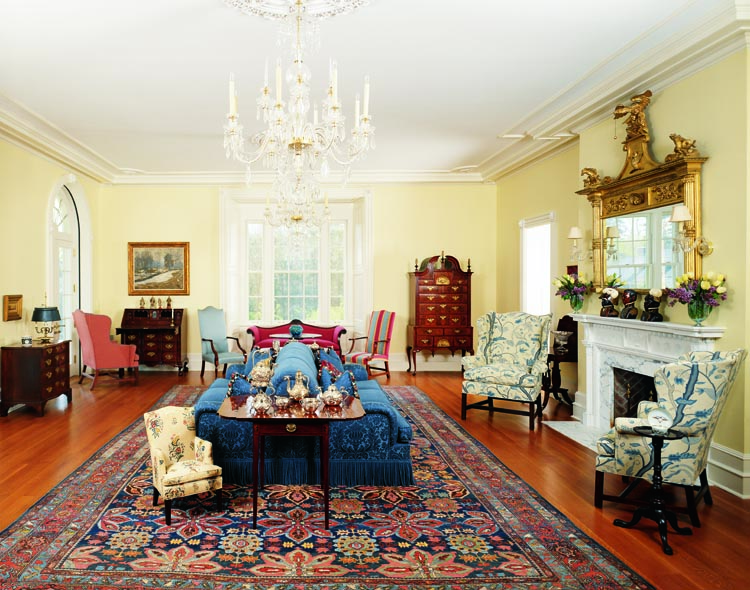 - “We lean toward Massachusetts and Rhode Island furniture of the Queen Anne through Federal period,” says the husband. One important piece, rear right, is a carved, walnut-veneered and gilded Boston Queen Anne high chest of drawers. John Kirk cites the casepiece, one of five similar examples known, as an outstanding example in his comparative study, American Furniture. Two Chippendale wing chairs flank the fireplace. One, a Boston example, is signed John Cogswell. The other, from Newport, is attributed to John Goddard. Another, in front of the slant-front desk, was originally owned by John Brown of Newport. In the foreground, an inlaid Charleston Pembroke table supports Chinese export silver. The child’s chair, left, in eighteenth-century embroidered fabric is from Cora Ginsburg. The circa 1890 Bidjar carpet is from Taylor B. Williams.
|
 - “We found it at Berry-Hill Galleries,” the wife says of the magnificent Severin Roesen (1815–1872) fruit still life painting that hangs over a Massachusetts Hepplewhite sideboard with rare Billston enamel pulls. Topping the sideboard is Flora Danica porcelain. The pair of Federal knife boxes and the Connecticut Hepplewhite shield-back chairs, one visible, came from Israel Sack, Inc. Right, The Sweets of Mexico, a 1973 still life by Gustavo Montaya. Below are antique Brazilian pottery pineapple garnitures, two found by the husband in Sao Paolo. Surrounding the 14-foot dining table are ten custom-made side chairs commissioned by the husband’s mother in the 1940s. The chandelier is Waterford crystal.
|
 - The cupola-topped octagonal library houses decorative arts references, vintage New York theater Playbills, first-edition copies of The Last of The Mohican, The Scarlet Letter, and George Washington’s Farewell Address printed by Loring Andrews in 1796. The Baltimore pedestal-base table, right, is one of a handful of Southern pieces in the couple’s collection.
|
 - “I’ve always loved Wedgwood,” says the wife, who searches for unusual examples of the mainly nineteenth-century English pottery, here displayed in her dressing room with vintage family photographs.
|

- From Wayne Pratt Antiques, this Salem, Massachusetts, mahogany serpentine-front card table dates to circa 1800–1810 and has carving attributed to Samuel McIntire. Above the table is Smelt Fishing, a signed and dated 1902 Childe Hassam (1859–1935) pastel on paper depicting the view from the banks of Cos Cob harbor near the Bush-Holley House.
“At the Hartford show, we looked at everything, then returned to Wayne Pratt’s booth, where we settled on a Dunlap highboy from New Hampshire. We just loved its pierced basket-weave cornice,” the wife continues.
“At the conclusion of the sale,” says Pratt, Inc.’s vice president Marybeth Keene, “I suggested the couple familiarize themselves with American furniture by reading certain books. By our second meeting the husband had read every one and we were able to have some wonderful discussions.”
The husband’s interest in American furniture soon became a passion, so much so that the couple built a first-rate collection of books and catalogues on decorative arts and design.
He reflects, “There are things that are particularly American and great, like jazz, cinema, and furniture through the Federal period.”
“We couldn’t have done this without Wayne Pratt and Marybeth Keene. We’ve always had complete confidence in them,” says the husband, who began attending auctions with Pratt, a well regarded expert in American furniture. The couple frequented Pratt’s shops in Woodbury, Connecticut, and in Nantucket, Massachusetts. Keene, who became the wife’s fast friend, taught the couple’s toddler daughter to say “ball and claw.”
“It was probably because of Wayne and Marybeth that we’ve leaned toward Massachusetts and Rhode Island
furniture of the Queen Anne through Federal period,” says the husband. Their earliest important piece is a carved, walnut-veneered and gilded Boston Queen Anne high chest of drawers, one of five of its kind known. It is joined by three wing chairs. One, a Boston example dating to circa 1770–1790, is signed by John Cogswell, and two are from Newport: one is attributed to John Goddard, the other was John Brown’s personal chair. All four works came from Pratt.
 - Cos Cob colony leader Elmer Livingston MacRae (1875–1953) created this pastel view, The Barn from The Holley House, in 1900. The collectors acquired the work from the Cooley Gallery in Old Lyme, Connecticut. MacRae, who married the Holleys’ daughter, was an organizer of the 1913 Armory show in New York.
|
 - A gouache in the master bedrooms is by Walter Launt Palmer (1854–1932), an upstate New York painter admired for his winter landscapes. It was previously in the collection of Maybelle Mann, author of the monograph Walter Launt Palmer: Poetic Reality.
|
 - Grassy Hill, Lyme, Ct., The Artist’s Farm, Frank V. DuMond (1865–1951), 1925, oil on canvas.
|
 - Winter Twilight, a signed pastel on paper by New Canaan, Connecticut, artist Ernest Albert (1857–1946).
|
 - Morning in Greenwich by Cos Cob artist Leonard Ochtman (1854–1934). The impressionist landscape painting on panel is inscribed $350 on its backside, making it quite a bargain today.
|
 - “Don’t varnish the painting until 1924,” artist Alfredo Carmen wrote on the back of his 1919 oil on canvas, Medio Dia, which needed a good cleaning when the collectors acquired it. The pointillist work depicts the wide-open landscape beyond Buenos Aires.
|
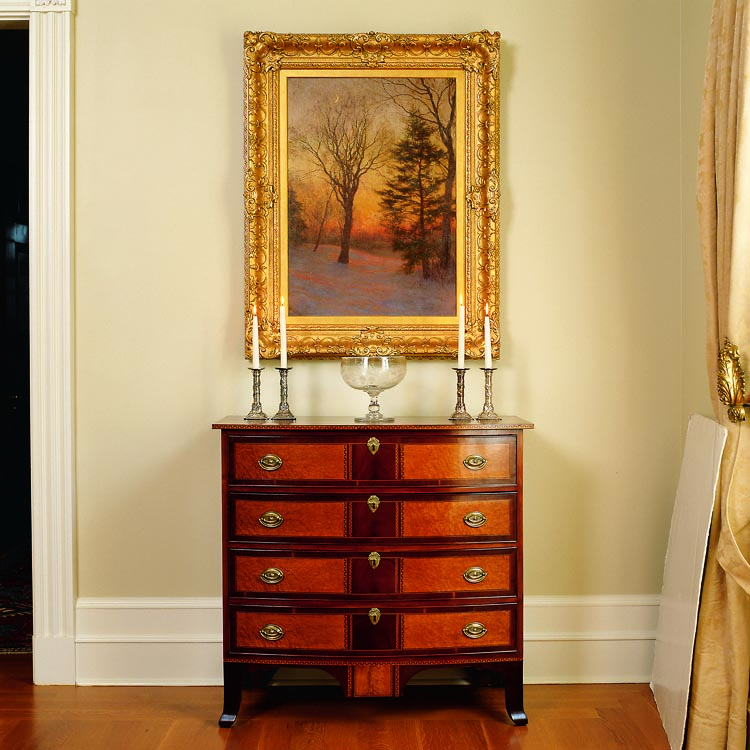 - In the gallery, a circa 1790–1810 bowfront drop-panel chest of mahogany with contrasting bird’s-eye maple drawer fronts is attributed to Ephraim Mallard of Gilmanton, New Hampshire. The moonlit view above is by Walter Launt Palmer (1854–1932), an Albany, New York, artist who was the son of sculptor Erastus Dow Palmer. Harmonizing with the winter landscape’s frosty sheen are Chinese silver candlesticks and an engraved Pittsburgh glass compote.
|
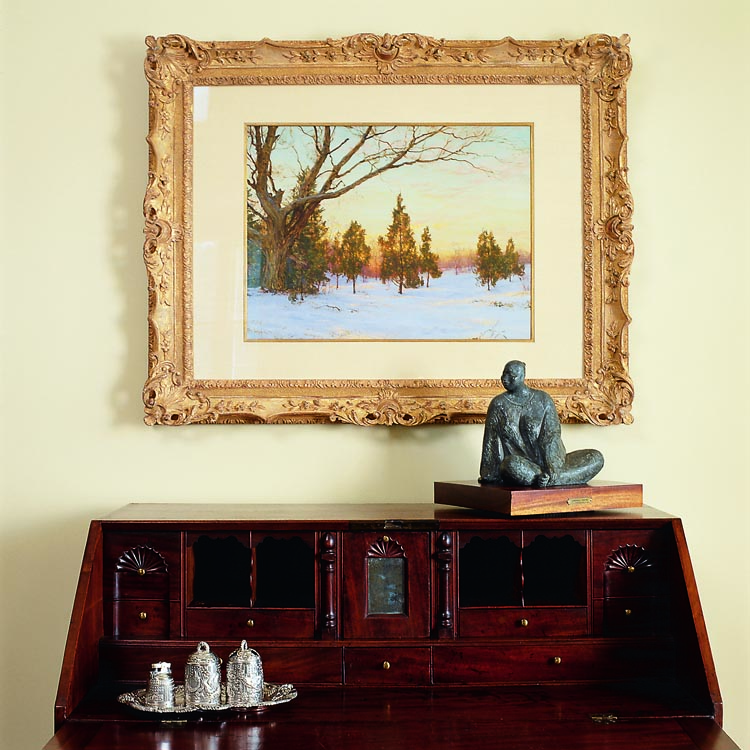 - From Boston or Salem, Massachusetts, the circa 1780 Chippendale mahogany reverse-serpentine slant-lid desk on ball-and-claw feet opens to reveal a shell-carved and mirrored prospect door. The pastel above the desk is a rare Greenwich view by Walter Launt Palmer (1854–1932). The bronze seated figure of a woman is by contemporary Mexican artist Armando Amaya.
|
 - “He’s a wonderful painter who isn’t as well known as he should be,” the husband says of Samuel Harkness McCrea (1867–1941). The Artist’s Studio, a 1939 oil on canvas, depicts a view near the Goodwives River in Darien, where McCrea lived and worked.
|
 - “We’ve had the good fortune to buy some wonderful McIntire furniture,” the wife says of the Salem, Massachusetts, sofa, center, a circa 1800–11 treasure that last surfaced in Christie’s landmark 1995 auction of the Nicholson Collection. Left is a rare Massachusetts Sheraton mahogany lolling chair of circa 1800–1815. The Chippendale mahogany tilt-top tea table is attributed to the Townsend-Goddard workshop, Newport, Rhode Island.
|
Israel Sack, Inc., supplied a notable pair of Connecticut Hepplewhite shield-back side chairs, formerly in the Taradash Collection, and a pair of Massachusetts knife boxes. From the late Cora Ginsburg came a child’s chair in eighteenth-century embroidered upholstery. A child’s slat-back rocking chair was personally delivered to the couple’s daughter by the late Zeke Liverant.
“As our tastes developed, we found ourselves increasingly drawn to Federal furniture,” says the husband, whose key acquisitions include a Massachusetts Sheraton lolling chair dating to circa 1800–1815.
“We’ve had the good fortune to buy some wonderful Samuel McIntire pieces,” says the wife, pointing out a diminutive sofa ornamented with the Salem carver’s characteristic basket of fruit and flowers. Bidding on behalf of the collectors, Pratt acquired the circa 1800–1811 treasure at Christie’s landmark Nicholson sale in 1995. It joins a pair of weathered McIntire columns, a bowfront server, and two carved mantels in the couple’s collection.
“My wife has superb taste. Only Taylor Williams dared offer her decorating suggestions,” the husband says with a smile. The couple met the late Chicago-area dealer and his partner, David Bernard, in Nantucket. Their friendship deepened when Williams and Bernard exhibited at Antiquarius, an antiques show in Greenwich, Connecticut, that the wife annually helps organize. From Taylor Williams Antiques in Harbert, Michigan, the couple purchased Anglo-Irish glass, porcelain, and occasional furniture, along with lighting and room-size carpets.
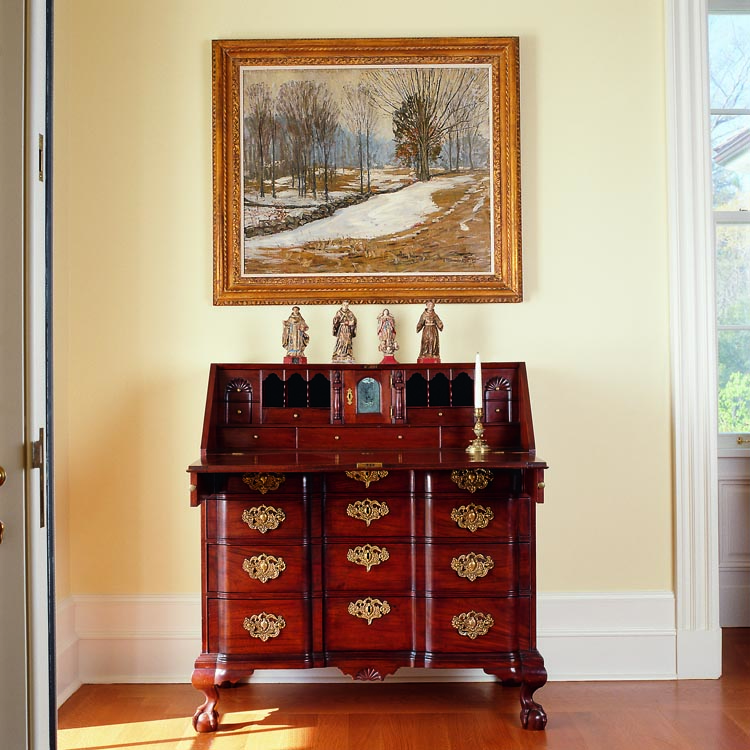 - This Chippendale mahogany block-front, slant-front desk from Salem, Massachusetts, circa 1750–1770, features cast-brass pulls and escutcheons with phoenix-bird crowns. The four eighteenth-century carved, gessoed , painted, and gilded figures of saints are Brazilian. The 1912 painting by Samuel Harkness McCrea is one of two McCrea canvases in the couple’s collection, both from the artist’s estate.
|
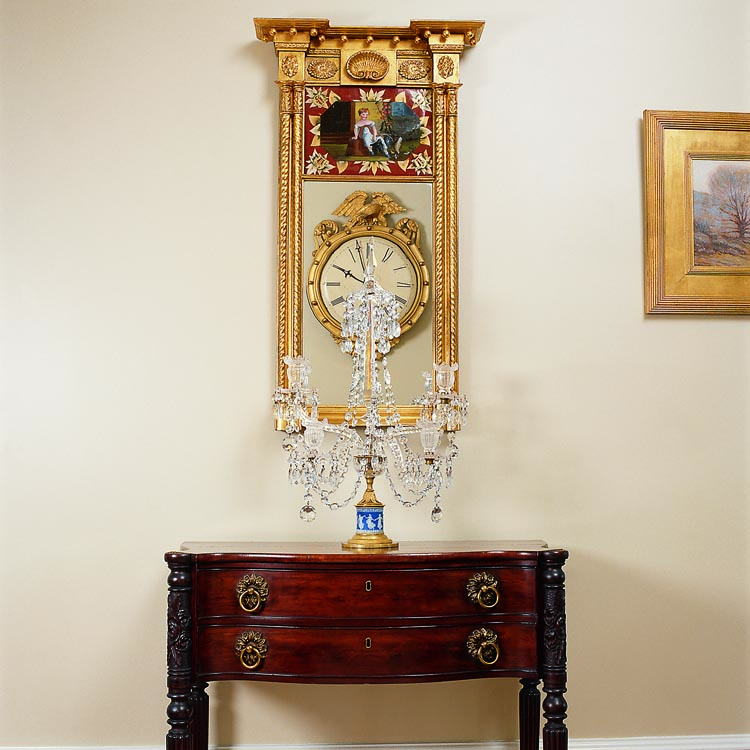 - The rose and star-punched caving on this circa 1810–1815 Federal two-drawer, serpentine-front serving table, possibly by Elijah and Jacob Sanderson or Nathaniel Appleton, is attributed to Samuel McIntire of Salem, Massachusetts. The candelabra is one of a pair deaccessioned by the Henry Ford Museum in Michigan. The couple acquired an unusual red-églomisé New York Federal looking glass, circa 1810–1815, from James Wilhoit in Alexandria, Virginia. The mirror reflects an Aaron Willard gallery clock, from Kirtland Krump in Connecticut, hung on the opposite wall.
|

- Accompanying a delicate New Hampshire step-back server of figured maple and mahogany is a neoclassical armchair with over-upholstered seat attributed to the workshop of Duncan Phyfe (1768–1854), New York City, circa 1807–1818. Both pieces came from Wayne Pratt Antiques. The classical gilt convex mirror dating to circa 1810–1820 is illustrated in Sack, Volume 10. Parian porcelain brackets support sang de boeuf vases.
“Over the past few years we’ve focused on Greenwich views by Cos Cob School artists,” say the couple, who have sought out oils, watercolors, and pastels by painters who summered nearby between 1890 and 1920.
From the Greenwich Gallery in Greenwich, Connecticut, the couple purchased a 1902 harbor-view pastel on paper, created by Childe Hassam just steps from the Bush-Holley House, a boarding house for artists that is now a museum.
The Cooley Gallery in Old Lyme, Connecticut, supplied a snowy Elmer MacRae pastel of Greenwich, dated 1900. Says the wife, “I love winter scenes, both because they are hard to paint and because they suggest that spring is just around the corner.”
One of their best paintings is a luminously moonlit canvas by Walter Launt Palmer, painted in upstate New York. It hangs in the gallery above a New Hampshire drop-panel bowfront chest whose mahogany and maple veneers radiate a similarly warm gleam.
The wife’s “traveling eye” has recently led her to Asian porcelain and textiles. Intricately embroidered Chinese court robes, some gifts from her husband, line the walls of her dressing room.
“It’s the color that I love,” she says of Chinese art. At Taylor Williams and David Bernard’s booth at the Winter Antiques Show in New York two years ago, the wife discovered lengths of hand-painted Chinese wallpaper, now mounted on panels and displayed against the expansive wall of the couple’s stair hall.
The family spend many a summer afternoon on the veranda, an architectural adjunct the wife, as a Southerner, can’t imagine being without. Her culture-hopping progress from Virginia to Latin America to Connecticut has convinced her that the world is meant for sampling, and art, for enjoying.
“We treasure the best from each place we live. I have two firm beliefs about collecting: you have to have fun and there is always room for one more thing,” she says.
Flowers courtesy of Miriam Landsman, Beautiful Flowers, Greenwich, CT.
This article was originally published in the Summer 2006 issue of Antiques & Fine Art magazine. Antiques & Fine Art is affiliated with InCollect.com.