








Bernard Lamotte
French, 1903 - 1983
A typical example of the self-made painter, Bernard Lamotte never sought any other avenue in life but that of artistic creation. From his earliest childhood, he ignored traditional games in favor of pencil and paper. A fall down a staircase at age 16 left him bedridden for two years, which he spent at his window, observing and recording the ever-changing atmosphere of the rue du Faubourg St. Honoré. Like Toulouse-Lautrec, Lamotte’s physical limitation opened his vision; he developed a keen memory and ability to evoke a story from the most commonplace scenes, assets which served him for the rest of his life.
At eighteen, Lamotte passed the first of three compulsory admittance tests to the École des Beaux-Arts. In 1935, after six years of study in Paris, he moved to New York City and within one year had secured his first solo exhibition at the esteemed Wildenstein Gallery. Though he spent most of his artistic life in the United States, and was naturalized in 1951, Paris-born Bernard Lamotte always remained thoroughly French. His appearance, accent, and bon vivant approach to life connected him emotionally to his native city; with his brush he captured the mood and spirit of the City of Light in an evocative, personal style. The artist continually returned to Paris for his preferred subject matter, distilling with his brush the fleeting moments of every day life in the quartiers, parks, and cafés of his beloved city. His studio above La Grenouille restaurant became a magnet for other expatriate French artists, writers and actors.
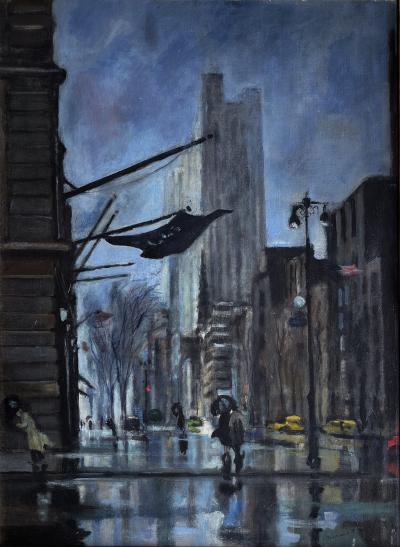
With his American wife, Lilyan White Kent (herself an artist and former wife of a Hollywood producer), Lamotte traveled in some of the most exclusive circles of New York, Palm Beach and Hollywood. His growing international reputation was noted in a 1948 article in Time magazine, “Lamotte’s paintings were as bright and cheerful as summer chinz; others seemed like twilit windows looking out on the rain-swept streets, the darkening alleys, the lonely deserted shops that caught his eye.”
Lamotte traveled extensively and carefully recorded his observances in sketches and photographs, which provided the bases for his canvases. His mastery of light and sensitivity to subtle gradations of tone create indelible impressions of a particular time and place. The artist’s versatility and personal vision earned him impressive recognition from France to Japan. Representation at galleries in New York, Los Angeles, Palm Beach, Paris and Tokyo exposed his work to a varied audience, and resulted in sales to both public and private collections. An artist whose magnetism captivated his generation, Lamotte reveals in his fluid sketches a whimsical, witty approach. His paintings are infused with his own charm and good humor.
At eighteen, Lamotte passed the first of three compulsory admittance tests to the École des Beaux-Arts. In 1935, after six years of study in Paris, he moved to New York City and within one year had secured his first solo exhibition at the esteemed Wildenstein Gallery. Though he spent most of his artistic life in the United States, and was naturalized in 1951, Paris-born Bernard Lamotte always remained thoroughly French. His appearance, accent, and bon vivant approach to life connected him emotionally to his native city; with his brush he captured the mood and spirit of the City of Light in an evocative, personal style. The artist continually returned to Paris for his preferred subject matter, distilling with his brush the fleeting moments of every day life in the quartiers, parks, and cafés of his beloved city. His studio above La Grenouille restaurant became a magnet for other expatriate French artists, writers and actors.
With his American wife, Lilyan White Kent (herself an artist and former wife of a Hollywood producer), Lamotte traveled in some of the most exclusive circles of New York, Palm Beach and Hollywood. His growing international reputation was noted in a 1948 article in Time magazine, “Lamotte’s paintings were as bright and cheerful as summer chinz; others seemed like twilit windows looking out on the rain-swept streets, the darkening alleys, the lonely deserted shops that caught his eye.”
Lamotte traveled extensively and carefully recorded his observances in sketches and photographs, which provided the bases for his canvases. His mastery of light and sensitivity to subtle gradations of tone create indelible impressions of a particular time and place. The artist’s versatility and personal vision earned him impressive recognition from France to Japan. Representation at galleries in New York, Los Angeles, Palm Beach, Paris and Tokyo exposed his work to a varied audience, and resulted in sales to both public and private collections. An artist whose magnetism captivated his generation, Lamotte reveals in his fluid sketches a whimsical, witty approach. His paintings are infused with his own charm and good humor.
Bernard Lamotte
New York City Rainy Night Street Scene in Moody Blue
H 29 in W 21 in
$ 16,000
Access Trade Price

 Loading...
