










Gilbert Charles Stuart
American, 1755 - 1828
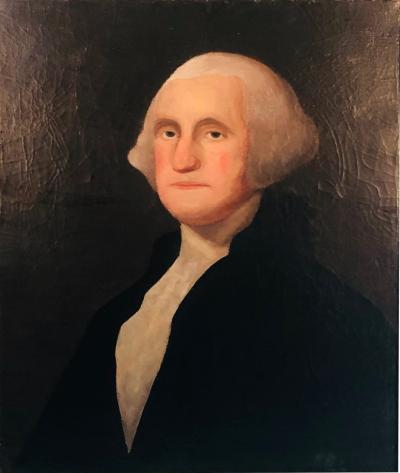
Nearly two hundred years after his death, the work of Gilbert Stuart remains central to American visual iconography. Since 1869, in varying design configurations, Stuart’s rendering of the face of President George Washington (the version known as the Athenaeum portrait) has occupied pride of place on the one dollar bill, an image so familiar that it barely registers. This is particularly ironic, in that the quality of Stuart’s art that garnered him the highest praise was his ability to paint the soul of his sitters, to capture on canvas the fine nuances of character that animated his images and enabled them to transcend the effect of mere mechanical likeness.
Gilbert Charles Stuart was born in Kingston, Rhode Island, to a Scottish immigrant snuff miller and merchant. Raised in nearby Newport, Stuart showed a precocious talent for drawing, first instructed in the art by an African slave, After a short period of study in Scotland, Stuart returned to Newport in 1773 and began to paint portraits. Political uncertainty in the years building up to the war for independence had a chilling effect on the local portrait trade, and Stuart soon decided to return to England. He sailed for London in September 1775, a few months after fighting had begun in Lexington and Concord, Massachusetts. While the Stuart family in America was Loyalist and spent the revolutionary war years in Nova Scotia, young Gilbert, in England, appears to have either been completely apolitical or mildly sympathetic to the colonial cause.
In England, Stuart sought out his highly successful countryman, Benjamin West, and joined the circle of young Americans who gathered at West’s studio for instruction and support. Stuart’s natural talent was refined by his time in West’s studio (where he acted as West’s assistant), and by his exposure to the sophistication of London style. Around 1782, he ventured out on his own and established a portrait practice. From the beginning, Stuart attracted positive attention both from critics and from influential patrons.
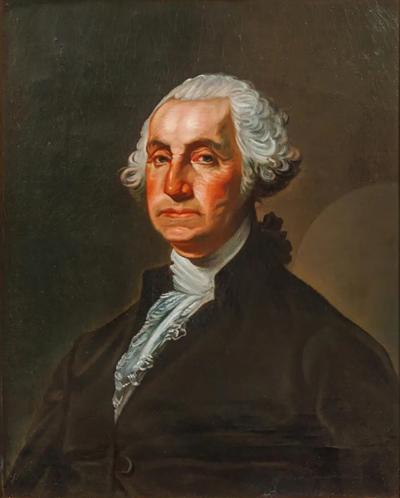
After eighteen years spent in England and Ireland, Stuart returned to America with a plan: to ultimately paint the definitive portrait of President George Washington. He went first to New York, where his sitters comprised a glittering array of the cream of New York society, including members of the Bayard, Livingston, and Jay families. In 1794, Stuart moved on to Philadelphia, the temporary capital of the nation from 1790 to 1800. With him he carried a letter of introduction to Washington from John Jay. Stuart’s mission in Philadelphia was resoundingly successful. George Washington sat for Stuart on two separate occasions, first in 1794 for the so-called Vaughn portrait, and again in 1796 for the Atheneaum portrait. These sittings resulted in a multitude of commissions for copies from Stuart’s own hand of his Washington portraits.
Stuart moved from Philadelphia to Washington, D.C., in 1803, following his political clientele to the new national capital. Stuart began his residence in Washington with a flurry of painting, but found himself hobbled by repeated bouts of malaria, a common summer hazard in the swampy city. One of his Washington sitters, Senator Jonathan Mason of Masachusetts, urged Stuart to relocate to Boston and assume the mantle, vacant since Copley’s expatriation, of portraitist to the Boston elite. In 1805, Stuart followed Mason’s advice and moved to Boston.
When Stuart established himself in Boston he was the reigning monarch of American portraiture. Stuart had painted all five of America’s presidents as well as a who’s who of American society. Stuart’s improvident habits, however, remained a constant throughout his life, and when he died, his family was left in distressed financial circumstances. A group of Boston citizens purchased the unfinished portraits of President and Mrs. Washington from the artist’s studio and donated them to the Boston Athenaeum, which had just instituted an art gallery in 1827.
Source: Hirschl and Adler
Gilbert Charles Stuart was born in Kingston, Rhode Island, to a Scottish immigrant snuff miller and merchant. Raised in nearby Newport, Stuart showed a precocious talent for drawing, first instructed in the art by an African slave, After a short period of study in Scotland, Stuart returned to Newport in 1773 and began to paint portraits. Political uncertainty in the years building up to the war for independence had a chilling effect on the local portrait trade, and Stuart soon decided to return to England. He sailed for London in September 1775, a few months after fighting had begun in Lexington and Concord, Massachusetts. While the Stuart family in America was Loyalist and spent the revolutionary war years in Nova Scotia, young Gilbert, in England, appears to have either been completely apolitical or mildly sympathetic to the colonial cause.
In England, Stuart sought out his highly successful countryman, Benjamin West, and joined the circle of young Americans who gathered at West’s studio for instruction and support. Stuart’s natural talent was refined by his time in West’s studio (where he acted as West’s assistant), and by his exposure to the sophistication of London style. Around 1782, he ventured out on his own and established a portrait practice. From the beginning, Stuart attracted positive attention both from critics and from influential patrons.
After eighteen years spent in England and Ireland, Stuart returned to America with a plan: to ultimately paint the definitive portrait of President George Washington. He went first to New York, where his sitters comprised a glittering array of the cream of New York society, including members of the Bayard, Livingston, and Jay families. In 1794, Stuart moved on to Philadelphia, the temporary capital of the nation from 1790 to 1800. With him he carried a letter of introduction to Washington from John Jay. Stuart’s mission in Philadelphia was resoundingly successful. George Washington sat for Stuart on two separate occasions, first in 1794 for the so-called Vaughn portrait, and again in 1796 for the Atheneaum portrait. These sittings resulted in a multitude of commissions for copies from Stuart’s own hand of his Washington portraits.
Stuart moved from Philadelphia to Washington, D.C., in 1803, following his political clientele to the new national capital. Stuart began his residence in Washington with a flurry of painting, but found himself hobbled by repeated bouts of malaria, a common summer hazard in the swampy city. One of his Washington sitters, Senator Jonathan Mason of Masachusetts, urged Stuart to relocate to Boston and assume the mantle, vacant since Copley’s expatriation, of portraitist to the Boston elite. In 1805, Stuart followed Mason’s advice and moved to Boston.
When Stuart established himself in Boston he was the reigning monarch of American portraiture. Stuart had painted all five of America’s presidents as well as a who’s who of American society. Stuart’s improvident habits, however, remained a constant throughout his life, and when he died, his family was left in distressed financial circumstances. A group of Boston citizens purchased the unfinished portraits of President and Mrs. Washington from the artist’s studio and donated them to the Boston Athenaeum, which had just instituted an art gallery in 1827.
Source: Hirschl and Adler


 Loading...
