








Ilya Bolotowsky
Russian, 1907 - 1981
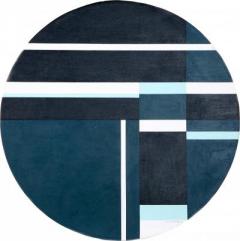
Ilya Bolotowsky (July 1, 1907 – November 22, 1981) was a pioneering Russian-American painter known for his abstract styles and geometric compositions, primarily based in New York City. His artistic journey was marked by a quest for philosophical order through visual expression, embracing influences from cubism and geometric abstraction, particularly the works of Dutch painter Piet Mondrian.
Born into a Jewish family in St. Petersburg, Russia, Bolotowsky's early life included time in Baku and Constantinople before he immigrated to the United States in 1923. Settling in New York City, he studied at the National Academy of Design and became part of "The Ten Whitney Dissenters," a group of artists that included notable figures like Louis Schanker and Mark Rothko. This collective sought to challenge the conventions of the Academy and held independent exhibitions that showcased their innovative approaches to art.
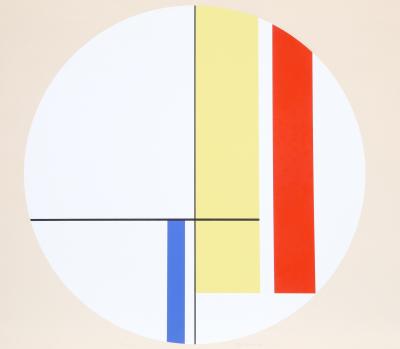
Influenced deeply by Piet Mondrian and the principles of the De Stijl movement, Bolotowsky adopted a distinctive style characterized by horizontal and vertical geometric patterns, utilizing a palette of primary colors and neutrals to express his vision of ideal order in visual arts. In 1936, he co-founded American Abstract Artists, a cooperative dedicated to promoting the interests of abstract painters and fostering greater public understanding of abstract art.
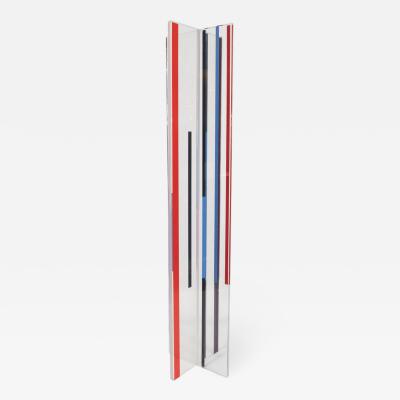
One of Bolotowsky's notable early achievements was his mural for the Williamsburg Housing Project in Brooklyn, completed in 1936. This work was among the first abstract murals created under the Federal Art Project. As his career progressed into the 1960s, Bolotowsky began experimenting with three-dimensional forms, typically vertical and straight-sided, further expanding his artistic repertoire.
In 1974, Bolotowsky held his first solo museum exhibition at the Guggenheim Museum in New York City, which later traveled to the National Collection of Fine Arts. His work has also been featured at the Anita Shapolsky Gallery in New York.
Beyond his painting career, Bolotowsky was a dedicated educator. He taught at Black Mountain College from 1946 to 1948, influencing artists such as Kenneth Noland and Ruth Asawa. His teaching extended to several institutions, including the University of Wyoming, Brooklyn College, and the University of New Mexico.
Bolotowsky's legacy continues to resonate in the art world, with his works achieving remarkable recognition, including a painting that was purchased at a North Carolina Goodwill store for $9.99 and later auctioned at Sotheby's for $34,375 in 2012. His commitment to abstract art and education left a lasting impact on future generations of artists.
Born into a Jewish family in St. Petersburg, Russia, Bolotowsky's early life included time in Baku and Constantinople before he immigrated to the United States in 1923. Settling in New York City, he studied at the National Academy of Design and became part of "The Ten Whitney Dissenters," a group of artists that included notable figures like Louis Schanker and Mark Rothko. This collective sought to challenge the conventions of the Academy and held independent exhibitions that showcased their innovative approaches to art.
Influenced deeply by Piet Mondrian and the principles of the De Stijl movement, Bolotowsky adopted a distinctive style characterized by horizontal and vertical geometric patterns, utilizing a palette of primary colors and neutrals to express his vision of ideal order in visual arts. In 1936, he co-founded American Abstract Artists, a cooperative dedicated to promoting the interests of abstract painters and fostering greater public understanding of abstract art.
One of Bolotowsky's notable early achievements was his mural for the Williamsburg Housing Project in Brooklyn, completed in 1936. This work was among the first abstract murals created under the Federal Art Project. As his career progressed into the 1960s, Bolotowsky began experimenting with three-dimensional forms, typically vertical and straight-sided, further expanding his artistic repertoire.
In 1974, Bolotowsky held his first solo museum exhibition at the Guggenheim Museum in New York City, which later traveled to the National Collection of Fine Arts. His work has also been featured at the Anita Shapolsky Gallery in New York.
Beyond his painting career, Bolotowsky was a dedicated educator. He taught at Black Mountain College from 1946 to 1948, influencing artists such as Kenneth Noland and Ruth Asawa. His teaching extended to several institutions, including the University of Wyoming, Brooklyn College, and the University of New Mexico.
Bolotowsky's legacy continues to resonate in the art world, with his works achieving remarkable recognition, including a painting that was purchased at a North Carolina Goodwill store for $9.99 and later auctioned at Sotheby's for $34,375 in 2012. His commitment to abstract art and education left a lasting impact on future generations of artists.

Sold
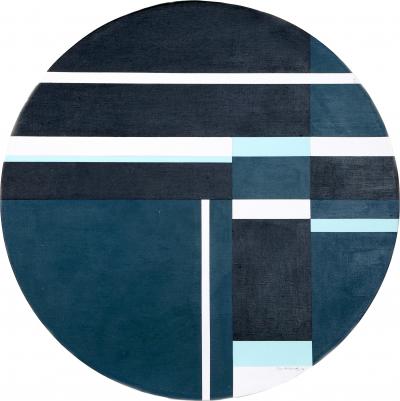
Ilya Bolotowsky
Midcentury Modernist Lucite Sculpture by Ilya Bolotowsky, "Plastic Column"
H 30 in W 7 in D 7 in

 Loading...
