













James Montgomery Flagg
American, 1877 - 1960
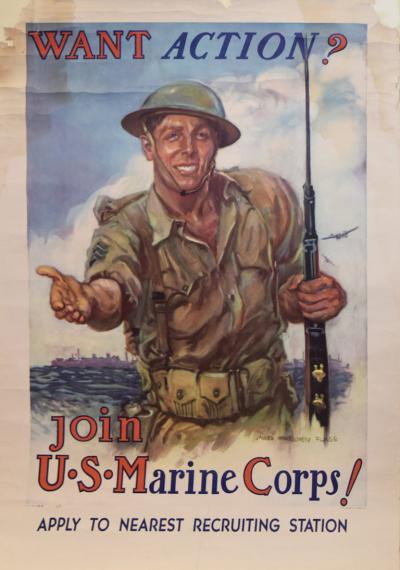
Famed illustrator James Montgomery Flagg created one of the most iconic images in American culture: the World War I recruitment poster of Uncle Sam proclaiming "I Want You." Modeled on his own self-portrait, the poster was one of forty-six war-related posters he produced between 1917 and 1919.
Born in Pelham Manor, New York, Flagg showed an early gift for illustrating and became, by the age of fifteen, a contributing artist to national publications such as Life magazine. He studied at the Art Students League in New York City from 1894 to 1898 and became active in the Society of Illustrators and the Lotus Club. He left for London and continued his education at the Herkomer School in Hertfordshire and also visited Paris.
Upon his return to America, Flagg ranked among the foremost illustrators of the day, producing comic strips and illustrating books, magazines, and advertisements. His work appeared in such noted periodicals as Collier's, McClure's, Cosmopolitan, Redbook, Leslie's Illustrated Weekly, Saturday Evening Post, Hearst's International and many others. In addition to his commercial success in graphic art, he was also a noted portrait painter and exhibited his work at the New York Watercolour Club, the National Academy of Design in New York, and the Paris Salon of 1900.
Though he is most recognized for illustration and caricature, Flagg was also proficient and worked in a variety of media and genres, including pure landscape. Evident in this watercolor landscape, Folly Beach, S.C., is Flagg's solid and unwavering technique. The lush coastal foliage in the view highlights his skill in rendering form with only the most minimal suggestion of details, producing a dense, richly-toned and varied landscape scene.
A bon vivant, Flagg lived a hedonistic existence, pursuing pleasure and surrounding himself with beautiful women, famous and sophisticated artists, writers, and entertainers. Though based in New York from 1904 on, he traveled frequently. Dedicated and prolific in his production, he sketched and worked consistently and enjoyed popular success. A detractor of modern art, Flagg died in relative obscurity in New York City, following years of failing eyesight and poor health. VAL
Biography courtesy of The Charleston Renaissance Gallery, www.antiquesandfineart.com/charleston
Born in Pelham Manor, New York, Flagg showed an early gift for illustrating and became, by the age of fifteen, a contributing artist to national publications such as Life magazine. He studied at the Art Students League in New York City from 1894 to 1898 and became active in the Society of Illustrators and the Lotus Club. He left for London and continued his education at the Herkomer School in Hertfordshire and also visited Paris.
Upon his return to America, Flagg ranked among the foremost illustrators of the day, producing comic strips and illustrating books, magazines, and advertisements. His work appeared in such noted periodicals as Collier's, McClure's, Cosmopolitan, Redbook, Leslie's Illustrated Weekly, Saturday Evening Post, Hearst's International and many others. In addition to his commercial success in graphic art, he was also a noted portrait painter and exhibited his work at the New York Watercolour Club, the National Academy of Design in New York, and the Paris Salon of 1900.
Though he is most recognized for illustration and caricature, Flagg was also proficient and worked in a variety of media and genres, including pure landscape. Evident in this watercolor landscape, Folly Beach, S.C., is Flagg's solid and unwavering technique. The lush coastal foliage in the view highlights his skill in rendering form with only the most minimal suggestion of details, producing a dense, richly-toned and varied landscape scene.
A bon vivant, Flagg lived a hedonistic existence, pursuing pleasure and surrounding himself with beautiful women, famous and sophisticated artists, writers, and entertainers. Though based in New York from 1904 on, he traveled frequently. Dedicated and prolific in his production, he sketched and worked consistently and enjoyed popular success. A detractor of modern art, Flagg died in relative obscurity in New York City, following years of failing eyesight and poor health. VAL
Biography courtesy of The Charleston Renaissance Gallery, www.antiquesandfineart.com/charleston


 Loading...
