

-
FINE ART
-
FURNITURE & LIGHTING
-
NEW + CUSTOM
- FEATURED BESPOKE MAKERS
- Stephen Antonson
- Pieter Adam
- Nader Gammas
- Eben Blaney
- Silvio Mondino Studio
- Neal Aronowitz
- Mark Brazier-Jones
- Proisy Studio
- Ovature Studios
- Cartwright New York
- Thomas Pheasant Studio
- Lorin Silverman
- Chapter & Verse
- Reda Amalou
- KGBL
- AL Design Aymeric Lefort
- Atelier Purcell
- Pfeifer Studio
- Susan Fanfa Design
-
DECORATIVE ARTS
- JEWELRY
-
INTERIORS
- FEATURED PROJECTS
- East Shore, Seattle by Kylee Shintaffer Design
- Apartment in Claudio Coello, Madrid by L.A. Studio Interiorismo
- The Apthorp by 2Michaels
- Houston Mid-Century by Jamie Bush + Co.
- Sag Harbor by David Scott
- Park Avenue Aerie by William McIntosh Design
- Sculptural Modern by Kendell Wilkinson Design
- Noho Loft by Frampton Co
- Greenwich, CT by Mark Cunningham Inc
- West End Avenue by Mendelson Group
- VIEW ALL INTERIOR DESIGNERS
- INTERIOR DESIGN BOOKS YOU NEED TO KNOW
- Distinctly American: Houses and Interiors by Hendricks Churchill and A Mood, A Thought, A Feeling: Interiors by Young Huh
- Robert Stilin: New Work, The Refined Home: Sheldon Harte and Inside Palm Springs
- Torrey: Private Spaces: Great American Design and Marshall Watson’s Defining Elegance
- Ashe Leandro: Architecture + Interiors, David Kleinberg: Interiors, and The Living Room from The Design Leadership Network
- Cullman & Kravis: Interiors, Nicole Hollis: Artistry of Home, and Michael S. Smith, Classic by Design
- New books by Alyssa Kapito, Rees Roberts + Partners, Gil Schafer, and Bunny Williams: Life in the Garden
- Peter Pennoyer Architects: City | Country and Jed Johnson: Opulent Restraint
- An Adventurous Life: Global Interiors by Tom Stringer
- VIEW ALL INTERIOR DESIGN BOOKS
-
MAGAZINE
- FEATURED ARTICLES
- Northern Lights: Lighting the Scandinavian Way
- Milo Baughman: The Father of California Modern
- A Chandelier of Rare Provenance
- The Evergreen Allure of Gustavian Style
- Every Picture Tells a Story: Fine Art Photography
- Vive La France: Mid-Century French Design
- The Timeless Elegance of Barovier & Toso
- Paavo Tynell: The Art of Radical Simplicity
- The Magic of Mid-Century American Design
- Max Ingrand: The Power of Light and Control
- The Maverick Genius of Philip & Kelvin LaVerne
- 10 Pioneers of Modern Scandinavian Design
- The Untamed Genius of Paul Evans
- Pablo Picasso’s Enduring Legacy
- Karl Springer: Maximalist Minimalism
- All Articles
Period
Location
Size
- Clear All
John Sennhauser
American, 1907 - 1978
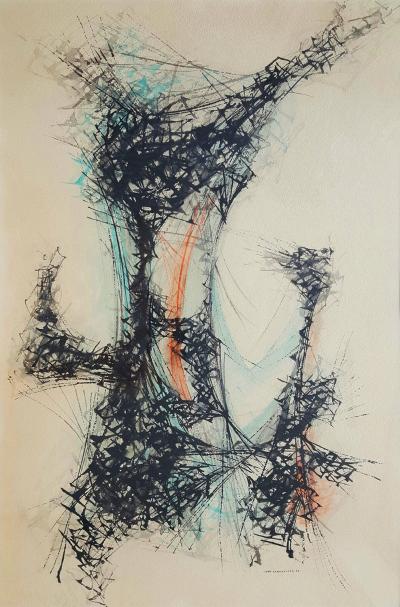
John Sennhauser emerged as an abstract painter in the late 1930s, becoming part of the influential circle around Hilla Rebay, director of the Museum of Non-Objective Painting (Solomon R. Guggenheim Foundation). Born in Switzerland and raised in Italy, he studied at the Royal Academy in Venice from 1926 to 1927 before relocating to the United States in 1928, where he worked as an architectural draftsman in New York.
Sennhauser honed his understanding of abstract art while studying at Cooper Union from 1930 to 1933. To support himself, he painted murals on commission and taught at the Leonardo da Vinci Art School and the Contemporary School of Art. It wasn't until the late 1930s that he began creating the non-objective works for which he is well-known.
In 1943, Sennhauser joined the Museum of Non-Objective Painting as a lecturer and preparator, where he was influenced by Kandinsky's style and the mysticism of non-objective art. However, he left the museum two years later due to disagreements with Rebay’s philosophies. He was introduced to the Abstract American Artists group by fellow artist Jean Xceron, participating in annual exhibitions until the late 1970s. Sennhauser served as the group's secretary and treasurer from 1949 to 1952. His work continued to evolve, incorporating a bright palette, expansive compositions, and later, more figurative themes influenced by Abstract Expressionism.
Sennhauser honed his understanding of abstract art while studying at Cooper Union from 1930 to 1933. To support himself, he painted murals on commission and taught at the Leonardo da Vinci Art School and the Contemporary School of Art. It wasn't until the late 1930s that he began creating the non-objective works for which he is well-known.
In 1943, Sennhauser joined the Museum of Non-Objective Painting as a lecturer and preparator, where he was influenced by Kandinsky's style and the mysticism of non-objective art. However, he left the museum two years later due to disagreements with Rebay’s philosophies. He was introduced to the Abstract American Artists group by fellow artist Jean Xceron, participating in annual exhibitions until the late 1970s. Sennhauser served as the group's secretary and treasurer from 1949 to 1952. His work continued to evolve, incorporating a bright palette, expansive compositions, and later, more figurative themes influenced by Abstract Expressionism.
John Sennhauser
Large 1945 John Sennhouser Abstract Oil Painting On Canvas, Framed and Signed
H 39 in W 30 in D 1 in
$ 12,000
Loading...