






Peter Driben
American
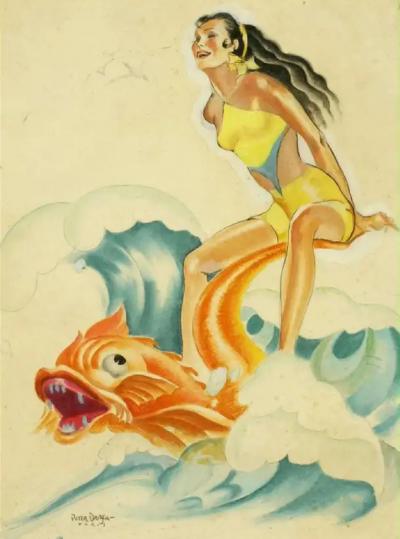
Peter Driben (October 22, 1903 - September, 1968) was a prolific American pin-up artist, known for his extensive body of work during the 1940s and 1950s. While artists like Alberto Vargas and Gil Elvgren also made significant contributions to the genre, Driben's output was unparalleled.
Originally from Boston, Driben honed his skills at the Vesper George Art School before moving to Paris around 1925. During his time at the Sorbonne in 1925, he began creating popular pen-and-ink drawings of Parisian showgirls. His first known pin-up appeared on the cover of La Paree Stories in March 1934. By 1935, he was producing covers for a variety of magazines, including Snappy, Pep, New York Nights, French Night Life, and Caprice.
Driben's career expanded into advertising after he relocated to New York in late 1936. He created innovative three-dimensional die-cut window displays for companies like Philco Radios, Cannon Bath Towels, and the Weber Baking Company. He also produced original posters and publicity artwork for the iconic film "The Maltese Falcon." Driben's close relationship with publisher Robert Harrison led to a prolific period of creating covers for Harrison's magazines, including Beauty Parade, Flirt, Whisper, Titter, Wink, Eyeful, Giggles, and Joker. At times, he had up to seven covers published in a single month, solidifying his status as a leading pin-up and glamour artist in America.
In 1944, Driben took on the role of art director for the New York Sun, a position he held until 1946. His work during this time, including a painting of American soldiers raising the flag at Iwo Jima, garnered significant media attention.
After retiring in 1956, Driben and his wife Louise Kirby moved to Miami Beach. There, he focused on painting portraits, including one of Dwight D. Eisenhower, and other fine art pieces. Louise organized successful exhibitions of his work. Driben passed away in 1968, followed by Louise in 1984.
Originally from Boston, Driben honed his skills at the Vesper George Art School before moving to Paris around 1925. During his time at the Sorbonne in 1925, he began creating popular pen-and-ink drawings of Parisian showgirls. His first known pin-up appeared on the cover of La Paree Stories in March 1934. By 1935, he was producing covers for a variety of magazines, including Snappy, Pep, New York Nights, French Night Life, and Caprice.
Driben's career expanded into advertising after he relocated to New York in late 1936. He created innovative three-dimensional die-cut window displays for companies like Philco Radios, Cannon Bath Towels, and the Weber Baking Company. He also produced original posters and publicity artwork for the iconic film "The Maltese Falcon." Driben's close relationship with publisher Robert Harrison led to a prolific period of creating covers for Harrison's magazines, including Beauty Parade, Flirt, Whisper, Titter, Wink, Eyeful, Giggles, and Joker. At times, he had up to seven covers published in a single month, solidifying his status as a leading pin-up and glamour artist in America.
In 1944, Driben took on the role of art director for the New York Sun, a position he held until 1946. His work during this time, including a painting of American soldiers raising the flag at Iwo Jima, garnered significant media attention.
After retiring in 1956, Driben and his wife Louise Kirby moved to Miami Beach. There, he focused on painting portraits, including one of Dwight D. Eisenhower, and other fine art pieces. Louise organized successful exhibitions of his work. Driben passed away in 1968, followed by Louise in 1984.
 Loading...
