









Offered by:
H&S Fine Art and Antiques
by appointment only, based in San Francisco, Bay Area
San Francisco, CA , United States
Call Seller
Showrooms
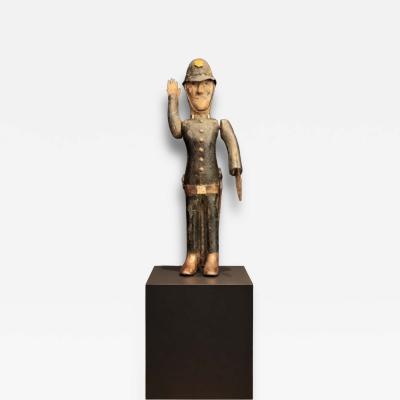
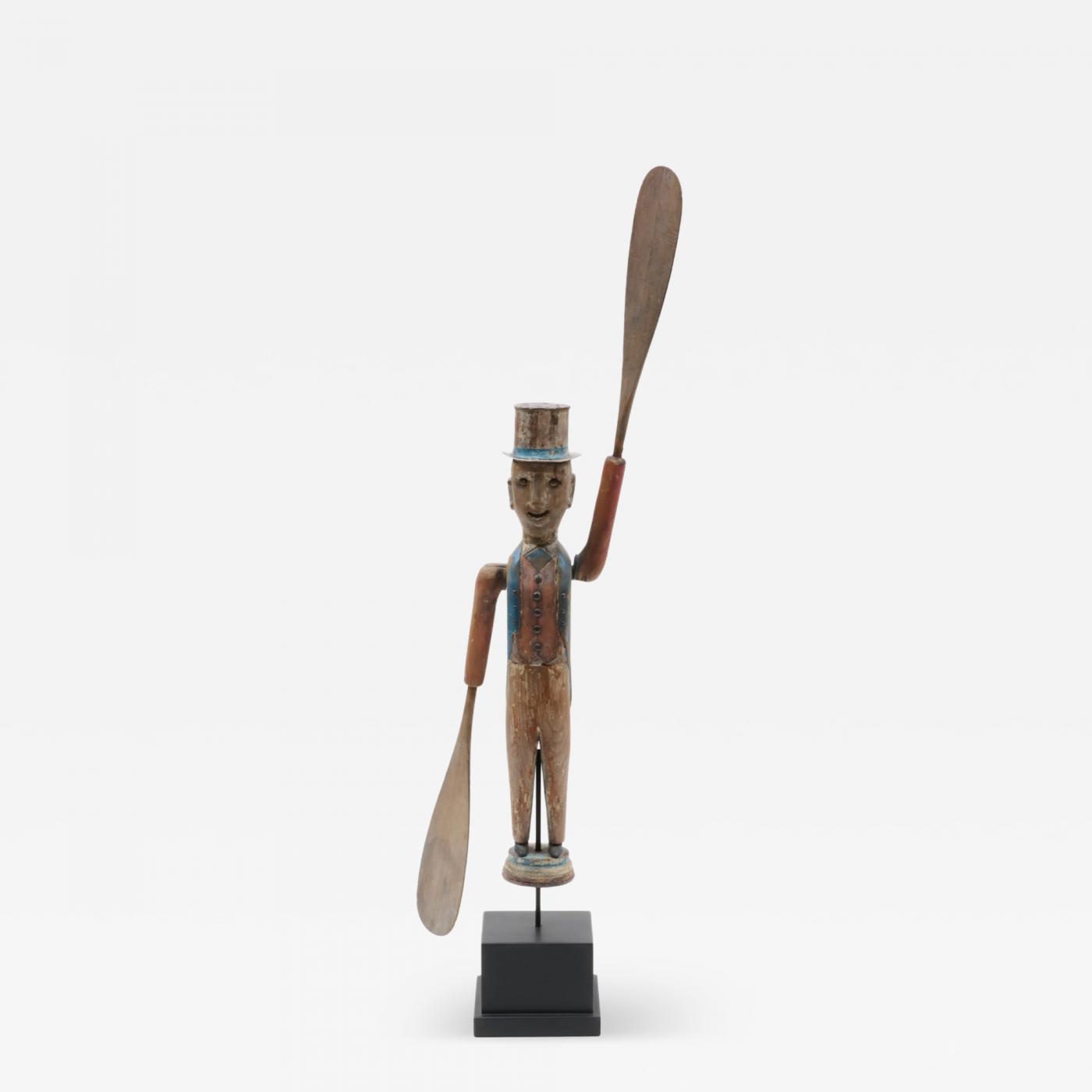
Uncle Sam Whirligig American, probably New England or New York State. 1876-1890
-
Description
Uncle Sam Whirligig American, probably New England or New York State Late 19th century, circa 1876–1890
Carved and painted wood with metal eyes, applied metal buttons, metal fittings, and articulated wooden paddle arms. Provenance:
Exhibited, Wilton Historical Society, Wilton, Connecticut, 1994. Collection of Dr. Lawrence Gordon, New York. Private Collection.
Description:
Created during the final quarter of the nineteenth century, this animated figure may reflect the extraordinary wave of patriotic expression surrounding the American Centennial of 1876. Uncle Sam, rendered in red, white, and blue and activated by the wind, would have served as both a lively outdoor ornament and a popular emblem of national identity. Although no inscription definitively associates the whirligig with the Centennial, its subject, palette, construction, and period make such a connection plausible.
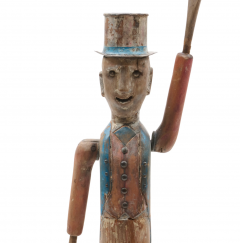
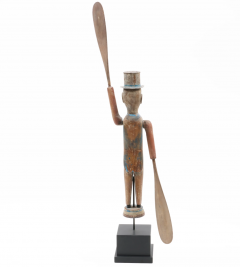
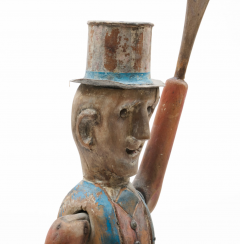
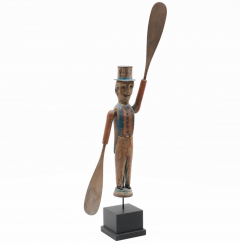
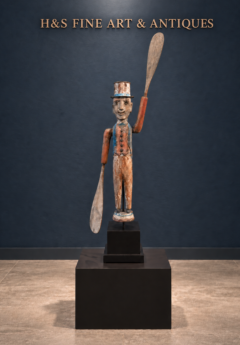
This expressive late nineteenth-century American whirligig depicts Uncle Sam in his familiar patriotic costume of red, white, and blue. The figure wears a tall striped top hat with a blue band, a blue coat or vest, a reddish waistcoat or shirtfront ornamented with applied metal buttons, light-colored trousers, and dark shoes.
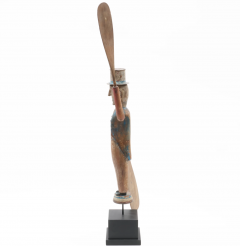
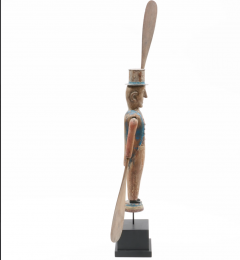
The unidentified maker carved Uncle Sam with a distinctly individual personality. His elongated face incorporates a prominent projecting nose, separately defined ears, an incised mouth, and applied metal eyes. These economical but highly effective details give the figure an engaging, almost theatrical expression. The facial carving was intended to be read clearly from a distance when the whirligig was mounted outdoors. His separately carved arms are attached to the shoulders by a simple metal pivot mechanism. Each arm terminates in an exceptionally long paddle-shaped blade. When exposed to moving air, the paddles would have caused the arms to revolve around the shoulders, transforming the stationary figure into an animated representation of the nation.
The present arrangement—with one arm raised and the other lowered—preserves this impression of movement even while the mechanism is at rest. The dramatic paddles, narrow upright body, tall hat, and strongly carved head give the sculpture an especially memorable silhouette.
Construction and Dating:
The whirligig is constructed from carved and shaped wooden elements joined with simple metal fittings. The body has a comparatively substantial, architectural character, while the shoulders incorporate recessed metal pivot plates or washers designed to accommodate the rotating arms. Applied metal eyes and buttons contribute texture and animation while emphasizing the homemade ingenuity of the construction.
Several characteristics support a late nineteenth-century date, probably circa 1876–1890: The comparatively heavy, hand-carved wooden construction
The individually carved and irregular facial features. The straightforward mechanical arrangement of the shoulder pivots. The deeply seated and oxidized metal fittings. The exceptionally long, simply shaped wooden paddles. The muted early red, white, blue, and black palette. The extensive surface erosion and wear associated with prolonged outdoor use. The accumulated compression and wear surrounding the moving joints. The softened edges and exposed wood beneath successive areas of aged paint.
The visible wear does not appear merely decorative. The erosion of the wood, oxidation around the metal elements, loss of paint from projecting surfaces, and wear concentrated around the mechanical joints are consistent with the history of a functional outdoor object. Uncle Sam’s patriotic costume was already firmly established in American visual culture during the second half of the nineteenth century. His striped top hat, lean figure, and red, white, and blue clothing were widely recognized by the 1870s. Consequently, the subject does not require the later date sometimes assigned to Uncle Sam imagery following James Montgomery Flagg’s famous First World War recruiting poster.
The American Whirligig Tradition:
Whirligigs occupy a particularly imaginative place within American folk art. Combining sculpture, mechanics, humor, and the natural force of the wind, they were generally made by unidentified rural craftsmen, carpenters, farmers, sailors, or other mechanically gifted individuals.
The simplest examples consisted of painted wooden propellers. More ambitious whirligigs took the form of human figures, animals, soldiers, tradesmen, policemen, sailors, farmers, and patriotic characters. Their arms might churn butter, saw wood, hammer metal, row a boat, wave paddles, or perform another repetitive action when activated by the wind. Although sometimes classified historically as toys or amusements, substantial examples such as the present Uncle Sam were functional pieces of outdoor sculpture. They were commonly mounted on fences, barns, workshops, outbuildings, or poles, where they could be seen in motion against the sky. The movement was essential to the meaning of the object. Wind animated the otherwise rigid figure, turning a carved wooden character into a performance. The resulting object occupied a fascinating position between sculpture and machine—at once practical, humorous, decorative, and expressive. Because whirligigs were ordinarily exposed to sunlight, rain, wind, and changing temperatures, early examples frequently deteriorated or were discarded after their mechanisms ceased to operate. Survival with the carved body, articulated arms, paddles, metal details, and substantial evidence of early paint is therefore significant.
Surface and Condition:
The whirligig retains a heavily weathered red, white, blue, brown, and black painted surface with extensive wear, fading, flaking, and areas of exposed wood. The wooden elements exhibit abrasions, age-related drying, surface erosion, small losses, and softened edges consistent with outdoor exposure.
The metal eyes, buttons, shoulder pivots, and related fittings display oxidation and accumulated wear. The shoulder joints show evidence of the repeated mechanical movement for which the figure was constructed.
The surface may include areas of historic repainting or strengthening, as is frequently encountered on outdoor folk sculpture. Any such earlier intervention forms part of the object’s working history and should be distinguished from recent cosmetic restoration.
Its weathered appearance should not be treated as a defect requiring refinishing. The surface is an essential part of the whirligig’s historical and aesthetic character. It documents exposure, movement, handling, and the gradual transformation of an outdoor mechanical object into a work of American folk sculpture. No attempt should be made to repaint, varnish, clean aggressively, or return the surface to a newly made appearance. Any necessary stabilization should be undertaken only by a conservator experienced with historic painted wood and American folk art.
Exhibition History:
Wilton Historical Society, Wilton, Connecticut
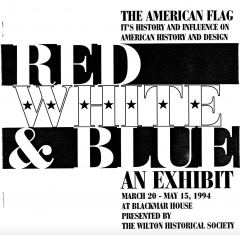
Red, White and Blue: An Exhibit March 20–May 15, 1994
The whirligig was included in Red, White and Blue: An Exhibit, presented at the Wilton Connecticut Historical Society’s recently acquired Blackmar House in 1994. Contemporary reporting describes an exhibition of nearly 150 objects loaned by twenty-two collectors and members of the Society, covering the period from the 1790s through the 1990s. The exhibition brought together early American flags, folk art, ceramics, textiles, Chinese export porcelain, historic Liverpool jugs, Civil War material, patriotic clothing, holiday ornaments, and works by contemporary folk artists. Within this broad examination of American patriotic material culture, the Uncle Sam whirligig represented the intersection of national symbolism, vernacular sculpture, and wind-driven mechanical art.
The inclusion of this Uncle Sam in the Wilton Historical Society’s 1994 exhibition is an important part of its documented history. Presented in an exhibition devoted to red, white, and blue material culture, the whirligig was recognized as an object connecting American patriotism, vernacular sculpture, and national symbolism. The exhibition establishes that the piece was known and appreciated within the American folk-art community more than thirty years ago. It contributes valuable historical context and distinguishes the whirligig from comparable objects that have no documented exhibition history.
Curator’s Note:
This Uncle Sam possesses many of the qualities most admired in American folk sculpture: a recognizable and culturally important subject, strongly individual carving, inventive mechanical construction, bold color, animated form, and a surface that records a genuine history of outdoor use.
Particularly compelling are the applied metal eyes, vertical row of buttons, striped top hat, eccentric facial expression, and exceptionally long paddle arms. These features give the figure an unforgettable silhouette and transform a familiar national emblem into a highly personal work of vernacular art. The extensive weathering is integral to the object. Its worn paint, exposed wood, oxidized fittings, and softened contours communicate the passage of time and the whirligig’s former existence as an active outdoor figure. That surface provides a quality that cannot be recreated through restoration or artificial aging.
Its documented inclusion in the Wilton Historical Society’s 1994 exhibition and its subsequent provenance from the collection of Dr. Lawrence Gordon add meaningful historical depth. Together, the patriotic subject, late nineteenth-century construction, sculptural presence, mechanical ingenuity, early exhibition history, and evocative surface distinguish it as a notable example of American folk art.
H&S Fine Art & Antiques considers this Uncle Sam an unusually expressive piece of late nineteenth-century patriotic folk sculpture—an object in which American identity, humor, craftsmanship, and movement are brought together in a single compelling form. -
More Information
Origin: United States Period: 19th Century Materials: Carved Polychrome Wood and Sheet Metal Whirligig of Uncle Sam Condition: Good. Wear, fading, abrasions, otherwise in good condition. Creation Date: 1876-1890 Styles / Movements: Folk Art, Americana, Traditional Patterns: Handmade, Traditional Catalog References: Wilton Historical Society, Wilton, Connecticut Red, White and Blue: An Exhibit March 20–May 15, 1994. The whirligig was included in Red, White and Blue: An Exhibit, presented at the Wilton Connecticut Historical Society’s . Incollect Reference #: 882496 -
Dimensions
W. 7 in; H. 34 in; W. 17.78 cm; H. 86.36 cm;
Message from Seller:
H&S Fine Art and Antiques is a distinguished gallery based in the San Francisco Bay Area, specializing in American folk art, decorative and modern art, as well as Oriental antiquities. With a keen eye for craftsmanship, historical richness, and aesthetics, we offer a carefully curated collection for collectors and enthusiasts alike. By appointment only. Contact us at h.s.fineartandantiques@gmail.com for inquiries.
More Listings from H&S Fine Art and Antiques View all 71 listings
-
LARGE BLUE AND WHITE UNDERGLAZE PORCELAIN TEAPOT.
-
American Carved and Painted whirligig soldier.
-
American Military Officer Whirligig An Important Nineteenth-Century, c.1840-1870
-
A Watercolor, Pen and Ink Drawing of George Washington on Horseback
-
American Centennial Celebration Flag Stars Forming “1776–1876”
-
George “Angelo” Crowhurst (1795–1839) Attrib. Lady in a Blue Dress.
-
38 STAR ANTIQUE FLAG,COLORADO STATEHOOD, CIRCA 1876.
-
WASHINGTON, MARTHA HANDMADE BRUSSELS LACE RIDING VEIL
-
Henry Clay, American School, after John Neagle Circa 1845–1860.
-
Manner of Joseph Alexander Ames (1816–1872) Portrait of Abraham Lincoln
-
A Carved Gilded Wooden Eagle, possibly Maine, 19th century.
-
PRANCING HORSE ATTRIBUTED TO J. WHITTICKER, CIRCA 1860.
-
John Vivolo (American, 1886–1987) Two Production Bosses
-
Carved Polychrome Wood Whirligig of a Policeman circa 1880–1900.