














Offered by:
H&S Fine Art and Antiques
by appointment only, based in San Francisco, Bay Area
San Francisco, CA , United States
Call Seller
Showrooms
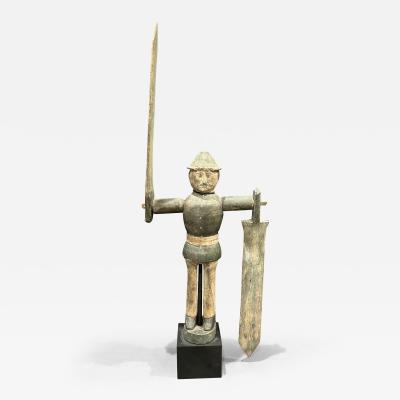
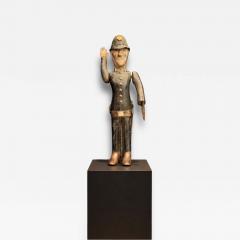
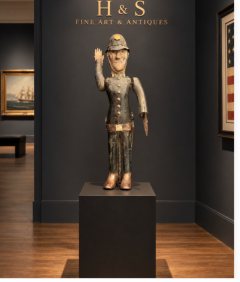
Carved Polychrome Wood Whirligig of a Policeman circa 1880–1900.
-
Description
Carved Polychrome Wood and Sheet-Metal Whirligig of a Policeman. American, probably circa 1880–1900
Carved and painted wood, sheet metal, metal fasteners and fittings
On a custom display stand
19 3/4 × 5 × 5 in. overall
Provenance: Betty & Joel Schatzberg American Folk Art, Riverside, Connecticut, 1995; Collection of Dr. Lawrence Gordon, New York
Estate of Dr. Lawrence Gordon, New York, Private Collection.
Exhibition Essay:
Standing erect in his dark uniform, one arm raised and the other extended, this wonderfully idiosyncratic policeman belongs to one of the most engaging traditions of American folk sculpture: the figural whirligig. At first encounter the figure appears almost comical—an elongated policeman with oversized feet, simplified hands and a gently smiling face. Closer examination, however, reveals an object of considerable sculptural sophistication and remarkable surviving surface. The maker transformed the recognizable visual vocabulary of the late nineteenth-century uniformed policeman into a piece of kinetic sculpture whose movement, weathering and personality are inseparable from its character. The figure measures just under twenty inches high and combines carved wood with sheet-metal elements and applied metal details. The body is conceived frontally and vertically, while the articulated arms provide the essential mechanical element of the whirligig. Originally exposed to moving air, the arms would rotate around their shoulder axis, bringing an otherwise rigid uniformed figure dramatically to life. This transformation—from stationary authority figure to animated folk sculpture—is part of the object's charm. The policeman, normally associated with discipline, order and controlled movement, becomes an endlessly gesticulating figure activated by the wind.
The Policeman and His Uniform. The uniform provides one of the most important clues to the object's probable date. The figure wears a dark, close-fitting tunic with a vertical succession of approximately six prominent metal buttons. A contrasting belt encircles the waist and terminates in a rectangular buckle at the front. Small light-colored devices appear at either side of the high collar. Most conspicuous is the dark rounded police helmet with its applied shield-shaped frontal badge. The helmet is especially significant. Its form belongs broadly to the family of late nineteenth-century police helmets influenced by the British custodian or "Bobby" helmet and adopted in various forms by American municipal police departments. Police uniforms were not nationally standardized, however, and helmet forms, badges, belts and collar insignia differed substantially between cities and periods. For that reason, the surviving details support a late nineteenth-century urban policeman interpretation much more securely than attribution to a particular department. The figure also carries what appears to be a sheathed sidearm or sword-like implement at the hip, with additional applied fittings around the belt. These details are unusually ambitious for a small folk whirligig. Rather than simply painting a generic man blue or black and calling him a policeman, the maker deliberately supplied the occupational attributes by which contemporary viewers would recognize him. The result places the object in the tradition of nineteenth-century American occupational portraiture.
The Face; The head is among the strongest aspects of the carving. Rather than being merely painted onto a featureless block, the face has been sculpturally modeled. A long projecting nose, recessed eye area, pronounced chin and subtly articulated mouth establish an unmistakable personality. The maker was not attempting academic anatomical realism. Instead, a handful of exaggerated features creates an immediately memorable individual. The tiny surviving traces of color around the eyes, cheeks and mouth are particularly valuable. They remind us that the face would originally have been considerably more animated, while its present weathered appearance records the object's age and outdoor existence. The result is precisely the quality prized in important American folk sculpture: individual character achieved through economy of means.
Surface, Paint and Texture.
Perhaps the most compelling feature of the policeman today is its surface. The dark coat possesses extensive, naturally developed craquelure, producing an almost reptilian network across the torso. Areas of abrasion expose successive layers of paint and, in places, the underlying wood. Similar wear occurs along the arms, trousers, helmet and extremities. The metal hands show oxidation and surface loss. The helmet has accumulated irregularity and wear along its rim. The face has lost substantial portions of its original painted complexion while retaining tantalizing fragments These conditions should not automatically be interpreted as defects.
The Whirligig in American Folk Art
Whirligigs occupy an unusual position between sculpture, toy, mechanical device and vernacular environmental art. Made largely by anonymous craftspeople, they converted wind into movement through paddles or arms attached to an axle. Human occupations were particularly effective subjects: soldiers marched, sailors rowed, farmers worked, and policemen waved or directed imaginary traffic. The genre therefore offered the folk artist something conventional sculpture could not—movement.
The policeman's rigid torso and animated arms create a deliberate contrast. The uniform represents civic authority and discipline; the whirling arms introduce humor and spectacle. Yet such objects should not be dismissed simply as toys. The best nineteenth-century whirligigs have long occupied an important position within the history of American folk sculpture, and policeman figures are represented in important institutional and historic collections.
Comparative Literature
Useful comparative references include:
Ida Ely Rubin, ed., The Guennol Collection, Vol. II, Metropolitan Museum of Art, 1982, American Folk Art section by Adele Earnest, including "Conductor and Policeman Whirligigs."
Herbert W. Hemphill Jr., ed., Folk Sculpture USA, exhibition catalogue, Brooklyn Museum / Los Angeles County Museum of Art, 1976. A nineteenth-century policeman whirligig from the Guennol Collection was included in the exhibition.
Roger Ricco and Frank Maresca, with Julia Weissman, American Primitive: Discoveries in Folk Sculpture, New York, 1988, no. 176, illustrating the New York policeman whirligig later sold at Sotheby's.
Provenance and the Gordon Collection: The provenance adds substantially to the object. It was acquired in 1995 from Betty & Joel Schatzberg American Folk Art, Riverside, Connecticut, placing the whirligig in the established folk-art trade more than thirty years ago. That is an important piece of documented ownership history and gives the object a firm pre-21st-century collecting history. It subsequently entered the collection of Dr. Lawrence Gordon, New York, where it remained until the dispersal of his estate.
Curator's Note:
Few figures were more immediately recognizable in the rapidly expanding American city of the late nineteenth century than the uniformed policeman. Here, an anonymous folk artist transformed that emblem of civic authority into something unexpectedly playful. The policeman stands rigidly upright, dressed in his dark buttoned tunic, helmet, belt and sidearm, yet his articulated arms were designed to surrender that dignity to the wind. With every gust, the officer would have come suddenly to life. The maker's economy is remarkable. A projecting nose, two small eyes and the faintest suggestion of a smile establish the face; metal buttons define the uniform; a helmet and badge establish occupation. Nothing is unnecessary. Time has subsequently become a second artist. Rain, sunlight, oxidation and handling have broken the once-smooth painted surface into an intricate network of craquelure. Pigment has receded from the face and extremities. Metal has oxidized. Wood emerges beneath worn paint. Yet these changes have not erased the original sculpture—they have deepened it. The policeman today therefore exists simultaneously as kinetic device, occupational portrait, folk sculpture and historical artifact. Its documented acquisition from Betty & Joel Schatzberg American Folk Art in 1995 and subsequent residence in the collection of Dr. Lawrence Gordon give the object an unusually satisfying modern provenance. For H&S, I think that combination is what makes this piece special. It isn't simply an old whirligig of a policeman. It is a wonderfully preserved piece of late nineteenth-century American vernacular sculpture whose carving, mechanics, occupational imagery, old surface and collecting history all reinforce one another. -
More Information
Origin: United States Period: 19th Century Materials: Carved Polychrome Wood and Sheet-Metal Condition: Good. expected wear, craquelure and scattered losses to the painted surface. otherwise in good overall condition Creation Date: 1880-1900 Styles / Movements: Folk Art, Americana, Traditional Patterns: Handmade, Traditional Incollect Reference #: 879735 -
Dimensions
W. 5 in; H. 19.75 in; D. 5 in; W. 12.7 cm; H. 50.17 cm; D. 12.7 cm;
Message from Seller:
H&S Fine Art and Antiques is a distinguished gallery based in the San Francisco Bay Area, specializing in American folk art, decorative and modern art, as well as Oriental antiquities. With a keen eye for craftsmanship, historical richness, and aesthetics, we offer a carefully curated collection for collectors and enthusiasts alike. By appointment only. Contact us at h.s.fineartandantiques@gmail.com for inquiries.
More Listings from H&S Fine Art and Antiques View all 70 listings
-
American Military Officer Whirligig An Important Nineteenth-Century American
-
Henry Clay, American School, after John Neagle Circa 1845–1860.
-
A Watercolor, Pen and Ink Drawing of George Washington on Horseback
-
PRANCING HORSE ATTRIBUTED TO J. WHITTICKER, CIRCA 1860.
-
A Carved Gilded Wooden Eagle, possibly Maine, 19th century.
-
George “Angelo” Crowhurst (1795–1839) Attrib. Lady in a Blue Dress.
-
Francis Wheatley, R.A. Industry and Idleness, 1786.
-
LARGE BLUE AND WHITE UNDERGLAZE PORCELAIN TEAPOT.
-
WASHINGTON, MARTHA HANDMADE BRUSSELS LACE RIDING VEIL

-
Manner of Joseph Alexander Ames (1816–1872) Portrait of Abraham Lincoln
-
A RARE THIRTEEN STAR AMERICAN PARADE FLAG,CIRCA 1875-1895.
-
38 STAR ANTIQUE FLAG,COLORADO STATEHOOD, CIRCA 1876.
-
American Centennial Celebration Flag Stars Forming “1776–1876”
-
American Carved and Painted whirligig soldier.