













Offered by:
Carlton Hobbs, LLC
PO Box 877
Tuxedo Park, NY 10987 , United States
Call Seller
212.423.9000
Showrooms
A SET OF FOUR RARE MARQUETRY AND PAINTED ARCHITECTURAL VIEWS OF ROME AND VENICE
-
Description
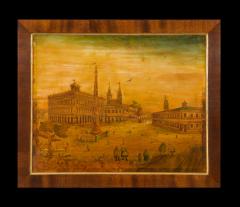
11020 A SET OF FOUR RARE MARQUETRY AND PAINTED ARCHITECTURAL VIEWS OF ROME AND VENICE, BY FRANZ RIENTZ German. Second Quarter of the Eighteenth Century. Measurements: Piazza san Giovanni in Laterano: Sight size: Height 17 /14” (43.8 cm); Width: 22” (55.5 cm). Piazza dei Sante Apostoli: Sight size: Height 17 /14” (43.8 cm); Width: […]
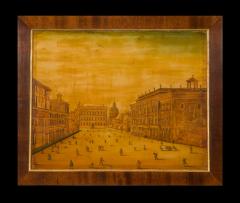
Of various inlaid woods with painted decoration. Two panels depict views in Rome; the Piazza san Giovanni in Laterano and the Piazza dei Sante Apostoli, two show views in Venice; the Piazza San Marco and an as yet unidentified location. Now in modern crossbanded mahogany frames.
Marks:
Panel depicting Piazza San Marco bears paper label to reverse:
Locus S. Marci venetus. De Plaets van S. Marrus de Venettiyan.
Franz Rienz. Tro (?)
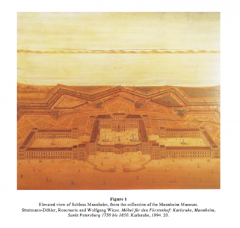
Two of these four extraordinary marquetry views are signed by Franz Rientz on the reverse. The combination of intricate marquetry with painted skies and water effects used by Rientz on the present panels appears to have been unique to his oeuvre. The only other known examples of this type of work, are an elevated view of Schloss Mannheim, and the group bearing the engraved mark of the Hohenzollern-Sigmaringen family .
The view of Schloss Mannheim, in the collection of Mannheim Museum (figure 1), is strongly attributed to Rientz. It shares with the present views its distinctively painted sky and it is peopled with the same characteristic tiny painted figures.
The Hohenzollern Group contained one panel also signed on the back by Franz Rientz. A set of six of these was formerly in the collection of Carlton Hobbs. Each depicted a view of a royal house in Bavaria, and they were confirmed to have come from the collection of Friedrich Wilhelm, Prince of Hohenzollern-Sigmaringen.
Apart from the painted skies and water effects, which are virtually identical in all the Rientz pieces, the panels also all share a further important feature of this artist’s intarsia work, which is his use of various woods to create the illusion of textures and surfaces, such as different types of stone on the ground and in the facades of the buildings in these views. For example, on the unidentified Venetian view in the present set, Rientz makes use of tight maple burrs to represent part of a cornice of the large portico on the left, and dark mahogany to indicate the underside of an overhang on the same. Cedar is employed to represent marble on the columns. When depicting water, he uses a veneer with a meandering grain that is enhanced with layers of opaque glazes. This technique demonstrates the creative and imaginative qualities of Rientz’s craftsmanship as opposed to the more usual reliance among marqueteurs upon the etching and staining of woods to achieve textural contrast.
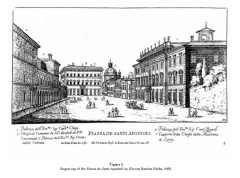
Three of the four scenes depicted in these remarkable marquetry panels are after known engravings; of the two views of Rome one is based on the Piazza de Santi Apostoli by Giovan Battista Falda in 1669 (figure 2) and the other is most closely related to a late-17th century painting of the Piazza san Giovanni in Laterano, attributed to the Studio of Gaspar van Wittel (figure 3). The view of Piazza San Marco in Venice appears to come from a 16th century engraving by Venetian artist Steffano Scolari (figure 4). The exact source of the second Venetian view has yet to be identified.
One of the Roman views was perhaps chosen for its concentration of significant Renaissance and Baroque palazzi; on the left is the Palazzo Colonna, however most prominently on the right is the Palazzo Chigi-Odelscalchi with its magnificent façade by Gian-Lorenzo Bernini, finished in 1665. At the far end of the square stands Palazzo Bonelli (today Palazzo Valentini), built in 1585 by Cardinal Michele Bonelli, nephew of Pope Pius V. The cupola of Santa Maria di Loreto can be seen to its right. At the beginning of the 18th century, Palazzo Bonelli was leased to numerous famous personages, including Francesco Maria Ruspoli (from 1705-1713), who hosted illustrious musicians of the day, particularly George Frideric Handel whom he employed as his House Composer.
The other Roman view shows a place in the city that is remarkably unchanged today, the southern transept façade of the Archbasilica of St. John Lateran, with its two medieval belltowers, dating from the 12th century, and the large loggia designed by Domenico Fontana in the late 16th century. On the left is the dominating Palazzo del Laterano, originally a major palace in ancient Rome and later adapted as a papal palace; it was the primary residence of the pope from 400 to 1400 AD. Today the Palazzo houses the Museo Storico Vaticano, which illustrates the history of the Papal States. Pictured in the far right center of the panel is the baptistery, which was founded by Pope Sixtus III in 440 and was the only baptistery in Rome for several generations. It’s octagonal structure served as the model for baptistries throughout Italy, such as those in Florence and Parma. In the foreground is the Lateran Obelisk, the tallest in Rome, which was brought from Egypt by Emperor Constantius II. It was discovered in the 14th and 15th centuries, but only restored fully during the reign of Sixtus V in 1588 on the site of the demolished tower of the Annibaldeschi, which formerly stood in the square. A similar view of the piazza, from a slightly different angle, can be seen in an early 19th century engraving by Luigi Rossini.
The known Venetian scene, although called La Piazzi di San Marco in Scolari’s engraving, actually depicts what is called the Piazzetta, a smaller adjoining plaza that connects to the lagoon. The Biblioteca stands on the left while the iconic Doge’s Palace occupies the right side of the picture. In the mid-ground, the Campanile stands behind the on the right, across from St. Marks Basilica on the left. The background of the Piazzetta is occupied by the Torre dell’Orologio. At the lagoon’s edge stand two large granite columns surmounted by sculptures of the two patron saints of Venice, Saint Theodore (the patron of the city before St. Mark), on the left side and the Lion of Venice on the right, while gondolas are driven past the piazzetta. -
More Information
Documentation: Signed Period: 19th Century Condition: Good. Styles / Movements: Old Master, Other Incollect Reference #: 721979 -
Dimensions
W. 22 in; H. 17.25 in; W. 55.88 cm; H. 43.82 cm;
Message from Seller:
Carlton Hobbs, LLC specializes in the acquisition, conservation, and research of 17th to 19th century British and Continental furniture and works of art, with a focus on pieces of exceptional merit, including royal and aristocratic provenance. For inquiries, contact 212.423.9000 or email stefanie@carltonhobbs.com.
More Listings from Carlton Hobbs, LLC View all 257 listings
-
11009d A SUPERB SET OF SIX REGENCY CARVED MAHOGANY SIDE CHAIRS

-
AN EXQUISITE STEEL AND GILT BRONZE CENTER TABLE WITH FOSSIL MARBLE TOP
-
11684 A VERY RARE SET OF FOURTEEN MAHOGANY DINING CHAIRS

-
11606 AN INTERESTING AND UNUSUAL OAK LIBRARY TABLE
-
11140 AN INTERESTING CARVED OAK ARTS AND CRAFTS PERIOD LIBRARY OR CENTER TABLE

-
Pair of needlework panels in impressive original gilt carton-pierre frames
-
THE ROMANOV BUREAU AN IMPERIAL MAHOGANY GILT AND PATINATED BRONZE MOUNTED
-
11539 A CHERRYWOOD VENEERED LIBRARY TABLE
-
Painting of a Boy Building a House of Cards, Accompanied by his Mastiff
-
AN INTERESTING PAIR OF CARVED AND POLYCHROME PAINTED STANDS
-
AN EXCEPTIONALLY WELL DRAWN AND FINE PAIR OF OCCASIONAL TABLES
-
11170 A VERY FINE QUALITY MARQUETRY AND GILT BRASS MOUNTED CENTER table
-
George III harewood and engraved boxwood marquetry serpentine two-door commode
-
A SPECTACULAR GEORGE III MAHOGANY OCTAGONAL SWIVEL TOP LIBRARY TABLE