



Offered by:
Thomsen Gallery
8 East 67th Street
New York City, NY 10065 , United States
Call Seller
212.288.2588
Showrooms
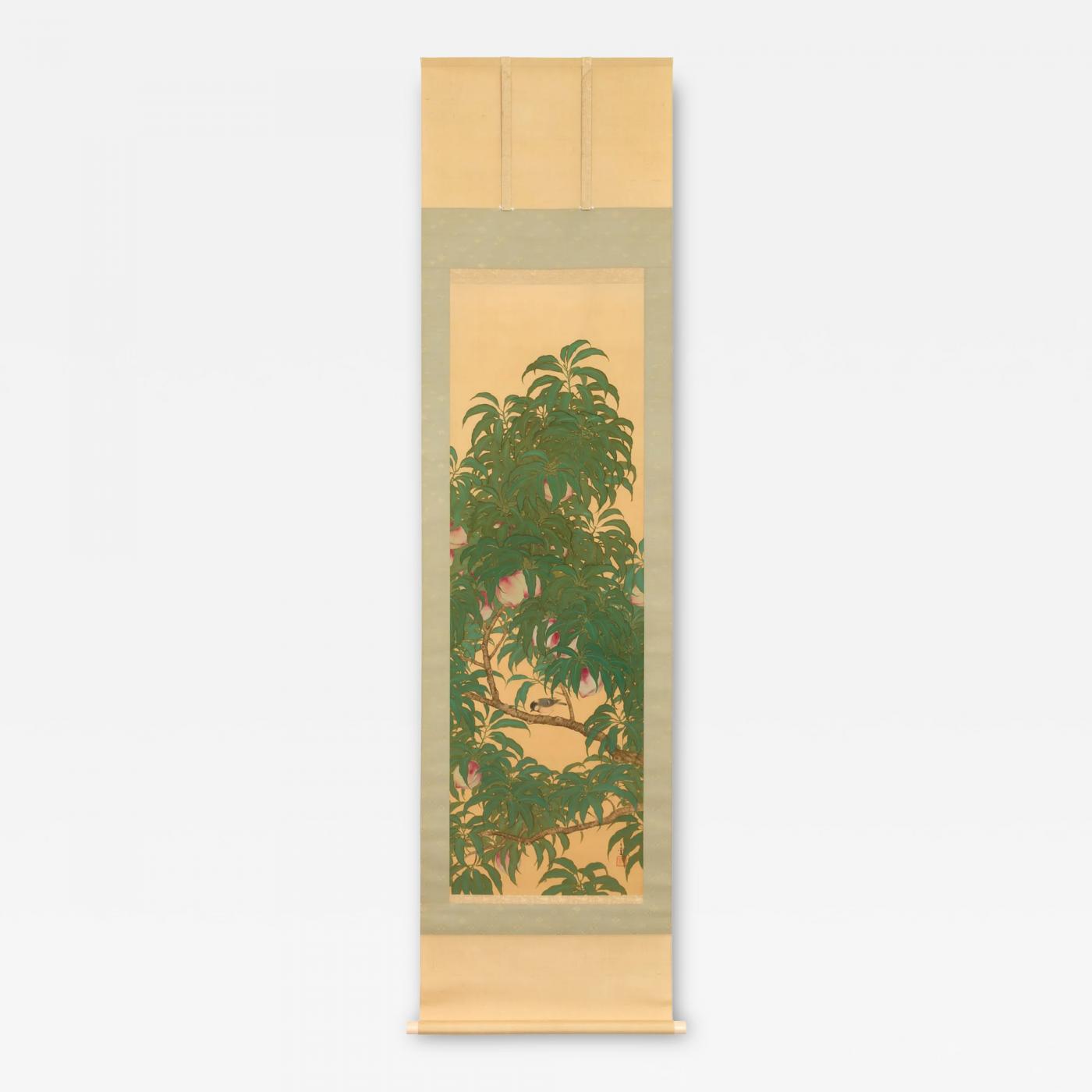
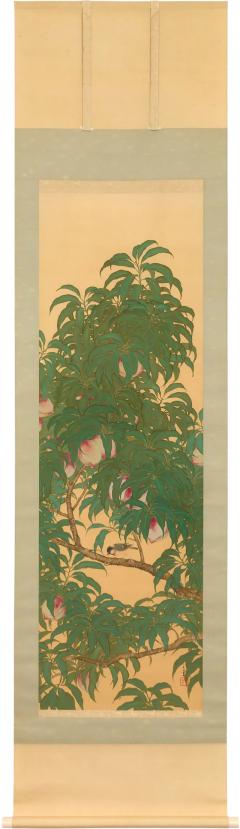
Bird in Peach Tree, 1920s
-
Description
Hirota Hyakuhō
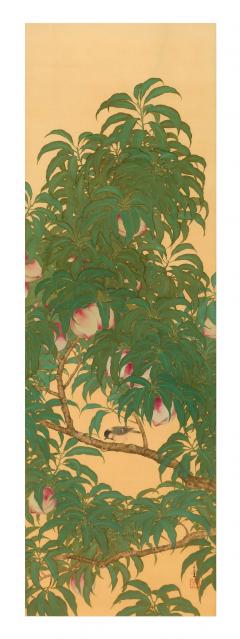
Bird in Peach Tree, 1920s
Hanging scroll; mineral pigments, shell powder and gold wash on silk
Overall size 85½ x 22 in. (217 x 56 cm)
Image size 53½ x 17 in. (136 x 43 cm)
T-5077
Signed and sealed at lower right Hyakuhō
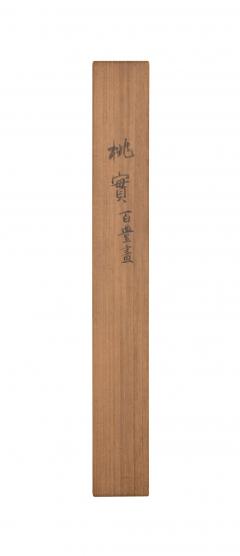
Comes with a fitted paulownia-wood storage box inscribed outside Mi Hyakuhō ga (Fruit, painted by Hyakuhō)
Boldly cropped, this hanging scroll by Hirota Hyakushō—an artist versed in the naturalistic bird-and-flower painting tradition that flourished in Kyoto from the eighteenth century onward—depicts the leafy branches of a peach tree bearing fruit. Drawing on a pictorial convention with a far deeper lineage, traceable to the court painting of China’s Song dynasty (960–1279), the composition centers on a perched shijūkara (Asian tit, Parus cinereus). The bird’s diminutive form, its plumage at times appearing almost translucent and offset by a tiny dab of white gofun, contrasts with the luxuriant, variegated greens of the foliage. These passages were likely painted with rokushō, a green pigment historically derived from malachite or copper acetate. The softly glowing, pinkish-red peaches—perhaps rendered with iron oxide or one of the synthetic mineral pigments introduced during the Taisho era—add a vibrant counterpoint.
Born in Yamanaka, Enuma District (today’s Kaga City), Ishikawa Prefecture, Hyakuhō (also rendered as Hyappō in a recent exhibition poster) was adopted into the Hirota family at the age of three. After graduating from Ishikawa Normal School (now part of Kanazawa University), he initially pursued a career in education, resigning in 1911 to devote himself fully to painting. Following his move to Kyoto, he studied Nihonga (neo-nativist painting) under Kishinami Ryōkei and soon thereafter became an uchideshi (live-in pupil) of Takeuchi Seihō, a towering presence in Kyoto’s early twentieth-century art world. That same year marked a decisive breakthrough, when his painting Umaya (The Stable)—a naturalistic depiction of horses, now lost—was accepted into the Fifth Bunten national exhibition. The work received a Minister of Education’s Commendation and was acquired by the Imperial Household Agency, securing Hyakuhō’s reputation at a critical moment in his career.
Hyakuhō continued to exhibit annually at the Bunten through 1916. In the years that followed, however, he joined many like-minded artists in withdrawing from the increasingly bureaucratic official exhibition system after its reorganization, becoming a founding member of the Nihon Jiyū Gadan (Japan Free Art Association). A formative trip to Europe in 1922 further sharpened his interest in expanding the expressive possibilities of Nihonga while remaining grounded in its materials and techniques. Throughout his life, he maintained close ties to the artistic circles of his native Ishikawa Prefecture, culminating in 1936 with the execution of a celebrated large-scale dragon painting on the ceiling of Reitaku Hall in Kanazawa’s renowned Kenrokuen Garden.
A retrospective exhibition of Hyakuhō’s work, subtitled Dentō o koete (Transcending Tradition), was presented at the Kaga City Art Museum in the summer of 2025 to commemorate the seventieth anniversary of the artist’s death. Although no accompanying catalogue was published, an informal online record conveys the breadth of his practice.1 Predominantly drawn from local collections, the exhibition included naturalistic animal studies; a two-panel folding screen depicting young peasant women at work—a favored subject in painting of the 1920s and 1930s; a meticulously brushed portrait of a standing maiko (young female entertainer); and a scroll of peacocks recalling the work of fellow Kanazawa native Ishizaki Kōyō, whose Vying Peacocks screens (circa 1929, now in the Nelson Atkins Museum of Art) caused a sensation when shown at Thomsen Gallery in 1913. Also featured was a pair of six-panel, gold-leaf screens depicting Chinese boys and a hanaguruma (a cart laden with blossoms). While the screens’ finely articulated detail seems to echo the patient intricacy seen in the present scroll, they lack its naturalism and subtle chromatic modulation. -
More Information
Documentation: Signed Period: 1920-1949 Creation Date: 1920's Styles / Movements: Asian Art Incollect Reference #: 863310 -
Dimensions
W. 22 in; H. 85.5 in; W. 55.88 cm; H. 217.17 cm;
Message from Seller:
Thomsen Gallery, now located at 8 East 67th Street, New York City, NY 10065, specializes in important Japanese paintings, folding screens, hanging scrolls, ceramics, ikebana bamboo baskets, lacquerware, and contemporary works by select artists. Owned and directed by Erik and Cornelia Thomsen, the gallery brings decades of expertise in Japanese art to a global clientele, including private collectors and major museums. For inquiries, contact them at 212-288-2588 or info@thomsengallery.com.
More Listings from Thomsen Gallery View all 201 listings
-
Seascape, 1915
-
Women Working in the Forest, ca 1910
-
Fukakusa no aki (Autumn in the Woods), 1920
-
Scrolls within Screens, 18th century
-
En (Cycle/Eternity), 1977
-
Double Golden Ratio Series
-
Sakuhin (Work), 1959
-
Hanging Flower Basket, 1930s
-
Kano School New Year's Pine Saplings, ca 1800
-
Handled Flower Basket Named “Well Head”, ca 1930
-
Boy's Dream, mid-1930s
-
"Oceans of Good Fortune” Handled Flower Basket, 1970s
-
Galaxy, 2019
-
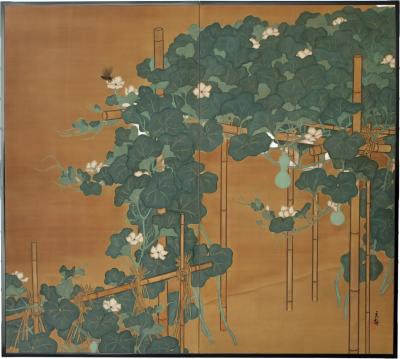
Flowering Gourds and Insect, 1920s