










Offered by:
Thomsen Gallery
8 East 67th Street
New York City, NY 10065 , United States
Call Seller
212.288.2588
Showrooms
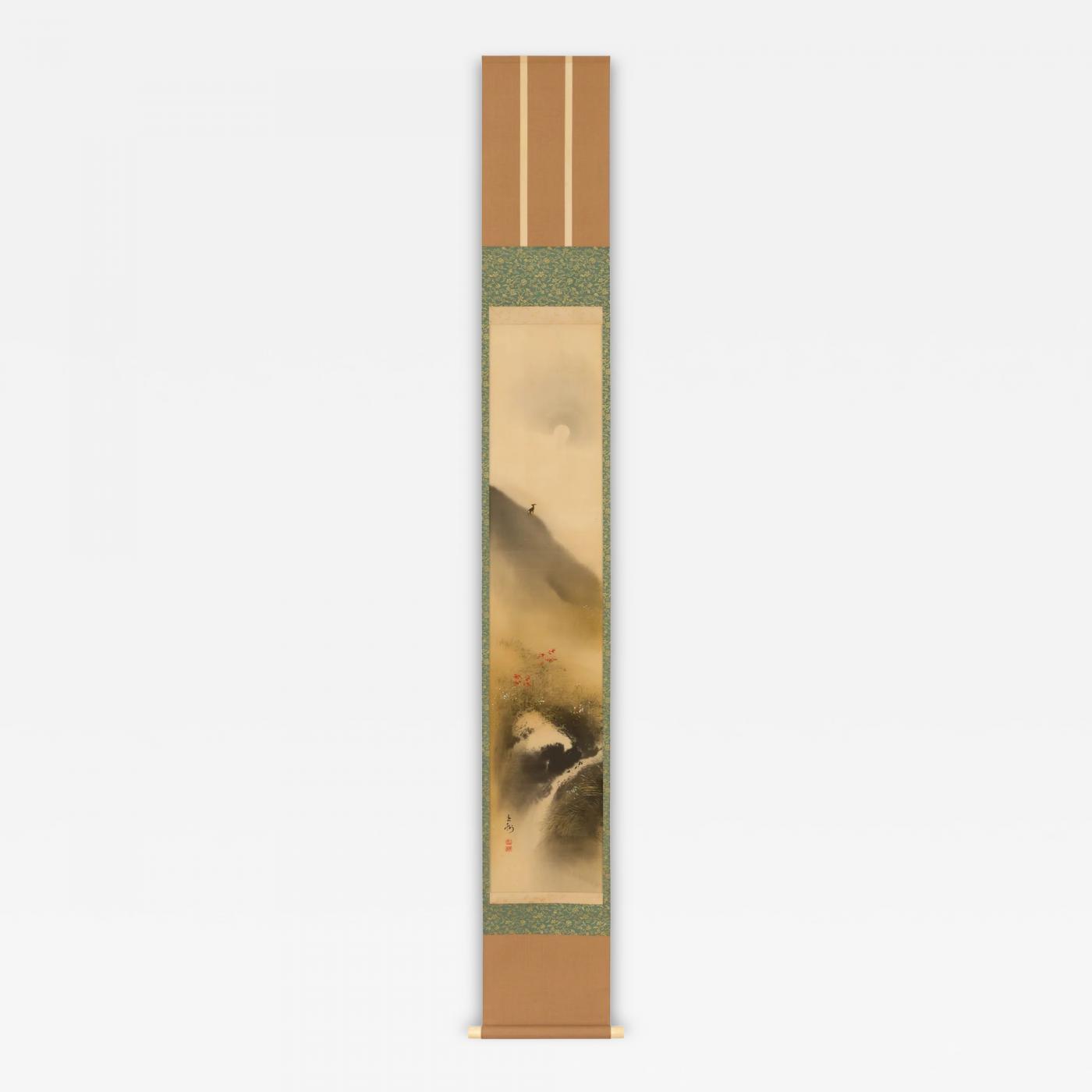
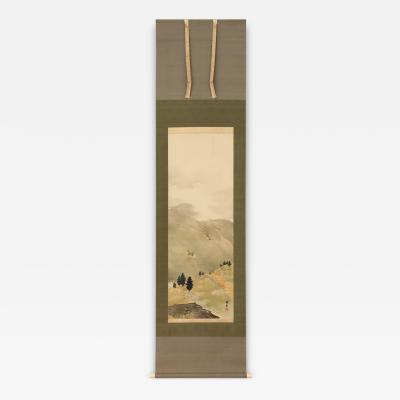
Clearing Storm in the Autumn Peaks , 1930s
-
Description
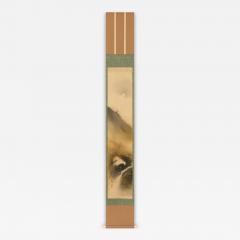
Imai Keiju
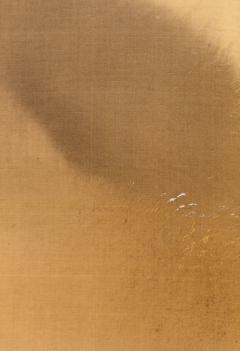
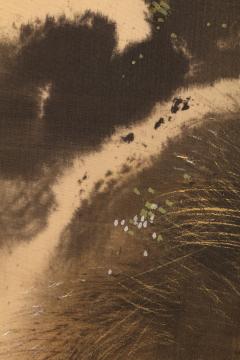
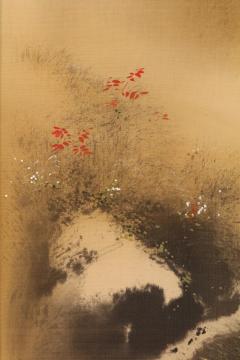
Clearing Storm in the Autumn Peaks , 1930s
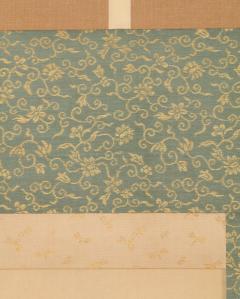
Hanging scroll; ink, mineral colors, shell powder and gold on silk
Overall size 73¼ x 9¼ in. (186 x 24 cm)
Image size 42½ x 8¼ in. (108 x 21 cm)
T-5174
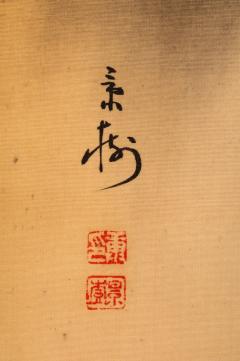
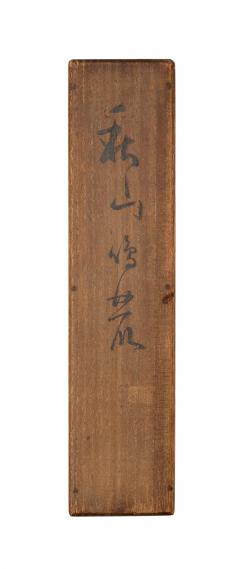
With the original paulownai-wood tomobako storage box titled: Shūzan seikō 秋山晴荒 (Clearing Storm in the Autumn Peaks); signed inside: Keiju dai 景樹題 (Inscribed by Keiju); sealed: Yasu 康
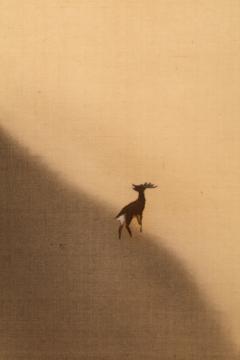
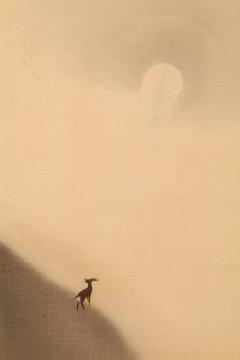
Imai Keiju offers here a fresh interpretation of a time-honored theme in Japanese literature and art. The image of a deer calling in an autumnal mountain landscape—often under the moon—can be traced at least as far back as a poem in the early tenth-century imperial anthology Kokinshū (A Collection of Old and New Poems): "In my mountain home / it is in autumn that I am / at my loneliest— / time and again I wake / to the deer's mournful cry." The subject appears in lacquerware from the medieval period onward and was later taken up by masters of the Rinpa school, most notably Ogata Kōrin (1658–1716). From that lineage likely derives the now-standardized depiction of the deer, its head turned to one side and one foreleg raised.
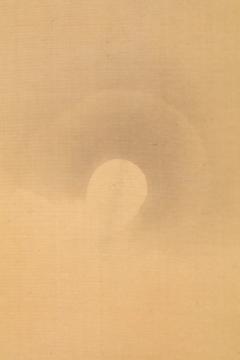
Yet Keiju departs from precedent by rendering the deer—despite its symbolic weight—as a diminutive presence on a lonely mountainside. In this, he recalls the practice of early Chinese painters, who inserted tiny human figures into vast landscapes to evoke humanity’s insignificance within the grandeur of nature. Drawing on his mastery of delicate ink washes and refined, naturalistic brushwork—hallmarks of the Kyoto Maruyama-Shijō tradition—Keiju emphasizes the scroll’s seasonality by including several autumn flowers alongside a rushing upland stream.
Born in Kizaki, Seki Town, Suzuka District (present-day Kameyama, Mie Prefecture), Keiju—born Yasu—displayed a strong interest in painting from an early age. At eleven, his exceptional talent was recognized by the prominent Kyoto painter Imao Keinen, under whom he began his training. After graduating from the Kyoto Municipal School of Arts and Crafts, he formally entered the Imao household in 1914 as Keinen’s adopted son, taking the first character of his master’s name to form part of his own. Four years later he left the household and returned to his hometown, before eventually settling again in Kyoto to pursue his career with renewed focus.
Although he remained independent—following his teacher’s advice to “make your way through your skill alone” rather than aligning with a particular school—Keiju maintained close ties with Keinen. In 1928, the two artists collaborated on a painting of pines for a large textile hanging that formed the backdrop to the Shōwa Emperor’s enthronement ceremony. -
More Information
Documentation: Signed Period: 1920-1949 Creation Date: 1930's Styles / Movements: Asian Art Incollect Reference #: 875592 -
Dimensions
W. 9.25 in; H. 73.25 in; W. 23.5 cm; H. 186.06 cm;
Message from Seller:
Thomsen Gallery, now located at 8 East 67th Street, New York City, NY 10065, specializes in important Japanese paintings, folding screens, hanging scrolls, ceramics, ikebana bamboo baskets, lacquerware, and contemporary works by select artists. Owned and directed by Erik and Cornelia Thomsen, the gallery brings decades of expertise in Japanese art to a global clientele, including private collectors and major museums. For inquiries, contact them at 212-288-2588 or info@thomsengallery.com.
More Listings from Thomsen Gallery View all 205 listings
-
Vase with Slip Decor (T-5158)
-
Vase with Brilliant Glaze (T-5161)
-
Mountain Landscape, ca 1916-1920

-
Vase with Silver Waves, 1980s

-
Three-Seat Sofa
-
Scenes from Life at the Chinese Imperial Court, early 17th century
-
Mizu 18 (Water 18), 2014
-
Blooming Plum and Cherry Trees along Stream, ca 1800
-
Vase with Marbleized Clay (T-5157)
-
Lingering Snow, 1940s-1950s
-
Oncoming Rain in a Mountain Valley, 1920s
-
Russet Black Vase, 1980s
-
Tea Bowl (T-4838)
-
View of the Yabakei Gorge, 1920