








Offered by:
Jim's of Lambertville
6 Bridge Street
Lambertville, NJ 08530 , United States
Call Seller
609.397.7700
Showrooms
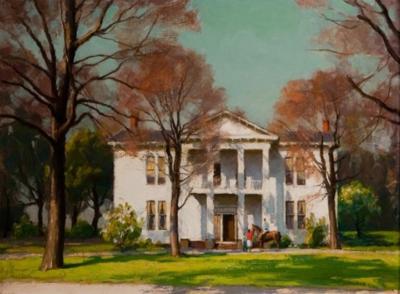
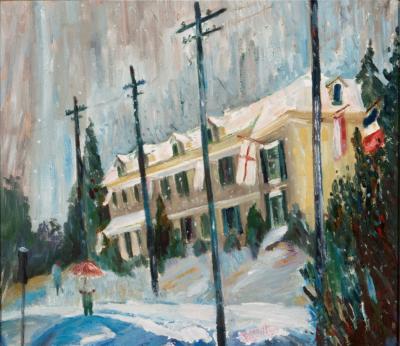
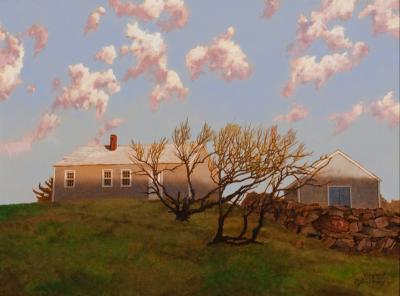
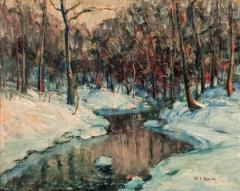
"Reflections"
-
Description
Circa 1935.
Signed lower right.
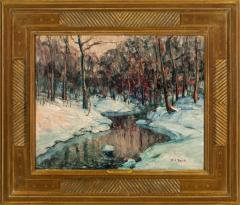
Complemented by a hand carved and gilt frame.
*Illus. in "New Hope for American Art", pg. 45
Walter Baum (1884-1956)
Born in Sellersville, Pennsylvania, Walter Baum was the one of the only members of the New Hope Art Colony actually born in Bucks County. Greatly inspired by the painters of the original “New Hope School”, Baum had an extremely profound impact on artistic development throughout the Delaware Valley.
As an artist, there was no other to even come close in matching his highly prolific artistic production. His works were admired by both collectors and aspiring artists. His involvement in establishing an art school and museum in Allentown would have an enormous influence on what would become one of the largest artistic communities in the United States.
It was not until the age of twenty that Baum would begin his art studies. First privately with William Trego, a respected local painter , followed by his enrollment to the Pennsylvania Academy of the Fine Arts, where his instructors included Thomas Anshutz and Daniel Garber. He was awarded the Jennie Sesnan Gold Medal from the Pennsylvania Academy in 1925.
Baum taught summer classes for the public schools of Allentown in 1926. Immense popularity of these classes would eventually lead to Baum co-founding the Kline-Baum School of Art in 1929 (later renamed the Baum School of Art). Baum also helped to found the Allentown Art Museum in1936, the Lehigh Art Alliance, and the Circulating Picture Club. Baum wrote over five hundred reviews for the Philadelphia Bulletin as well as Two Hundred Years, a study of the Pennsylvania Germans and their heritage. Baum did much to enrich the cultural environments of eastern Pennsylvania’s past. He received an Honorary Doctorate of Humane Letters from Lehigh University in 1946.
During his long career Baum worked in several mediums and painted in various styles. Many of his earlier works are magnificent impressionist landscapes of Bucks County and the Lehigh Valley showing the strong influence of Redfield and Schofield. Baum developed friendships with Schofield and Garber which deepened his appreciation for the regional landscape. In the late 1940’s into 1950’s, Baum’s style of painting changed completely taking on modernist qualities similar to that of the French Post-Impressionist painters .These later works usually depict urban views of Allentown, Bethlehem and Easton as well as figurative works, still life and scenes portraying the students in his art classes and studio. Baum actively taught art and promoted artists throughout his life. As Art Editor of the Philadelphia Bulletin, he wrote hundreds of reviews.
While he is known for his larger works, Baum painted over a thousand pictures of smaller sizes including extremely detailed 4 x 6 inch miniature landscapes. He would often paint the same scene again and again. Because of his unusually strong work ethic, not all of his many paintings are representative of his potential greatness. When studying his work, it is not uncommon to see several similar views of fair quality and then coming upon a fine execution of the same scene. Great painters did not always paint great paintings, and when one was as prolific as Baum, this should be remembered and understood. There has always been a cloud cast upon Baum’s work by less knowledgeable collectors regarding forgeries and paintings finished and signed by the artist’s son. Granted, there are a lot of fake paintings bearing his name, and whether or not his son painted or signed them remains to be seen, but if a painting even looks remotely questionable, it is likely to be at best, of poor quality, and worst case a fake. Either or, this is not the kind of painting a collector should consider buying at any price. A Baum painting of investment quality will look like a fine painting and will not cast any doubt upon the trained eye.
Sources: New Hope for American Art by James M. Alterman -
More Information
Documentation: Signed Notes: Signed lower right Origin: United States, Pennsylvania Period: 1920-1949 Materials: Oil on board. Condition: Good. Creation Date: 1935 Styles / Movements: Impressionism, New Hope School Book References: Illustrated in "New Hope for American Art", pg. 45 Dealer Reference #: PB0204 Incollect Reference #: 124967 -
Dimensions
W. 20 in; H. 16 in; W. 50.8 cm; H. 40.64 cm;
Message from Seller:
Welcome to Jim's of Lambertville Fine Art Gallery, located in the heart of Lambertville, NJ. Specializing in Pennsylvania Impressionist and Modernist paintings, antiques, and custom framing, we invite you to visit us or contact us at 609.397.7700 or via email at info@jimsoflambertville.com.
Sold