


















Offered by:
Kristan Hauge Japanese Art
2-32 Saishoji-cho, Okazaki, Sakyo-ku,
Kyoto 606-8342 , Japan
Call Seller
81757515070
Showrooms
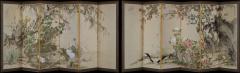
19th Century Japanese Screen Pair – Birds & Flowers of the Four Seasons
-
Description
Birds & Flowers of the Four Seasons
Yamamoto Baiitsu (1783–1856)
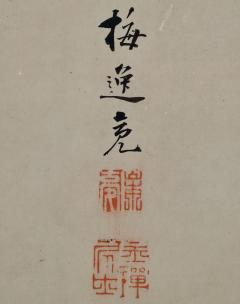
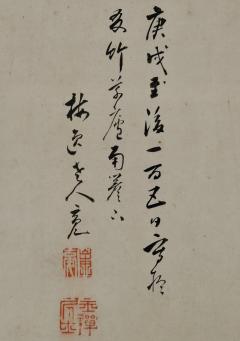
Late Edo period, Dated 1850
Pair of six-panel Japanese Screens, ink and color on paper
Dimensions of Each Screen: H. 171.5 cm x W. 372 cm (67.5” x 146.5”)
Price: USD 47,500
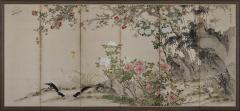
A magnificent pair of six-panel Japanese folding screens by Yamamoto Baitsu, representing a lush landscape that seamlessly blends the transition of the seasons from spring to summer and on to autumn and winter.
Yamamoto Baitsu, a literati painter of the late Edo period, has been acclaimed as one of Japan’s consummate painters of bird-and-flower compositions. He is best known for his meticulous and unfailingly elegant polychrome bird-and-flower paintings.
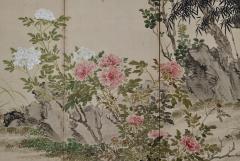
The right screen is composed with a sweeping diagonal movement, where the dense natural elements on the right and upper portion of the screen counterbalance the expansive, open foreground on the left. A rocky outcrop and bamboo grove dominate the far right, providing a dark, grounding element. Overarching the scene from the upper half of the screen is a red crape myrtle. These flowers provide a vital splash of color during the midsummer heat, emphasizing the screen’s summer theme. Intermingled with this tree are large, globular white flower clusters that appear to be a variety of hydrangea. In Japanese art and culture, the hydrangea is a classic symbol of the rainy season of early summer. Its inclusion beautifully captures the atmospheric conditions of the onset of summer. Central to the foreground are large, full blossoms of peonies in pink and white. Their position in the lower-center of the painting acts as a visual focal point, marking the transition from the luxuriant growth of late spring. Fringed Pinks are classic summer flowers in Japanese art and poetry. They are celebrated for their delicate beauty and feminine symbolism, reinforcing the mid-to-late summer narrative of the screen.
The overall atmosphere is one of abundant growth, vibrant color, and the fertile beauty of the changing seasons.
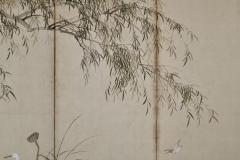
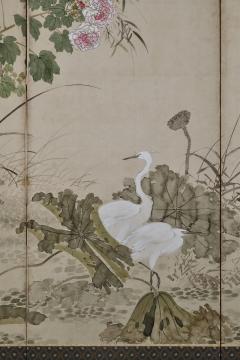
The composition of the left screen is dominated by a sweeping, over-arching willow tree that hangs down from the top edge, its long, thin branches and colorless leaves providing a sense of melancholy. The willow is among the last to drop its leaves in autumn. The large, fading leaves and seed pods of the lotus at the center of the composition represent summer extending into early autumn. The motif of the lotus and white herons (or egrets) depicted together is a classic convention in Asian art, seen for hundreds of years, symbolizing an elegant purity. The white and yellow chrysanthemums are staples of autumn representation in Japanese art. Finally, the inclusion of daffodils, which bloom in the winter, serves as the final, specific marker for the cold season.
The screen’s narrative beautifully transitions from the end of summer (lotus) through late autumn (willow) and into the full arrival of winter (daffodils).
Yamamoto Baitsu 1783~1856 was a literati painter of the late Edo period. While influenced by the Maruyama-Shijo school, the serene and sensuous detail and clarity of his works have a wholly original quality. He developed his own delicate and elegant style from his study of ancient calligraphy and paintings from the Ming and Qing dynasties. He was involved with key members of the Japanese literati. His works are collected by top-class institutions, i.e. the Metropolitan Museum of Art and the Idemitsu Museum of Art.
Two of his paintings have been designated as ‘important cultural properties’ in Japan.
His works are held in many international museums, including the Minneapolis Institute of Art, the Cleveland Museum of Art, the Saint Louis Art Museum, the Detroit Institute of Arts, the Phoenix Art Museum, the Indianapolis Museum of Art, the Denver Art Museum, the Santa Barbara Museum of Art, the Museum of Fine Arts, Boston, the University of Michigan Museum of Art, the Philadelphia Museum of Art, the British Museum, the Portland Art Museum, the Asian Art Museum in San Francisco, the Honolulu Museum of Art, the Walters Art Museum, the Harvard Art Museum, the Art Gallery of New South Wales, the Art Gallery of South Australia, and the Art Gallery of Greater Victoria. -
More Information
Documentation: Signed Period: 19th Century Creation Date: 1850 Styles / Movements: Asian Art Incollect Reference #: 833493 -
Dimensions
W. 146.46 in; H. 67.52 in; W. 372 cm; H. 171.5 cm;
Message from Seller:
Kristan Hauge Japanese Art, based in Kyoto's museum district since 1999, specializes in important Japanese screens and paintings for collectors, decorators, and museums worldwide. Contact us at khauge@mx.bw.dream.jp or +81 75-751-5070 for exceptional access to Japanese art and history.
More Listings from Kristan Hauge Japanese Art View all 52 listings
-
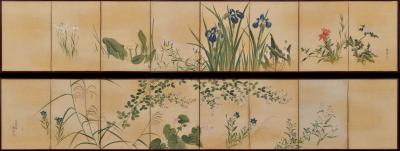
1838 Japanese Screen Pair. Flowers & Grasses of the Four Seasons
-
Korean grapevine painting. 17th century.

-
Mitani Toshuku Unkoku School, 17th century. Japanese falcon painting.

-
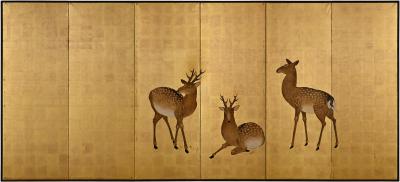
19th Century Japanese Deer Screen by Okamoto Toyohiko. Maruyama Shijo School
-
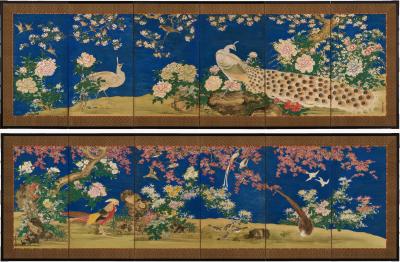
Mid 19th Century Japanese Screen Pair. Flowers & Birds of the Four Seasons
-
Early 20th Century Japanese Nihonga Scroll. Crow & Persimmon.

-
urtledoves in a Peach Tree | Nakamura Daizaburo

-
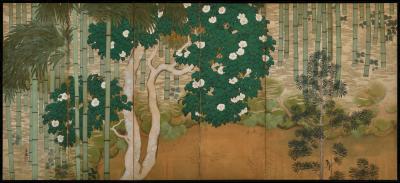
Early 20th Century Japanese Nihonga Screen. Bamboo Forest
-
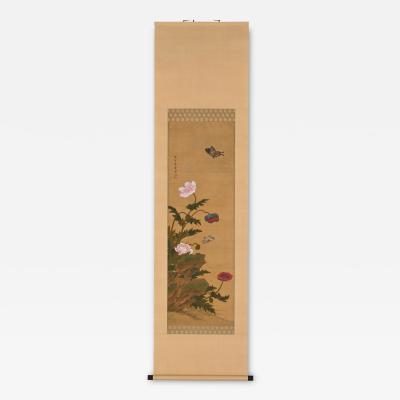
19th Century Japanese Scroll Painting by Igarashi Chikusa, Poppies & Butterflies
-
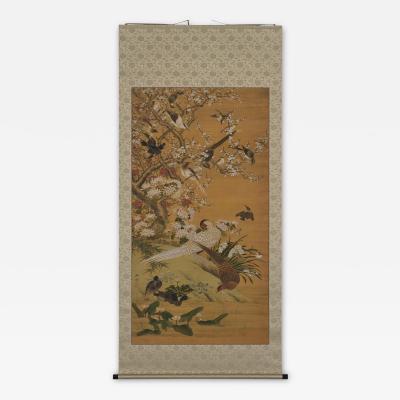
19th Century Japanese Scroll Painting, Birds & Flowers of the Four Seasons.
-
Japanese Screen Pair, Tigers by Kishi Renzan, Late Edo Period.

-
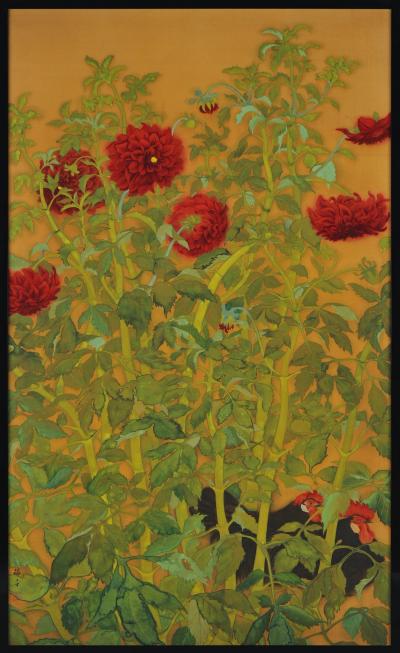
Dahlias and Roosters | Tanaka Tessen (b.1890) | Taisho period silk painting
-
Early 20th Century Japanese Screen. Cat & Mouse by Otaki Uzan.

-
Playful Cat | Hirose Toho (1875-1930) | Japanese scroll painting

