








Offered by:
Kristan Hauge Japanese Art
2-32 Saishoji-cho, Okazaki, Sakyo-ku,
Kyoto 606-8342 , Japan
Call Seller
81757515070
Showrooms
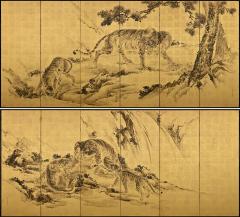
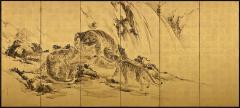
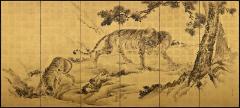
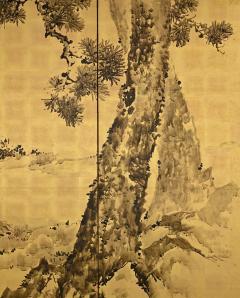
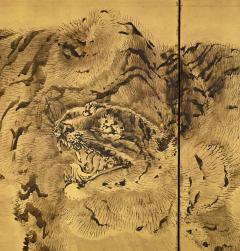
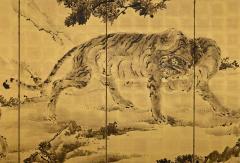
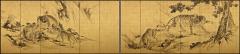
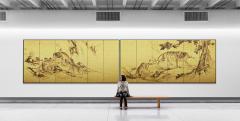
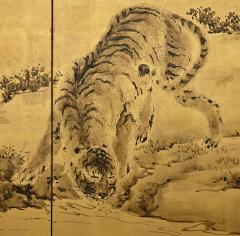
Japanese Screen Pair, Tigers by Kishi Renzan, Late Edo Period.
-
Description
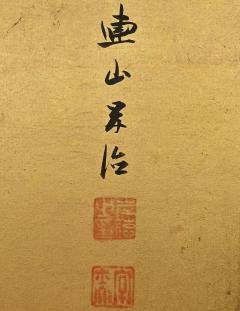
Kishi Renzan (1804-1859)
Tigers
Pair of six-panel Japanese screens.
Ink and gold-leaf on paper.
Dimensions:
Each screen measures H. 67’’ x W. 148” (171 cm x 376 cm)
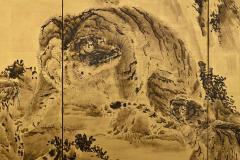
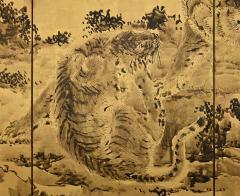
In this monochromatic pair of six-fold Japanese screens painted on gold-leaf, Kishi Renzan has created a breathtaking composition of a family of tigers. The screens are filled with a sense of drama which is conveyed by both the subject matter and the wet, expressive brushwork. The running mountain stream and the towering waterfall allude to refreshment during the summer months and we feel the tiger families familiarity and security within their environment. Renzan’s master, Kishi Ganku, could not see a live tiger and worked from a preserved skin and skull in his personal collection. This led directly to the strangely flattened heads and elongated bodies which Renzan has inherited here. Compensating for this lack of direct observation is the undoubted vitality and spirit he has imbued each tiger with. In this pair of Japanese screens by Kishi Renzan, we are also beginning to see signs that he is taming the wild, bravura brushwork of his master Ganku, and we can feel the beginnings of the milder Shijo school influence. It is a masterpiece of pure ink painting; freely manipulating the expressiveness of the ink to depict movement and spatiality.
Kishi Renzan was a Kyoto-based artist who was the premier pupil and son-in-law of the founder of the Kishi school of painting, Kishi Ganku (1749-1838). He was trained in the studio of Kishi Ganku, together with Ganku’s son Kishi Gantai, Yokoyama Kazan, Minwa Bumpo and Shodo. Together they were the second generation of the Kishi school. Of all the followers of the Kishi school Renzan has the greatest reputation in Japan. He rose to a position of importance, being known as one of the ‘Four Great Masters of Kyoto’ at the end of the Edo period. Where Kishi Ganku’s style is strongly influenced by the influence of the traditional style of the Chinese painter Nanpin, the second generation was more open to modern influences. Renzan’s work starts off in the Ganku style and gains in freedom, softness and quality in artistic communication with the Shijo school, which developed concurrently. Renzan specialized in landscapes and flower-and bird paintings and is most noted for his paintings of the fusuma doors at the Kyoto Imperial Palace titled “Room of the Wild Geese.” After Ganku’s death he became the co-leader of the Kishi school, together with his brother-in-law Kishi Gantai. His works may be found in many museum collections throughout the world including the Ashmolean Museum, Oxford; Fogg Art Museum, Harvard; Freer and Sackler Gallery of Art, Washington; Minneapolis Museum of Art; St. Louis Museum of Art; Kyoto National Museum; and, The Victoria and Albert Museum, London. -
More Information
Documentation: Signed Period: 19th Century Condition: Good. Styles / Movements: Asian Art Incollect Reference #: 733443 -
Dimensions
W. 148 in; H. 67 in; W. 375.92 cm; H. 170.18 cm;
Message from Seller:
Kristan Hauge Japanese Art, based in Kyoto's museum district since 1999, specializes in important Japanese screens and paintings for collectors, decorators, and museums worldwide. Contact us at khauge@mx.bw.dream.jp or +81 75-751-5070 for exceptional access to Japanese art and history.
More Listings from Kristan Hauge Japanese Art View all 65 listings
-
Early 20th Century Japanese Screen. Cat & Mouse by Otaki Uzan.

-
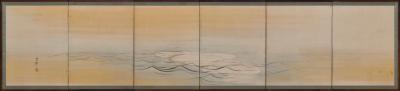
Japanese Screen. 19th Century. Reflections of the Moon
-
Mitani Toshuku Unkoku School, 17th century. Japanese falcon painting.

-
Japanese Screen. Early 20th Century. Furosaki Screen. Wagtail & Chrysanthemum

-
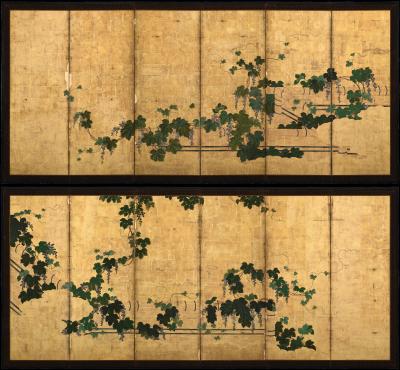
17th Century Japanese Screen Pair. Grapevines. Attributed to Kano Tsunenobu
-
17th Century Japanese Screen. Ink Plum Tree & Birds by Kano Naonobu

-
Early 20th Century Japanese Screen Pair – Ink Pine Trees on Gold

-
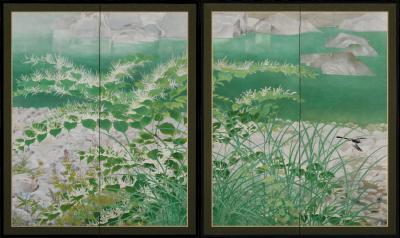
Japanese Screen Pair. Showa era. Nihonga Riverside landscape. Late Summer
-
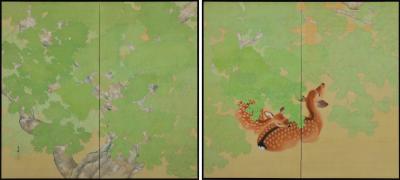
Early 20th Century Pair of Japanese Screens | Deer under Maple Trees
-
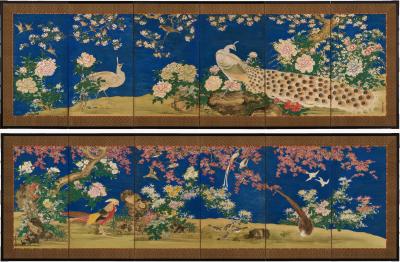
Mid 19th Century Japanese Screen Pair. Flowers & Birds of the Four Seasons
-
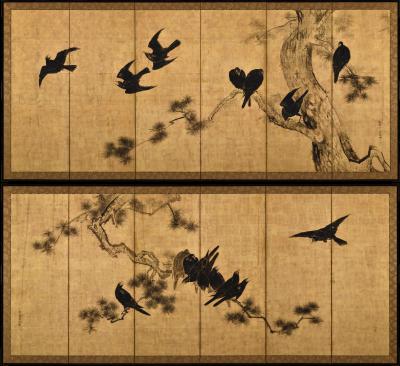
Mid 18th Century Japanese Screen Pair. Crows & Pines by Unkoku Toshuku
-
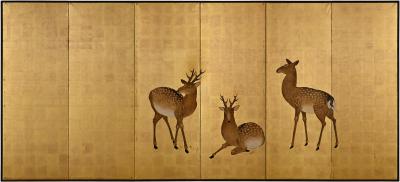
19th Century Japanese Deer Screen by Okamoto Toyohiko. Maruyama Shijo School
-
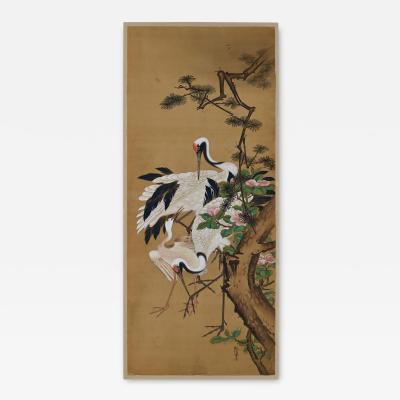
19th Century Japanese Silk Painting by Kano Chikanobu. Cranes, Pine & Camelia.
-
Japanese Screen Pair. 18th Century. Flowers & Birds of the Four Seasons