










Offered by:
Robert Funk Fine Art
1581 Brickell Ave., Suite 2303
Miami, FL 33129 , United States
Call Seller
305.857.0521
Showrooms
On Kawara is Predated in Conceptual Use of Numbers or Word Art by Ray Johnson
-
Description
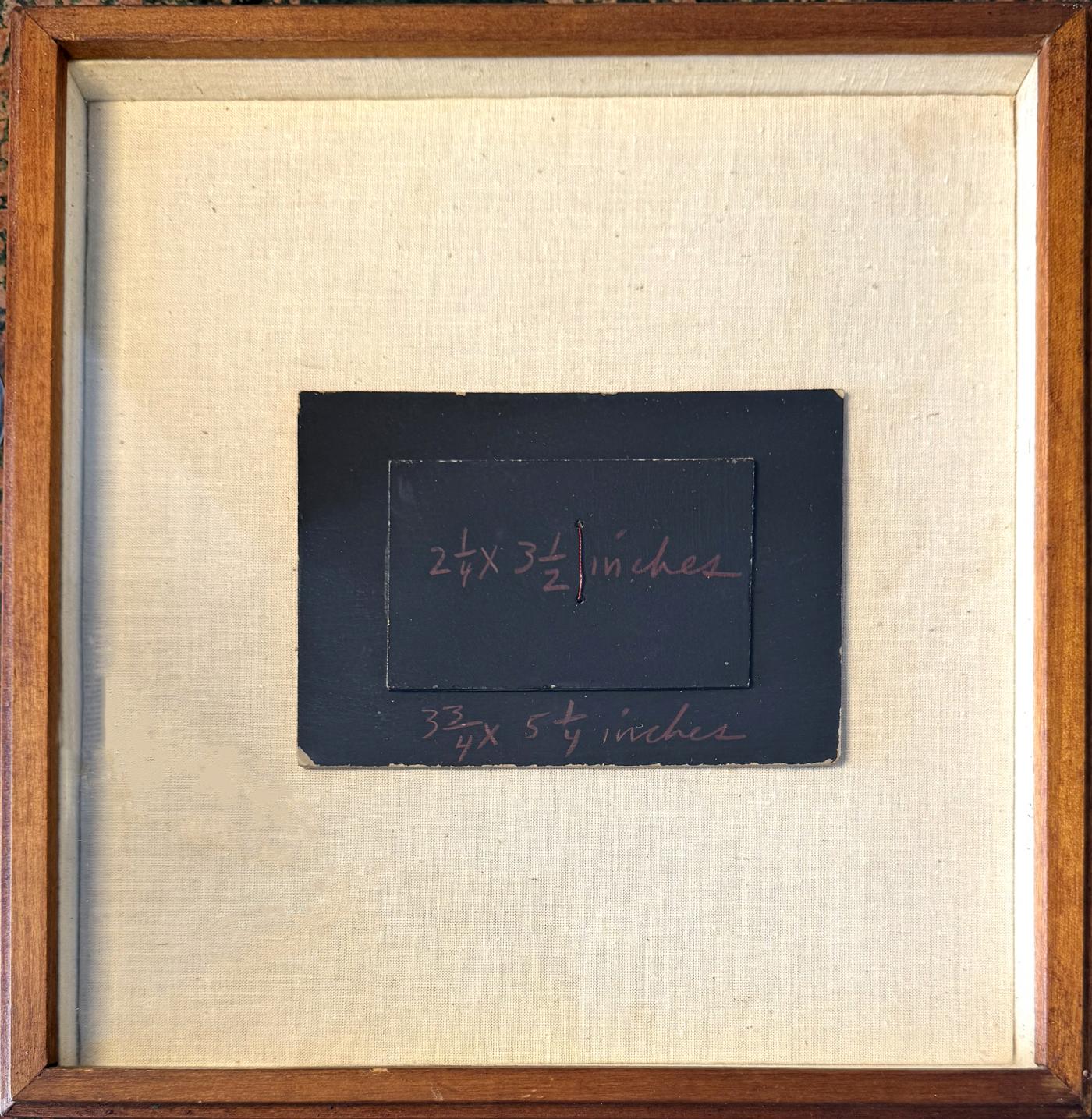
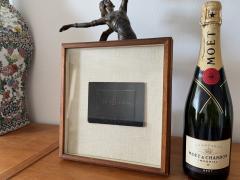
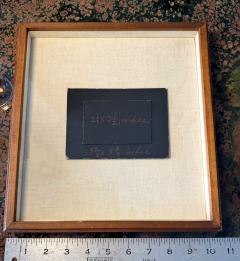
In the present work, Ray Johnson predates On Kawara in the conceptual use of employing only written numbers as Number Art /Word Art. Johnson's work elevated "Idea over Object" in his art, where the concept of measurement replaces visual imagery.
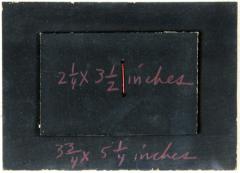
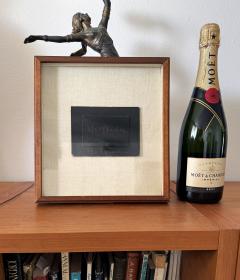
Ray Johnson, 1959. Untitled, Measurement Collage with measurements of the collaged board written by Johnson. Piece measures 3 1/2 x 5 1/4 in. It is a breakthrough conceptual work executed in a minimalist way, with a monochrome red-crayon structure on cut black cardboard.
"Ray Johnson: Mail Art before Email"
Words are like color; they reflect mood, sentiment, feelings, and temperament. For Ray Johnson, they were the elements by which his work could be made and come into existence.
Whether fragments or full sentences, they stood for the character, mood, and being of each piece. He is, in the classic sense a collagist. His palette and tools the very ordinary materials of daily life: letters, stamps, envelopes, words, dates, and addresses, each laid out in tiny intimate script. Like Joseph Cornell or Kurt Schwitters, his compositions reside framed, set apart from the world to be protected and admired. Their essence is in the small scale, like a whisper from a lover. While the temperament of the art world in those days was big, bold, and dynamic in paint and scale, Johnson turned the other way, seeing the power of a quieter and more subdued work of art.
After his education at the now-famous Black Mountain College in North Carolina in the late 40s, Johnson moved to New York like many artists look to establish a name and a career. And New York in the 50s was a hotbed of new art movements and a postwar expansion.
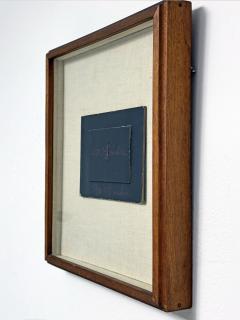
Among his earliest works is this work, "Collage 1959", Johnson used black paper and red crayon. The work is a play on a picture and frame; the picture has its dimensions written on it, and it is set against a black background, the frame, also identified by its dimensions. Simple and to the point like a Duchamp statement. Through works like this, Johnson uncovered the quality of words, language, and numbers. This elegant numeric paradigm anticipates the Conceptual Art movement of the 70s, especially Mel Bochner’s measuring pieces.
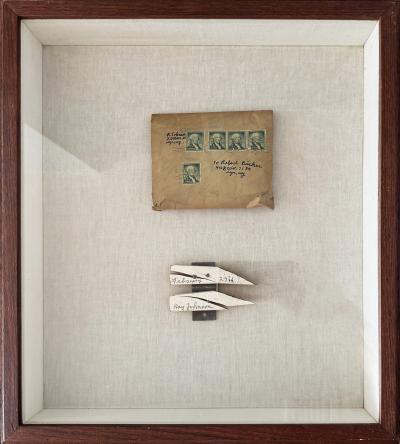
"Brown Envelope With Hinge" (1960/63) is an example of Johnson at work. While Warhol painted Marilyn and Rauschenberg built his Combines, Johnson created this piece, an assemblage of an envelope and two wooden fragments dated and signed by the artist, a telling example of less is more.
The intimate details here are the handwritten address in ink on the grey envelope with its row of weathered stamps and the miniature date and signature of the artist on the hammered wooden fragments.
This select group collected here demonstrates his aesthetic but in various forms. These also represent the passion and curiosity of the owner, Robert Funk Fine Art, who set out to collect and assemble a group that demonstrates the quality and charm of such deeply personal and enigmatic works, artwork now so contrary to the technology-inspired work now on view across the contemporary art scene.
In many of these collages, postage stamps are used to bring color to the paper. In others, it is an envelope addressed to a colleague or friend along with the contents of that envelope, sometimes a written note; sometimes a photo cut from a magazine. It is a secret between two people, revealed. Some works are more minimal than others, like a one-note musical composition by John Cage.
Using the mail as a means to exchange ideas became known as Mail Art. The Tate Gallery in London described Mail Art: “Mail art began in the 1960s when artists sent postcards inscribed with poems or drawings through the post rather than exhibiting or selling them through conventional commercial channels.” They go on to explain: “New York artist Ray Johnson, who in the mid 1950s, posted small collages, prints of abstract drawings and poems to art world notables, giving rise to what eventually became known as the New York Correspondence School. This movement is shared by a small number of artists, but Johnson is the key to its existence, and the works assembled here represent a range of visual themes he developed and used.
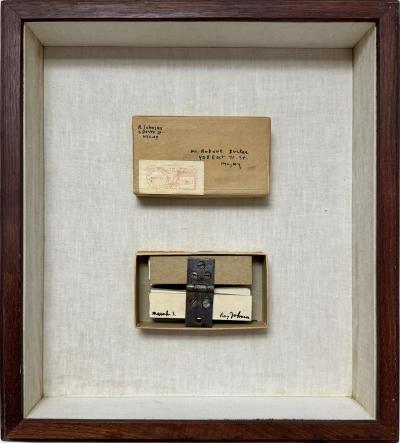
Another example is "Grey Envelope with Hinge" from 1960. The cardboard box was mailed to a friend in New York City; its contents were a box in which one finds cardboard fragments connected by a screwed hinge. The piece is dated March 2nd. On a small, if not miniature, scale, Johnson competes with the larger-scale works of Pop artists like Jasper Johns or Robert Indiana who used ordinary objects in their respective paintings and sculpture. Why? To communicate that art is about life, and Johnson underscores it too by using the energies of the U.S. Postal Service. A similar work using wood fragment and a hinge is dated March 15th. The neatly stacked wood fragments are connected by a device meant to link the two separate parts. The abstract forms are a visual metaphor for linking two people together, which is the function, purpose, and ultimate goal of the mail. It becomes the very raison d’être of the Mail Art form and movement.
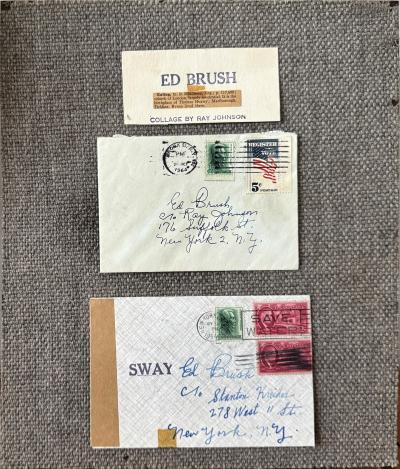
"Ed Brush", a 1964 collage using envelopes with the name ED BRUSH stamped at the top. Is this a pun on an artwork being made with a “brush”? The bold typeface anticipates the graphic Pop work of Ed Ruscha, whose career was beginning at the time in Los Angeles. What is also of note is the contrast between the rubber stamp headline ED BRUSH and the cursive script on the envelopes. The mystery of Mr. Brush is compounded by the fact that he is addressed in both envelopes but in care of two different people: Mr. Johnson and a Mr. Kreider!
Johnson died in 1995, at the age of 68. But more than 70 years since he began his brand of art-making, these personal miniature masterpieces still have enormous power and remain intriguing and provocative works of art. On the website for his estate, one reads, “His works reflect his encyclopedic erudition, his promiscuous range of interests, and an uncanny proto-Google ability to discover connections between a myriad of images, facts, and people.”
Essay by Michael Klein
In the present work, Ray Johnson predates On Kawara in the conceptual use of showing only written numbers as Number Art /Word Art. Johnson's work elevated "Idea over Object" in his art, where the concept of measurement replaces visual imagery.
Ray Johnson, 1959. Untitled, Measurement Collage with measurements of the collaged board written by Johnson. Piece measures 3 1/2 x 5 1/4 in. It is a breakthrough conceptual work executed in a minimalist way, with a monochrome red-crayon structure on cut black cardboard.
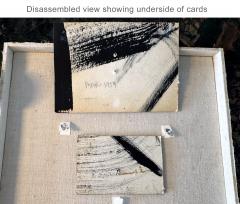
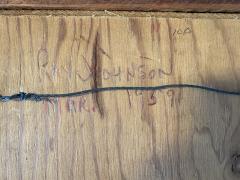
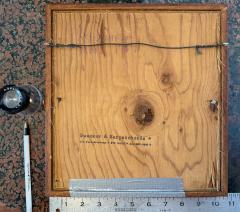
Framed under glass, it measures 10 x 10 1/2 in. In this instance, the frame is an integral part of the artwork; consider the frame size to be the artwork's size. Reverse bears Buecker & Harpsichords stamp and handwritten “Ray Johnson Mar. 1959.”
Overall good condition - black board has wear commensurate with age and has been reaffixed to support surface -
More Information
Documentation: Signed Origin: United States, New York Period: 1950-1979 Materials: Crayon, Cardboard, Wood, Mixed Media, Condition: Good. Overall good condition - the two black cardboards has wear commensurate with age and have been reaffixed to support the surface, Frame as a few nicks. Creation Date: 1959 Styles / Movements: Conceptualism, Black & White, Minimalism Incollect Reference #: 879730 -
Dimensions
W. 10 in; H. 10.5 in; W. 25.4 cm; H. 26.67 cm;
Message from Seller:
Robert Funk Fine Art in Miami offers an eclectic collection shaped by 45 years of experience, blending art with commercial perspectives. For inquiries or art advisory services, contact Robert Funk at decoypoet@yahoo.com or 305.857.0521.
More Listings from Robert Funk Fine Art View all 1158 listings
-
Mail Art Early Conceptual Art Neo-Dada and Early Pop Art
-
Richard Scarry Little Benny Wanted a Pony Illustration Children Book Illustrator

-
Portrait Champetre
-
Mail Art Correspondence Art Pioneer Two Envelops and Collage Signed
-
Haitian Surrealism Children in a Swirling Dance
-
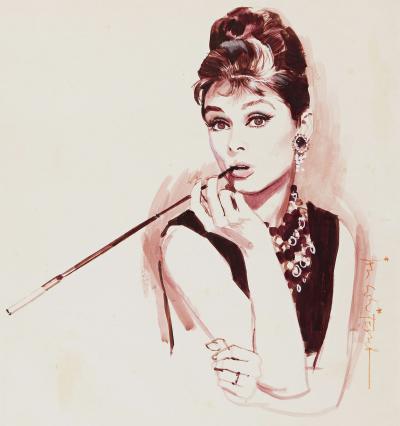
Audrey Hepburn Portrait from Breakfast at Tiffany original artwork on paper
-
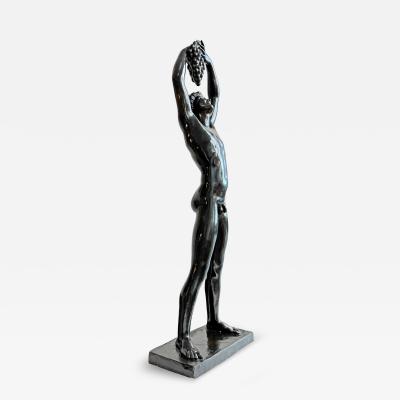
Art Deco Erotic Male Nude Bronze Sculpture Gay Interest
-
Androscoggin River Falls, study for The Manufacturers National Bank of Lewiston
-
Portrait of a Little Girl

-
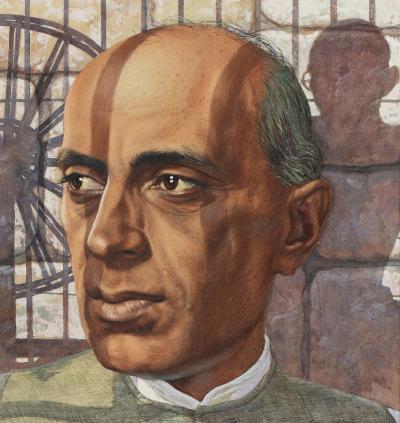
India's Nehruand Gandhi Time Magazine Cover Original Art Signed
-
Wedding Day - Norman Rockwell Americana - Female Illustrator

-
Damballa Ceremony Original Painting of Haitian Art Vodou Ceremony
-
Mail Art Conceptual Art Box With Hinge Nassau County Museum of Art
-
"Men Who Plan Beyond Tomorrow" Illustration, Advertising Campaign