









Offered by:
Robert Funk Fine Art
1581 Brickell Ave., Suite 2303
Miami, FL 33129 , United States
Call Seller
305.857.0521
Showrooms
The Sunbonnet Babies - Modernist Female Artist
-
Description
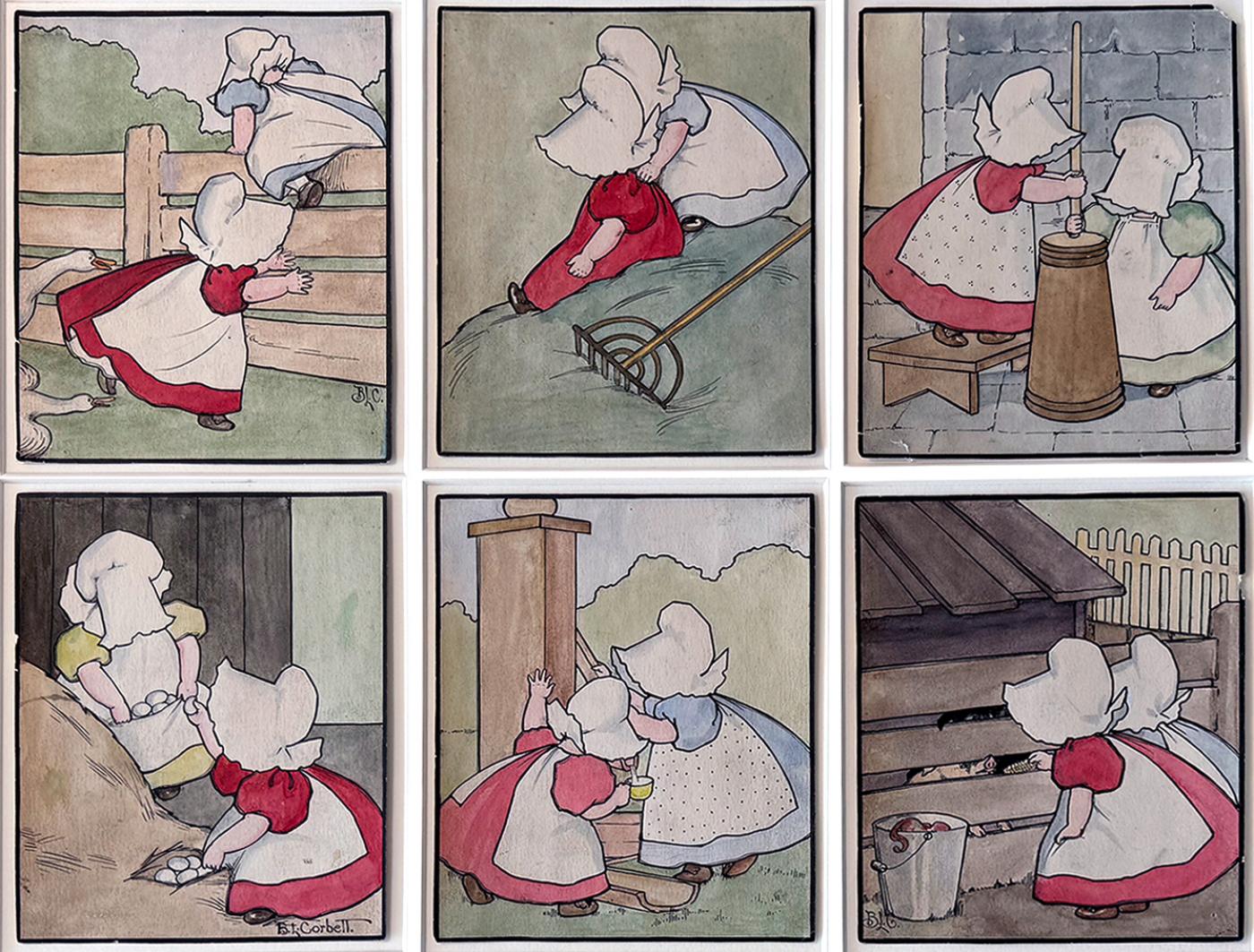
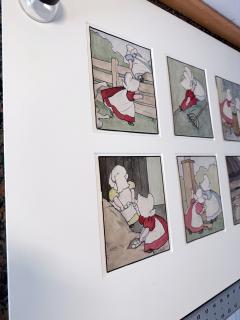
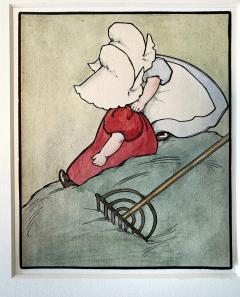
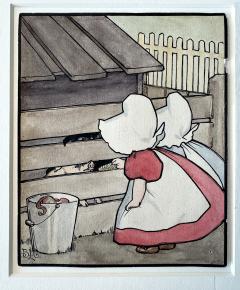
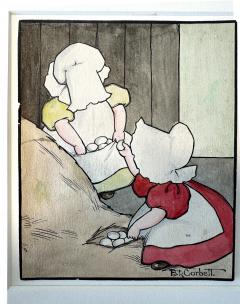
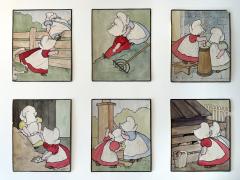
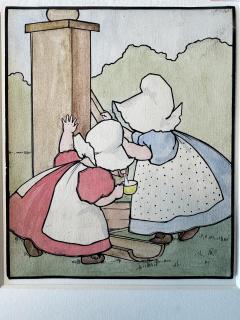
Bertha Corbett Melcher's The Sunbonnet Babies, with their flat, minimalist, semi-abstract, and symbolic style, are an early example of American Modernism/Surrealism by a lesser-known female artist/illustrator. The present work demonstrates a delicate balance between abstraction and representation and between the commonplace and the mysterious. Her signature use of a hat or sunbonnet to hide the identity of her subjects is a big conceptual and visual idea that has been overlooked in the fine art canon. The exact meaning of this is unknown, but 120 years after they were done, it resonates as somewhat surrealistic. Her work is a contradiction. She shows innocent children engaging in everyday activity but are depicted in vail of mystery. Why does she not show the faces of her subjects?
Watercolor on paper (each)
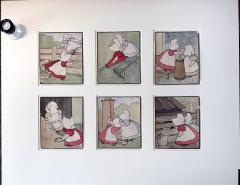
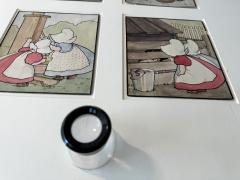
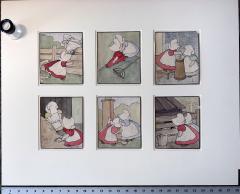
Six drawings in all on one board. 6-1/8 x 5 inches (15.6 x 12.7 cm) (each)
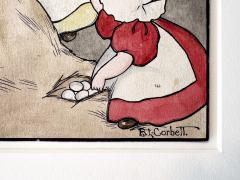
One signed; two initialed; three not signed.
The Sunbonnet Babies characters were created by illustration Bertha L. Corbett when she was challenged to create a faceless character who nonetheless was engaging and appealing. The characters were a wild hit and appeared in books, comics, and popular collectibles. They also became a popular motif in quilting. Few of Corbett's original drawings for the babies are known to survive, making this a rare offering.
From: Wikipedia
Sunbonnet Babies are characters created by commercial artist Bertha Corbett Melcher (1872–1950). Sunbonnet Babies featured two girls in pastel colored dresses with their faces covered by sunbonnets. Sunbonnet Babies appeared in books, illustrations and advertisements between the years of 1900 and 1930. Sunbonnet Babies were later used as a popular quilting pattern also known as Sunbonnet Sue.[1] Melcher created a male version of the Sunbonnet Babies, named the 'Overall Boys' in 1905.[2][3]
History
Bertha L. Corbett Melcher
Sunbonnet Babies were created by Bertha Corbett Melcher (1872–1950).[4] Melcher was born in Denver and moved with her family to Minneapolis in the 1880s. Melcher attended art school in Minneapolis with plans to become a commercial artist.[5] She may have also studied with Howard Pyle.[6] By the 1920s, Melcher had moved to Topanga, California.[7][4]
Melcher started drawing the Sunbonnet Babies in 1897. The origin of the signature style of the faces being covered by sunbonnets is contested by different members of Melcher's family and by Melcher herself. In an interview, Melcher's brother said their mother suggested Bertha avoid the difficulty of drawing faces by covering them with sunbonnets.[4] Melcher herself said that covering faces allowed her to communicate with body position.[4] Melcher has also said that the design came about in "answer to a friend’s challenge to convey emotion without a face."[2]
Melcher published her first book, The Sun-Bonnet Babies in 1900.[3] Later, she shopped her illustrations to publisher Rand McNally of Chicago, and nine subsequent books were written by Eulalie Osgood Grover and illustrated by Bertha Corbett. In 1905, Melcher wrote The Overall Boys.[3] Many of these books were used as primers and used widely in primary schools in the midwest.
Melcher used the sunbonnet babies in advertising and later established the Sunbonnet Babies Company. She started a studio to illustrate and create merchandise of the Sunbonnet Babies.[2] The characters also appeared in a comic strip.[2]
Quilting
Melcher herself did not originate the use of the sunbonnet babies as quilting pattern. The Sunbonnet Babies quilting pattern appeared in textile art 1910's in the Ladies Home Journal 1911–1912 in a quilt stitched by Marie Webster. The pattern was popular during the Great Depression. In the American South, it was often known as "Dutch Doll" until the 1970s.[3] There was also a quilt pattern based on the "Overall Boys," known by the various names including “Overall Bill, “Overall Andy,” “Sunbonnet Sam,” “Suspender Sam,” “Fisherman Jim."[3] Many patterns for quilts and sewing were designed by Ruby Short McKim and published in nationally syndicated newspapers.[8]
Sunbonnet Sue became symbolic of 'female innocence and docility'.[9] Linda Pershing collected accounts from women quilters who depicted 'Sues' doing activities such as smoking, wearing more revealing clothing, and subverting feminine stereotypes.[10] In 1979, the “Seamsters Union Local #500," a group of quilters from Lawrence, Kansas, created “The Sun Sets on Sunbonnet Sue," a quilt depicting the character murdered in a variety of ways.[3]
Collectibles
Sunbonnet Babies merchandise includes school books, valentines cards, postcards, china, and quilts.[2][5][11]
Sunbonnet Babies were adapted into three dimensional porcelain collectibles and pottery made by Royal Bayreuth Company in the early 1900s. The Royal Bayreuth China Company collection featured plates and figurines most popular were the days of the week series featuring the two Sunbonnet babies engaging in daily tasks of the week, similar to the material in the 1906 The Sunbonnet Babies at Work, at Play.[12] The original series was manufactured in the early 1900s. A series was reissued in the 1970s.
Books
The Sun-Bonnet Babies – Bertha L. Corbett 1900
The Sunbonnet Babies Book – Eulalie Osgood Grover and Bertha L. Corbett 1902
The Sunbonnet Babies Primer – 1902
The Overall Boys: a first reader – 1905
The Sunbonnet Babies at Work, at Play – 1906
The Sunbonnet Babies in Italy – 1922
The Sunbonnet Babies in Mother Goose Land – 1927
The Sunbonnet Babies A-B-C Book A Modern Horn Book – 1929
The Sunbonnet Babies at Work at Play – 1906
The Sunbonnet Babies in Holland – 1915 -
More Information
Documentation: Signed Origin: United States, California Period: 1900-1919 Materials: Watercolor on paper Condition: Good. Scattered areas of very minor losses along extreme edges and to corners of some. One with two repairs at the lower extreme edge. Each fixed to mat, verso of each not examined. Creation Date: 1905 Styles / Movements: Modernism, Surrealism, Illustration Incollect Reference #: 794052 -
Dimensions
W. 5 in; H. 6.13 in; W. 12.7 cm; H. 15.57 cm;
Message from Seller:
Robert Funk Fine Art in Miami offers an eclectic collection shaped by 45 years of experience, blending art with commercial perspectives. For inquiries or art advisory services, contact Robert Funk at decoypoet@yahoo.com or 305.857.0521.
More Listings from Robert Funk Fine Art View all 1148 listings
-
Hellenic Hypotenuse. Nudes among Greek Columns
-
Untitled (French Barque under Staysail)

-
Ribbon Dance Female Figure with Blue Ball Oil on Canvas
-
Wisdom is Better than Rubies, The Book of Proverbs Original art for sale
-
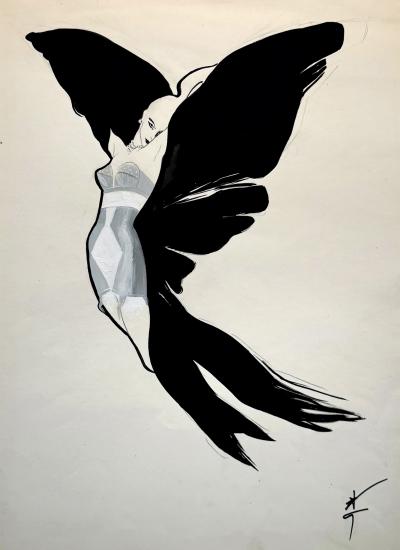
Vintage Bra and Girdle Advertisement Winged Fashion Model Original Art for Sale
-
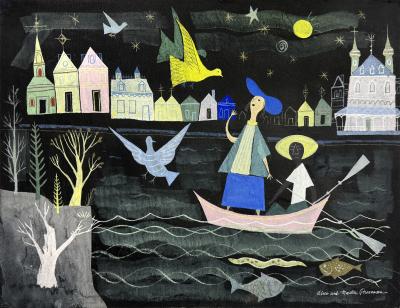
Mid-Century Fairy Tale Children's Book Illustration , Girl in a Boat Signed
-
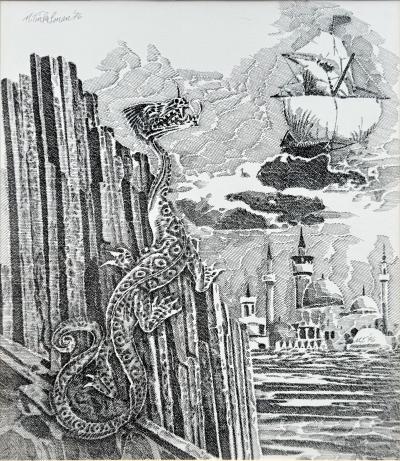
H.P. Lovecraft Dream Quest of Unknown Kadath Original Art for Sale, Signed
-
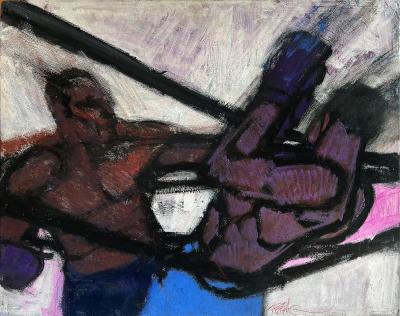
Boxer Knockout Punch - Esquire Magazine Mid- Century Sports - Action Painting
-
Madeline in a Garden with Windmill Original Art twelve little girls

-
Portrait of Theresa Rogers
-
Sensuous Reclining Nude Original Work on Paper Signed,
-
Cabeza de Nina Negra, Signed Exhibited at the Museo Guayasamín
-
Icarus, Muscular Man Nude Bronze with Wings , Signed G. Colin and stamped 5888

-
Early Wall Street Vintage Lower Manhattan Skyline painting. Capitalism Rising