






Listings / Fine Art / Prints / Cities & Towns
Offered by:
Arthur T. Kalaher Fine Art
28E Jobs Lane
Southampton, NY 11968 , United States
Call Seller
631.204.0383
Showrooms
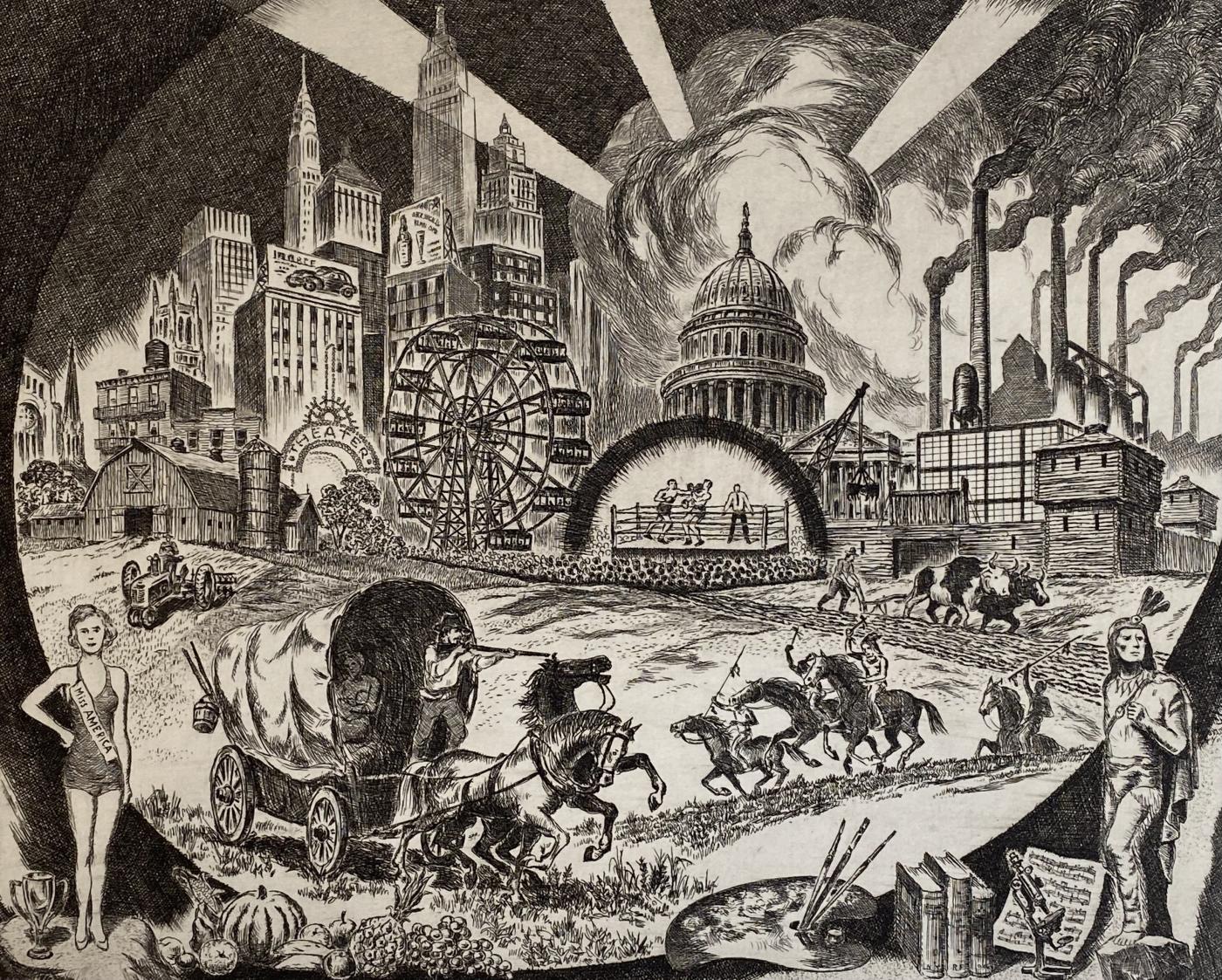
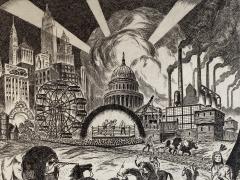
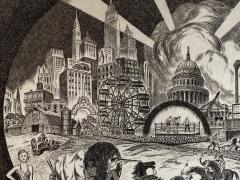
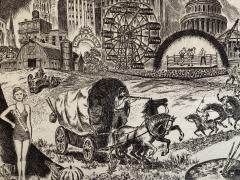
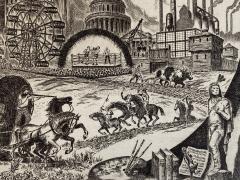
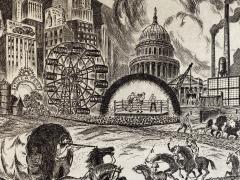
"Americana"
-
Description
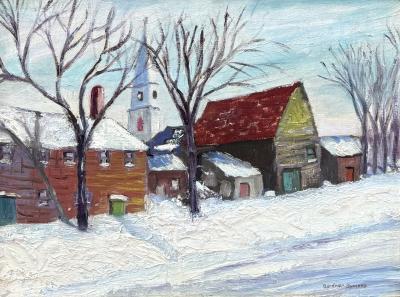
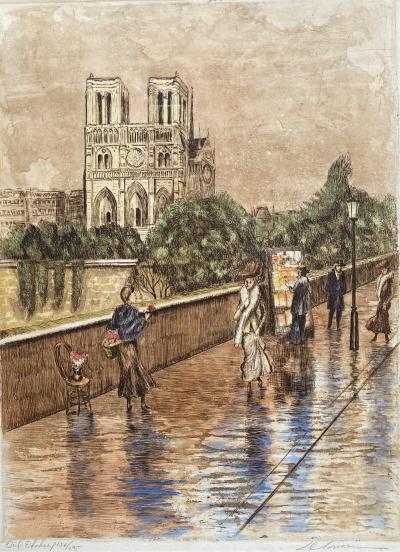
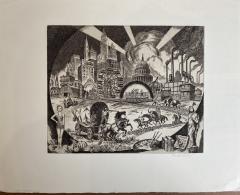
Here for your consideration is a wonderful original etching on archival paper by the well known American artist, Ralph Fabri. Strong impression; signed in pencil by the artist lower right margin. Titled and dated bottom left of the sheet “1947-Americana”. Condition of the etching is excellent. Top corner of sheet and bottom right corner of sheet have tiny creases. Not visible, under the mat. Sheet size is 12 by 15 inches. Image size is 8 by 9.75 inches. Matted but not framed. Provenance: A Long Island, New York collector.
Painter and printmaker, commercial artist, writer, and teacher, Ralph Fabri was born Fabri Reszo in Hungary in 1894. He was educated in Budapest, first studying architecture at the Royal Institute of Technology from 1912 to 1914. He then enrolled in the Royal Academy of Fine Arts, from which he graduated in 1918 with a Professor's Diploma (M.A.) "for teaching drawing, painting and geometry – including descriptive and projective geometry – in schools of higher education."
Fabri arrived in New York City in 1921 and soon adopted the anglicized version of his name, Ralph Fabri. He began doing commercial design work and during the academic year of 1923/24 was enrolled as an evening student at the National Academy of Design. After becoming an American citizen in 1927, he traveled extensively in Europe. Upon returning to New York that same year, Fabri decided his financial situation was stable enough to allow him to focus his attention on fine art.
During the Great Depression, Fabri's already inadequate portrait commissions and art sales further declined and he returned to commercial work. He established a workshop known as the Ralph Fabri Studios, that designed theatrical and movie sets, window displays, and retail interiors. But Fabri found the workshop dirty and distasteful, and eventually was able to concentrate on advertising work which could be done from home. The largest clients for his pen and ink drawings were The Stamp and Album Co. of America, Inc. (for which he designed covers for stamp albums and produced illustrations for envelopes housing sets of stamps sold to collectors), Geographica Map Co., and Joseph H. Cohen & Sons (for whom he designed and illustrated mail order catalogs). Another source of income during this period was the design and construction of an addition to "Iroki," Theodore Dreiser's estate in Mt. Kisco, N.Y., for which Fabri acted as architect and contractor.
Soon after arriving in the United States, Fabri began writing art reviews and articles on art and other topics for publication in Hungarian newspapers, and began submitting similar pieces to American newspapers and periodicals. Between 1949 and 1951 Pictures on Exhibit published a series of twenty articles by Fabri on materials and techniques, and from 1952 through 1961 he was a critic for that publication. Fabri contributed many articles on a variety of topics to Today's Art, starting in 1953, the year the magazine was established. In 1961, Fabri became associate editor of that monthly periodical and was named its editor in 1970, a position he held for the remainder of his life. During his tenure, every issue of Today's Art included signed and unsigned articles and editorials by Fabri, as well as some pieces written under pseudonyms. He also worked as a book reviewer for American Artist and art editor of Funk & Wagnall's New Encyclopedia .
Fabri may be best known for his books in the how-to-do-it vein, some of which were distributed through art supply stores. Among his many books are: Learn to Draw (1945), Oil Painting: How-to-Do-It! (1953), A Guide to Polymer Painting (1966), Sculpture in Paper (1966), Color: A Complete Guide for Artists (1967), Complete Guide to Flower Painting (1968), The First Hundred Years: History of the American Watercolor Society (1969), Painting Outdoors (1969), Painting Cityscapes (1970), and Artist's Guide to Composition (1971).
For nearly three decades, Fabri taught art in New York City. He was an instructor in the life and still life classes at the Parson's School of Design from 1947 through 1949. In 1951, Fabri was appointed associate professor at City College of New York, where he taught painting and art history until retiring in 1967. In addition, he was on the faculty of School of the National Academy of Design, teaching painting, drawing, and graphics from 1964 until his death.
Fabri was an active member of many artists' organizations. He was president of the National Society of Painters in Casein, Inc., an organization founded by Fabri in 1953 (it later became the National Society of Painters in Casein and Acrylic, Inc.); he also served as president of the Audubon Artists and the Allied Artists of America, Inc. As historian of The American Watercolor Society, Fabri wrote a book length history of that organization published on the occasion of its centennial. He was the secretary and treasurer of the National Academy of Design, as well as serving on many of its committees.
Paintings and prints by Ralph Fabri have been exhibited widely in solo and group exhibitions throughout the United States and, to a lesser extent, in Europe. A frequent lecturer, his painting demonstrations were quite popular. Fabri received numerous honors and awards, and his work is included in the permanent collections of the Metropolitan Museum of Art, the Library of Congress, the New York Public Library, the National Academy of Design, the Norfolk Museum of Art and Science, Smithsonian Institution, the Museum of Fine Arts, the National Gallery in Budapest, and many other public and private collections.
Ralph Fabri died in New York City in February 1975. -
More Information
Documentation: Signed Origin: United States Period: 1920-1949 Materials: Etching on archival paper Condition: Excellent; mild creases top left and lower right corners of sheet. Not visible, under mat. Creation Date: 1947 Styles / Movements: Modernism Incollect Reference #: 555182 -
Dimensions
W. 9.75 in; H. 8 in; D. 0.25 in; W. 24.77 cm; H. 20.32 cm; D. 0.64 cm;
Message from Seller:
Arthur T. Kalaher Fine Art, located in Southampton, NY, offers a curated selection of traditional and contemporary works, including pieces by the Peconic Bay Impressionists and the estate of Nahum Tschacbasov. For inquiries, contact 631.204.0383 or visit arthurkalaherfineart.com.