











Frank Vincent DuMond
American, 1865 - 1951
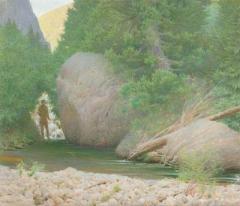
DuMond was born on August 20, 1865 in Rochester, N.Y. and died February 6, 1951, New York City. DuMond was in Lyme 1902-41.
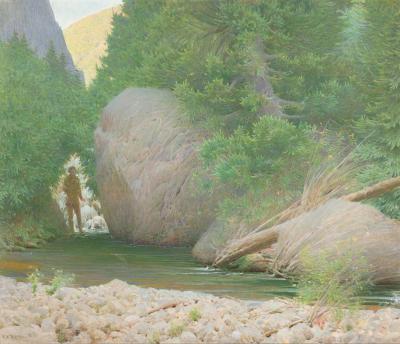
"-Now while it's nice and quiet here," Frank DuMond wrote to his parents from Lyme in August, 1909, -I'm finishing a little picture which I think of sending to our annual Lyme show. It's purely of the imagination and is that cherished land where all is peace and beauty. We all seem to yearn for it and that I suppose is a very good reason for painting it.' Since the places DuMond painted were those he really knew, the landscape of Lyme figures large in his work, imbued with imagination, certainly, but also with the spirit of place. His palette lightened at Old Lyme, too. DuMond lived in a part of Lyme called Grassy Hill and commuted to New York's Art Students League, where he was a favorite teacher. One of his host of students (that included artists as diverse as John Margin, Kenneth Hayes Miller, and Georgia O'Keeffe) said that 'His dedication to teaching was such that he showed more stamina . . . at 86 than most of us in our 20s. As well as doing his own painting and holding his regular classes, he had an extra late-afternoon session in the League basement once a week. Present and past students would bring in work painted outside of class, and . . . he would go over them one at a time for the benefit of lie taught for inure than fifty years at the Art Students League, maintaining a schedule that often required him to take the night ferry from New London in order to be in New York in time for his classes. The DuMonds also had an apartment in the cooperative building on W. 67th St. DuMond was an original stock¬holder there and helped finance the Hotel des Artistes as well. DuMond was born in Rochester, New York, in 1865. He went to New York in 1884 to study at the Art Students League and became an illustrator, first for the New Daily Graphic, then for Century and for Harpers Weekly. In 1888 he went to Paris to study at the Academe Julian under Boulanger, Constant, and Lefebvre. In 1892 Harper's editor, who was president of the Art Students League, persuaded DuMond to teach there. He was twenty-seven years old. Besides teaching, he continued his illustration career for a time, eventually doing the art work for Mark Train's Joan of Arc. In the 1890s DuMond also taught summer classes in France, first for the Art Students League and then privately. Students in those classes literally worked from dawn to dusk, since they were expected to be outdoors each day to paint both sunrise and sunset and attend drawing and other lessons between. Such schedules were not unusual for students of landscape painting in the period. DuMond for a time did many murals, for places such as The Lotos Club, Central Park Studios, and the Hotel des Artistes in New York City. His fifteen-foot mural for the Court of the Universe at the Panama-Pacific Exposition in San Francisco in 1915 was "Conquest of the Pacific Coast.' He had already received a number of awards: a gold medal at the 1890 Paris Salon (for a religious painting called "Holy Family-), gold medals at the Boston Exposition of 1892 and the Atlanta Exposition of 1895, two silver medals at the Pan-American Exposition in Buffalo in 1901, and another at the St. Louis Exposition of 1904. He was director of the department of fine arts for the Lewis ands Clark Exposition in Portland, Oregon, in 1905, and a member of the awards jury at the Panama-Pacific Exposition. Vic was a member of the National Academy of Design and the Society of American Artists, as well as of several other professional groups, and he belonged, as well, to the Lotus, Players, Salmagundi, and Century Clubs. DuMond and his family first went to Old Lyme in 1902. With Will Howe Foote as his assistant, DuMond directed the Lyme Summer School of Art, which became known as the foremost in the country. By 1904 the school had forty or fifty students. By 1906 it was feared that the great number of students would spoil the "place where the best American painters congregate,' and the Art Students League was persuaded to move the school to Woodstock, New York. DuMond and others continued to give private lessons in Lyme. He was so highly thought of as a teacher that Mrs. Woodrow Wilson reputedly had come to Lyme just to study with him. DuMond apparently taught sum¬mer classes in Lyme until at least 1915. He bought his Grassy Hill home several years earlier. Between world wars, he taught summer sessions in Gape Breton, Nova Scotia. In about 1939 he was apparently at Kent and Essex for summer classes, and later he had a popular summer school in Pownal, Vermont. He combined his favorite sport of fly-fishing with painting and was known for a series on salmon fishing in the 1940s. He moved to New York in 1941, at least for the winters. In 1952, a year after DuMond's death, the Art Students League sponsored a memorial exhibition of his work. Further reading: Abrams, Herbert E. "Teachings of Frank Vincent DuMond: Penetrating Light." American Artist, 38 (March 1974), 36-45. Frank Vincent DuMond. Exh. cat., Art Students League, 1949. Frank Vincent DuMond Papers. Archives of American Art microfilm copy. .1 Memorial Exhibition of Paintings by F. DuMond, Exh. cat., Art Students League, 1952.Biography courtesy of Roughton Galleries,
frank-vincent-dumond-paintings-art
frank-vincent-dumond-paintings-art
 Loading...
