













Offered by:
Kristan Hauge Japanese Art
2-32 Saishoji-cho, Okazaki, Sakyo-ku,
Kyoto 606-8342 , Japan
Call Seller
81757515070
Showrooms
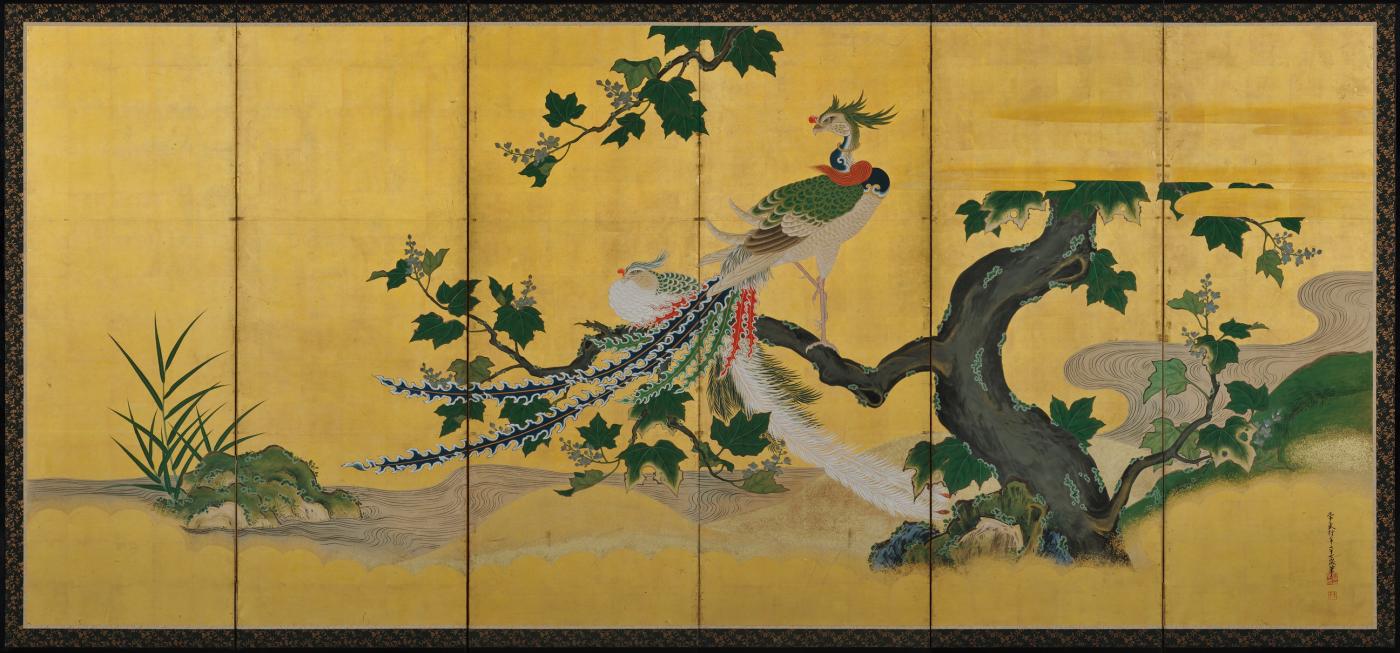
Tsunetake Yotei (18 c.) | Phoenix & Peacocks | Japanese folding screen pair
-
Description
Phoenix and Peacocks.
A pair of six-panel Japanese folding screens by Tsunetake Yotei (n.d.)
First half of the 18th century.
The signature reads 67 year old Tsunetake.
The seals read:
-Tsunetake no in,
-Yotei,
-Seishin
Dimensions:
Each screen – H. 69” x W. 149” (176 cm x 378 cm)
A pair of Kano Grand Picture (Waga) screens depicting phoenix and peacocks rich with symbolic meaning. Dating to the first half of the 18th century, from the Kobikicho Kano school in Edo, this pair of folding screens spring from the height of the Japanese Tokugawa reign. The Kano school of art was within the Tokugawa dispensation and provided for its internal needs rather than a public constituency. A Kano decorated castle, or temple, was a way to acquire military standing and to ensure confidence in the steadfastness of their virtue. Temple residences, especially senior abbacies, were decorated similarly to castles, unsurprisingly as they were sponsored by the same warriors. Beyond image halls and places of ritual exercise, temples had abbacies, monastic living quarters and guest houses, all of which would be ornamented, as rich as any mansion, and in not a dissimilar way.
Kano Grand-Picture Waga invokes the broad notion of auspiciousness, especially its political dimension. The mythical phoenix was a symbol of peace and would only appear in a kingdom blessed with prosperity during the reign of a virtuous emperor. The paulownia tree was regarded as sacred and home to the phoenix, and the phoenix and paulownia together carried strong auspicious connotations. Peacocks communicate high status, wealth and power. This pair of screens would have left no doubt as to the status of their owner or patron.
Waga was understood as bold and colourful, with copious use of gold. The artists strived for luxurious tints and beautiful appearances. This pair of screens epitomise the concept and their startlingly fresh pigments and sublimely hued gold leaf effortlessly sweep the viewer to a previous epoch.
Tsunetake Yotei was an artist of the Kano school. He is listed in Araki Nori. Dai-Nihon Shoga Meika Taikan (Dictionary of Great Japan Calligraphy and Painting Masters). Tokyo: Dai-ichi Shobo. 1975. p.2435. His dates are unknown. Almost certainly he was a student of Kano Tsunenobu Yoboku 常信 養朴 (1636-1713) of the Kobikicho Kano. All of Tsunenobu’s well-known students used the first and third characters of his name, as is the case with Tsunetake Yotei 常武 養亭. -
More Information
Period: 18th Century Styles / Movements: Asian Art Incollect Reference #: 839439 -
Dimensions
W. 148.82 in; H. 69.29 in; W. 378 cm; H. 176 cm;
Message from Seller:
Kristan Hauge Japanese Art, based in Kyoto's museum district since 1999, specializes in important Japanese screens and paintings for collectors, decorators, and museums worldwide. Contact us at khauge@mx.bw.dream.jp or +81 75-751-5070 for exceptional access to Japanese art and history.
More Listings from Kristan Hauge Japanese Art View all 69 listings
-
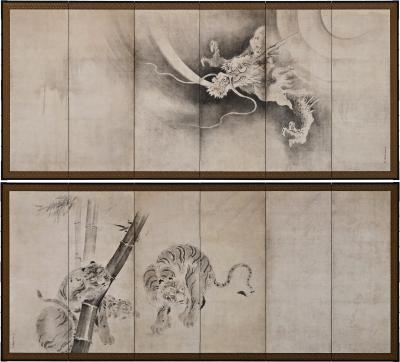
17th Century Japanese Screen Pair. Tiger & Dragon by Kaiho Yusetsu
-
urtledoves in a Peach Tree | Nakamura Daizaburo

-
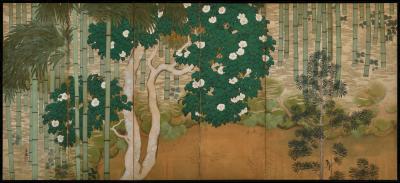
Early 20th Century Japanese Nihonga Screen. Bamboo Forest
-
19th Century Japanese Scroll Painting, Birds & Flowers of the Four Seasons.
-
19th Century Japanese Scroll Painting by Igarashi Chikusa, Poppies & Butterflies
-
Mother’s Breast (Chichi) 1844. Japanese scroll painting.

-
Playful Cat | Hirose Toho (1875-1930) | Japanese scroll painting

-
17th Century Momoyama era. Crows on Pine. Studio of Hasegawa Tohaku
-
Early 20th Century Japanese Screen. Flowers of the Four Seasons
-
Mid 19th Century Framed Japanese Painting. Snail, Wasp & Hollyhock.
-
17th Century Japanese Screen Pair. Roosters and Chickens in a Bamboo Grove
-
Mitani Toshuku (1577-1654). Unkoku School. Japanese falcon painting.

-
Amaranth & Rooster | Circa 1930 | Japanese scroll painting

-
Korean grapevine painting. 17th century.

