

-
FINE ART
-
FURNITURE & LIGHTING
-
NEW + CUSTOM
- FEATURED BESPOKE MAKERS
- Stephen Antonson
- Pieter Adam
- Nader Gammas
- Eben Blaney
- Silvio Mondino Studio
- Neal Aronowitz
- Mark Brazier-Jones
- Proisy Studio
- Ovature Studios
- Cartwright New York
- Thomas Pheasant Studio
- Lorin Silverman
- Chapter & Verse
- Reda Amalou
- KGBL
- AL Design Aymeric Lefort
- Atelier Purcell
- Pfeifer Studio
- Susan Fanfa Design
-
DECORATIVE ARTS
- JEWELRY
-
INTERIORS
- FEATURED PROJECTS
- East Shore, Seattle by Kylee Shintaffer Design
- Apartment in Claudio Coello, Madrid by L.A. Studio Interiorismo
- The Apthorp by 2Michaels
- Houston Mid-Century by Jamie Bush + Co.
- Sag Harbor by David Scott
- Park Avenue Aerie by William McIntosh Design
- Sculptural Modern by Kendell Wilkinson Design
- Noho Loft by Frampton Co
- Greenwich, CT by Mark Cunningham Inc
- West End Avenue by Mendelson Group
- VIEW ALL INTERIOR DESIGNERS
- INTERIOR DESIGN BOOKS YOU NEED TO KNOW
- Distinctly American: Houses and Interiors by Hendricks Churchill and A Mood, A Thought, A Feeling: Interiors by Young Huh
- Robert Stilin: New Work, The Refined Home: Sheldon Harte and Inside Palm Springs
- Torrey: Private Spaces: Great American Design and Marshall Watson’s Defining Elegance
- Ashe Leandro: Architecture + Interiors, David Kleinberg: Interiors, and The Living Room from The Design Leadership Network
- Cullman & Kravis: Interiors, Nicole Hollis: Artistry of Home, and Michael S. Smith, Classic by Design
- New books by Alyssa Kapito, Rees Roberts + Partners, Gil Schafer, and Bunny Williams: Life in the Garden
- Peter Pennoyer Architects: City | Country and Jed Johnson: Opulent Restraint
- An Adventurous Life: Global Interiors by Tom Stringer
- VIEW ALL INTERIOR DESIGN BOOKS
-
MAGAZINE
- FEATURED ARTICLES
- Northern Lights: Lighting the Scandinavian Way
- Milo Baughman: The Father of California Modern
- A Chandelier of Rare Provenance
- The Evergreen Allure of Gustavian Style
- Every Picture Tells a Story: Fine Art Photography
- Vive La France: Mid-Century French Design
- The Timeless Elegance of Barovier & Toso
- Paavo Tynell: The Art of Radical Simplicity
- The Magic of Mid-Century American Design
- Max Ingrand: The Power of Light and Control
- The Maverick Genius of Philip & Kelvin LaVerne
- 10 Pioneers of Modern Scandinavian Design
- The Untamed Genius of Paul Evans
- Pablo Picasso’s Enduring Legacy
- Karl Springer: Maximalist Minimalism
- All Articles
Period
Medium
Size
- Clear All
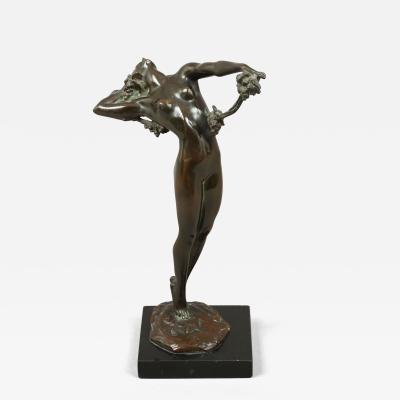
Harriet Whitney Frishmuth
American, 1880 - 1980
Harriet Frishmuth was born in Philadelphia, PA in 1880. She moved to Europe at an early age with her mother and two sisters. She received most of her early schooling in Switzerland and was introduced to sculpture at the age of 19. Moving to Paris she inquired about art classes and the only one she could find open to women was a class taught by Auguste Rodin. She also studied under Gauguie and Injalbert and spent two years in Berlin as an assistant to Professor Cuno von Enchtritz.She returned to the United States and studied with Hermon MacNeil and Gutzon Borglum at the New York Art Students League and worked for a year in Weehawken, New Jersey, with Karl Bitter. For an understanding of anatomy, she studied dissection at the college of Physicians and Surgeons in New York for two years.Her career was an outstanding success. Her bronze sculptures were exhibited extensively and were in great demand by collectors.She was a member of the National Sculpture Society, Allied Artists of America, New York Municipal Art Society, American Federation of Arts, the Architectural League of New York and the National Arts Club. She was elected an Associate Member of the National Academy of Design in 1925 and a Member in 1929.Her sculpture was exhibited at the Paris Salon, the National Sculpture Society, Architectural League of New York and the Pennsylvania Academy of Fine Arts. Her work was shown at the Panama-Pacific Exposition of 1915 in San Francisco, at the National Academy, with the Allied Artists of American and with the American Garden Club in Philadelphia. The list of the awards and metals she received for her work is extensive.In 1913 Frishmuth and her mother bought a converted stable at Sniffen Court in New York City. The area had been a large farm, owned by a family named Sniffen, and the huge stables were converted into dwellings. It is located at 152 East 36th Street and has been designated a historical landmark.Frishmuth is quoted as having said "I did my best work in my studio -home in Sniffin Court. l was there until 1937. " She moved to Philadelphia and only one commercially popular sculpture, "Daydreams," was done after the move.She died in 1980, her centennial year.Biography courtesy of Roughton Galleries, www.antiquesandfineart.com/roughton
Harriet Frishmuth Sculpture
Loading...