- In 1993 the Glazers acquired their Bailey Island house, the oldest part of which dates to 1865, and spent a year and a half remodeling it. Shaped shingles, nautical touches such as the compass window on the second-floor dormer, perennial borders, and a wildflower meadow are a few of the couple’s many creative touches
Every summer for seventeen years, Jim and Nancy Glazer, their son and daughter in tow, made the long trek from their nineteenth-century Philadelphia townhouse to a rented cottage on Bailey Island in Maine. Leaving the din and dust of the city eight hours behind, they reached a place where the only sound was that of fog horns, lobster boats, and water lapping against the granite-slab bridge that rises like a sea serpent from Will’s Gut, the narrow channel separating Bailey Island from its nearest neighbor, Orr’s Island.
“Every time we arrived we stopped at the bridge, rolled down the window, and just inhaled,” says Nancy, who returned to Philadelphia each year dreaming of salt spray and light so crystalline that the faint outline of Mount Washington, New England’s highest peak, can be seen seventy-five miles away.
When their dream abode—a nineteenth-century farmhouse whose white clapboard exterior, graceful porches, and unassuming interiors recalling Maine’s rural past—came on the market in 1993, the Glazers, full-time dealers in American country furniture and folk art since 1972, leapt at the opportunity to make it their year-round home.
“Oh, Nanny, it’s a real fixer-upper,” the Glazers’ five-year-old grandson, Jamie, exclaimed to his grandmother the first time he saw what would become his new summer home. Now sixteen, Jamie loves the laid-back island lifestyle. Sasha, the Glazers’ three-year-old granddaughter, is partial to afternoon naps in the tree-shaded hammock posted between the potting shed and the cottage.
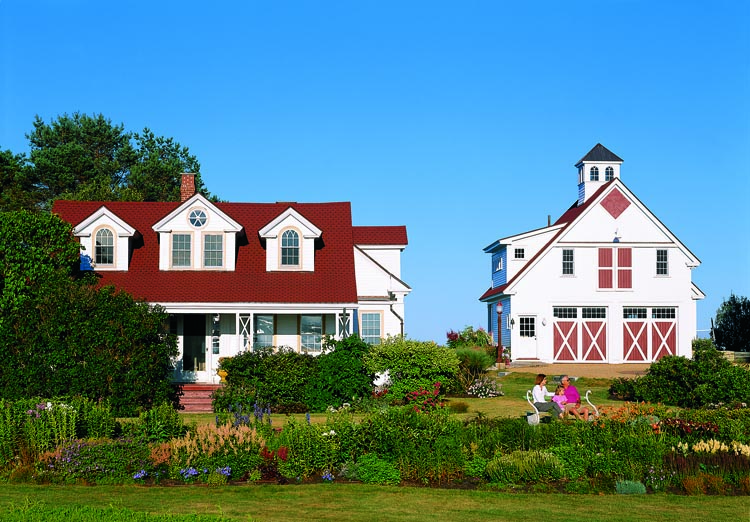
- In 2003, they collaborated with Topsham, Maine, builder David Gosselin to build the barn, which combines a gallery and garage. A balcony on the rear of the barn affords stunning views of the island-dotted ocean. A spacious porch offers additional room for outdoor living.
It took the Glazers a year and a half to acquire an adjacent property, home to what was known as the “Filling Station,” a primitive, one-room dentist’s office where patients who traveled by ferry to Bailey Island were treated. Redesigned as a sleeping cottage by Nancy, it now doubles as the Glazers’ private retreat and overflow quarters for family.
The Glazers’ main house, a Cape Cod-style dwelling whose two front rooms were built around 1865, continues to evolve. The principal bedrooms date to the 1890s. The front porch was added in the 1920s. Taking the house back to its original roof line, the Glazers removed a covered porch on the side of the residence, adding instead a small, open porch with built-in benches.
On the first floor, the Glazers installed antique paneling and a fireplace surround in the dining room, added bathrooms, and reconfigured hallways and closets. Two new dormers on the previously unfinished second floor provide additional light and space. Red shingles shaped like scallop shells crown the house, whose cheerful demeanor prompts motorists on their way to Land’s End, at the island’s southernmost tip, to slow down as they pass.
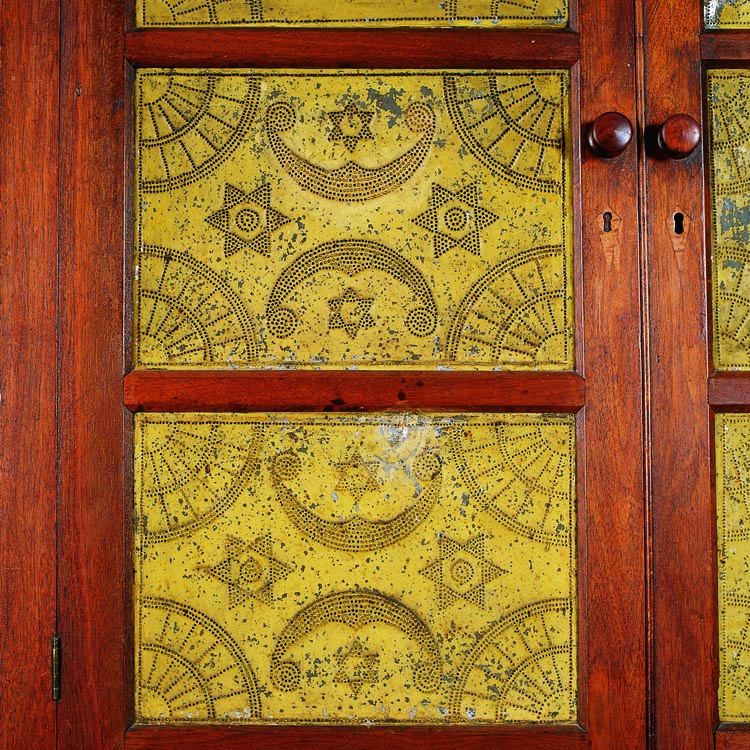 - Detail of a punched-tin panel from one of the Glazers’ favorite pieces of furniture, a Randolph County, Virginia, pie safe or textiles storage cabinet that is prominently displayed in their dining room. The finely crafted piece once belonged to Milan, Ohio, dealers Mildred and George Samaha. The star motif appears throughout the room on both a Pennsylvania corner cupboard and on the wallpaper.
|
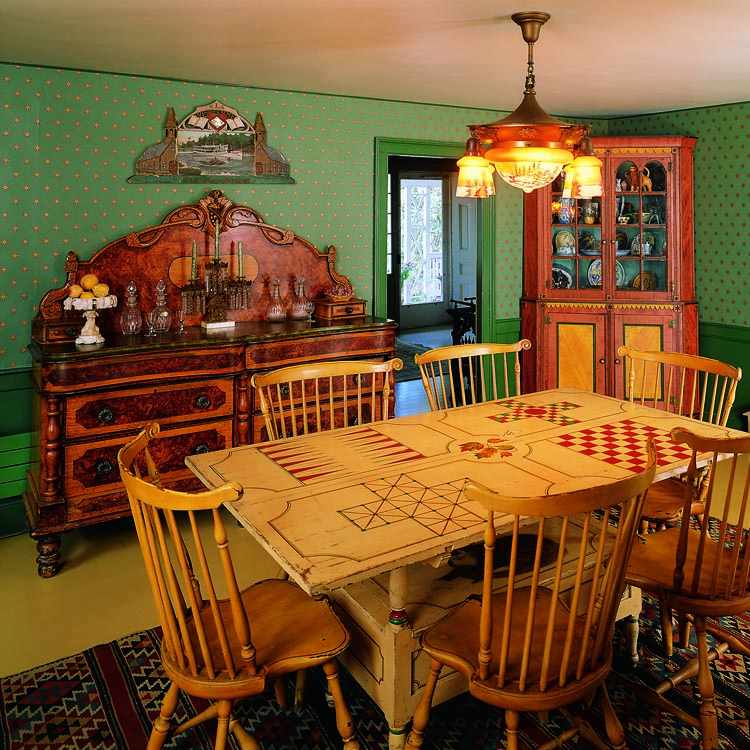 - “In everything antique there is something of the wondrous. This cupboard is a perfect example,” Jim says of the Lebanon County, Pennsylvania, corner cupboard with vivid paint decoration, applied stars, and dentil molding. The couple bought the cupboard from Litchfield, Connecticut, dealer Peter Tillou twenty-five years ago. It is one of Nancy’s favorite pieces. Jim commissioned the handmade hutch table as a Christmas present for Nancy in 1998 from Kendl Monn of Irion Company in Christiana, Pennsylvania. The exuberantly decorated bow-front sideboard is an English example made between 1840 and 1860. Purchased at auction in Thomaston, Maine, the carved and painted wall plaque depicts a picnic boat that plied Boothbay Harbor. The Glazers installed period lighting fixtures throughout the house.
|
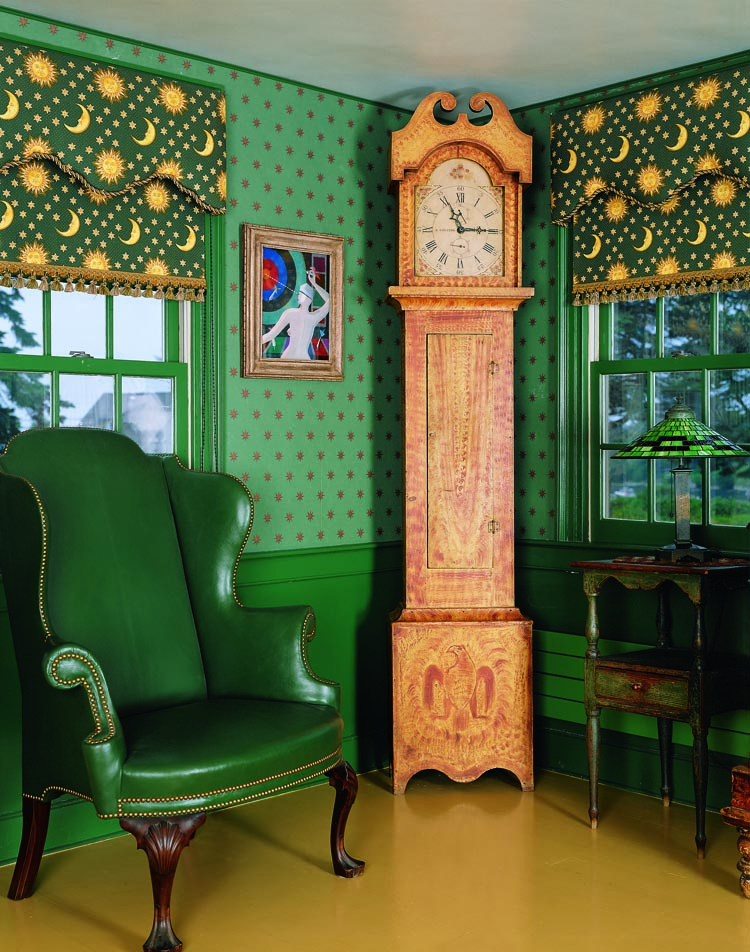 - A Federal eagle enhances the appeal of this circa 1815–1820 tall-case clock with original works by Riley Whiting of Winchester, Connecticut. The reverse painting on glass, left, is by Angelo Pinto, a Barnes Foundation instructor and friend of the Glazers. In decorating the house, Nancy employs artistic theories she learned as a student at the Merion, Pennsylvania, institution. She also turned to Peggy and Steve Zablotny of Z Studio on Martha’s Vineyard for advice on color and design.
|
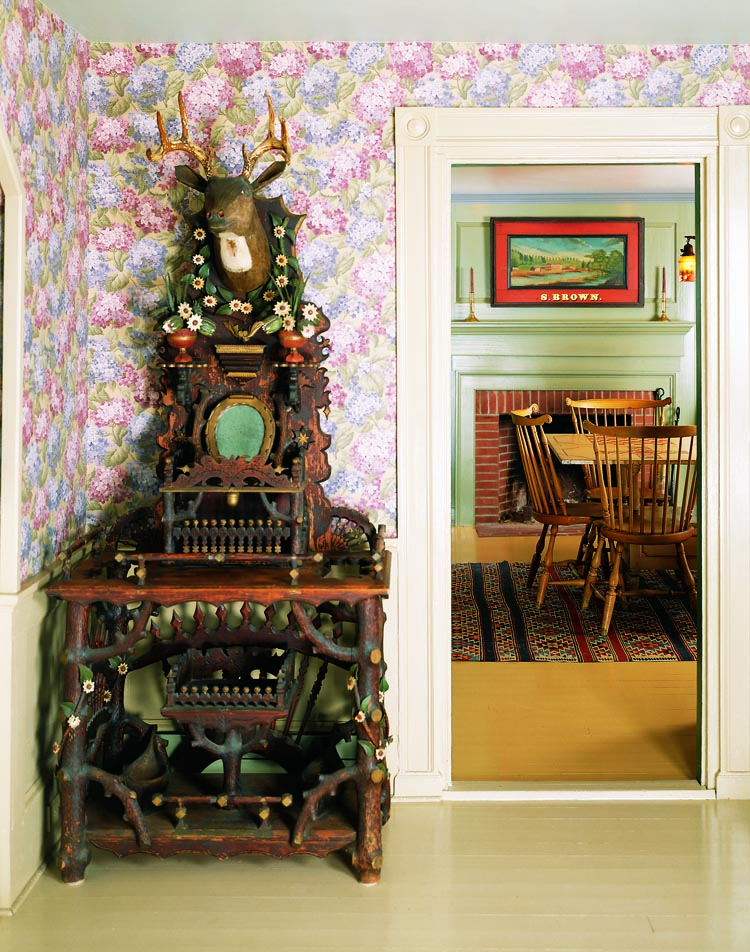 - “We bought this before we ever thought about having a house in Maine,” Jim says of the rustic hall stand in the Glazers’ sitting room. The carved and painted white pine and native mistletoe piece combines faux twig supports, a carved stag’s head, applied urns and flowers, and a horseshoe looking glass. It dates to around 1870 and is said to have come from a hunting lodge in Sherman Station, Maine. Visible above the mantel in the dining room is a mid-nineteenth-century painted chest lid, signed A. Smith, illustrating York Springs in Adams County, Pennsylvania.
|
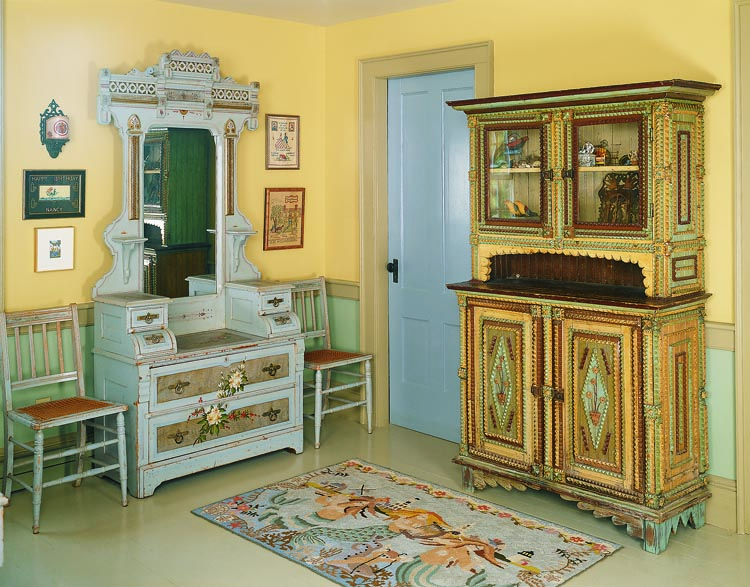 - Nancy owns dozens of early-twentieth-century cross-stitch kit samplers, two of which are shown in the master bedroom with a suite of circa-1860 New England cottage bedroom furniture. The painted tramp-art cupboard, right, is one of the Glazers’ favorite pieces. From upstate New York, it was made between 1890 and 1910.
|
 - The Glazers built their two-story barn to maximize their panoramic views of the Gulf of Maine to the east, pictured, and Mackerel Cove to the west. Reached by a series of causeways and bridges, Bailey Island lies thirteen miles off the mainland. It has been a summer colony since 1888, when regular steam ship service from Portland began.
|
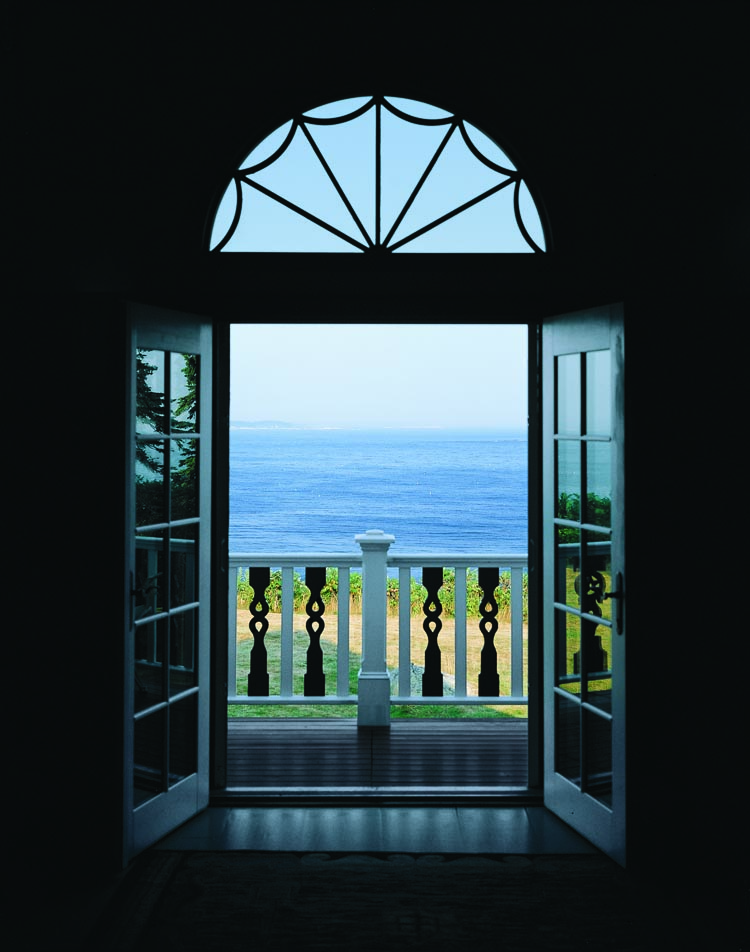
The two-story barn that the Glazers erected in 2003 houses their gallery and a garage. A balcony on the rear of the barn, a white clapboard structure with sliding barn doors painted red, overlooks stunning ocean views and a grass-lawn badminton court where Jamie engages in fierce tournaments with his grandfather. Providing additional room for outdoor living, a spacious rear porch displays the Glazers’ collection of cast-iron garden antiques.
It took three men to install the gilded copper mermaid weathervane that recently took her place on top of the barn’s cupola. Mermaids are nearly everywhere in the Glazer home: beckoning visitors to turn into Mermaid Lane, the couple’s name for their private drive; tucked into mullions; suspended from ceilings; and popped into ice-cold drinks as swizzle sticks.
Designed to “let the mermaid in,” as Nancy says, a compass window over the second-floor window seat overlooks some of her favorite mermaid antiques, among them an English carnival sign and a northern European chandelier. Mermaids frequently arrive in the mail or are presented by friends who know of Nancy’s affection for the sea sirens she considers her “guardian angels.” Nancy even has an unofficial curator of mermaids: New York dealer Joel Kopp, who scours flea markets for the whimsical collectibles.
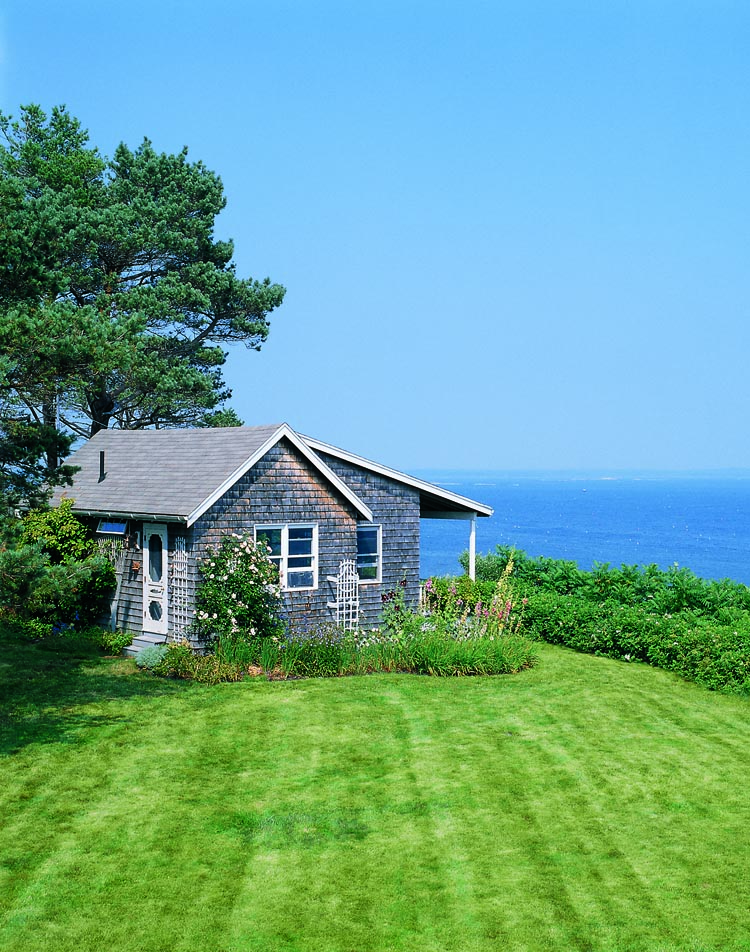
- “This is paradise,” Nancy says of the former dentist’s office she transformed into a cottage. The couple escape here to listen to the ocean and watch the moon rise. The idyllic retreat perches on a seventy-five-foot-high cliff one hundred yards from the main house. Lush with hollyhocks, delphinium and other old-fashioned flowers, Nancy’s gardens recall Childe Hassam’s paintings of Celia Thaxter’s garden on Appledore Island in Maine.
“Our business is our lifestyle,” says Jim, who still commutes to Philadelphia one week out of every six. While he’s away, Nancy minds their by-chance-or-appointment island gallery and tends to her duties as president of the Maine Antiques Dealers Association, all the while receiving a steady stream of guests. Dealers, collectors, friends, children and grandchildren are casually greeted by the Glazers’ three Maine Coon cats—Ragged, Bailey, and Wiscasset—who spend their days lazing in the sun and stalking prey in stands of towering hollyhocks.
The Glazer enterprise is a smooth blend of his talents and hers. Married forty-three years, the energetic couple seems to have found the fountain of youth in the chilly Atlantic, a stone’s throw from their cliff-side perch. It was through ocean swimming, in fact, that Jim discovered triathlon events, which he competed in from Maine to Hawaii in the 1980s. He still keeps a collection of racing bikes, some housed in the cedar-shingled potting shed that the couple bought at a country fair. Nancy’s ambitious perennial borders keep her gardening from morning to night during the summer months. Irises, daylilies, astilbe, phlox, peonies, delphinium and roses bloom in old-fashioned abundance. The wildflower meadow that Nancy resows each year is resplendent in August.
The Glazers met at the University of Pennsylvania, where Jim studied economics and Nancy pursued duel interests in literature and art. After college, Jim excelled as an executive in Manhattan’s garment industry between 1967 and 1972. Nancy taught school in Philadelphia and later studied art history at the Barnes Foundation, the Merion, Pennsylvania, institution that houses the renowned collection of French postimpressionist paintings assembled by Dr. Albert Barnes.
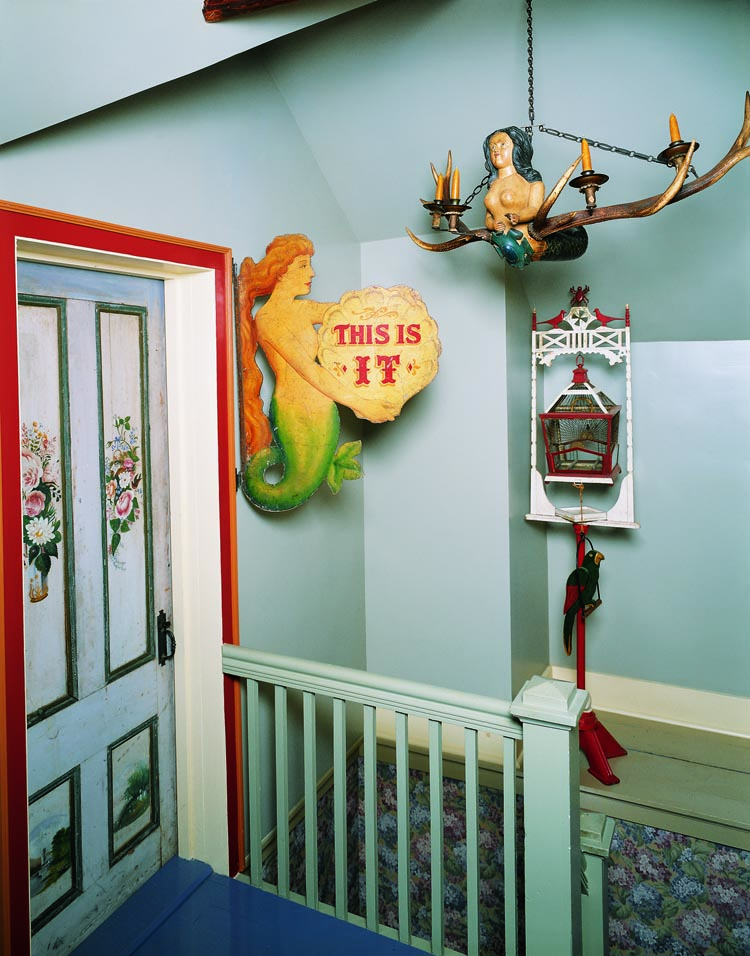 - Friends send Nancy mermaids from all over the world. On the second-floor landing hangs an English carnival sign and a northern European chandelier, the latter ex-collection of the late Pennsylvania dealer Chris Machmer.
|
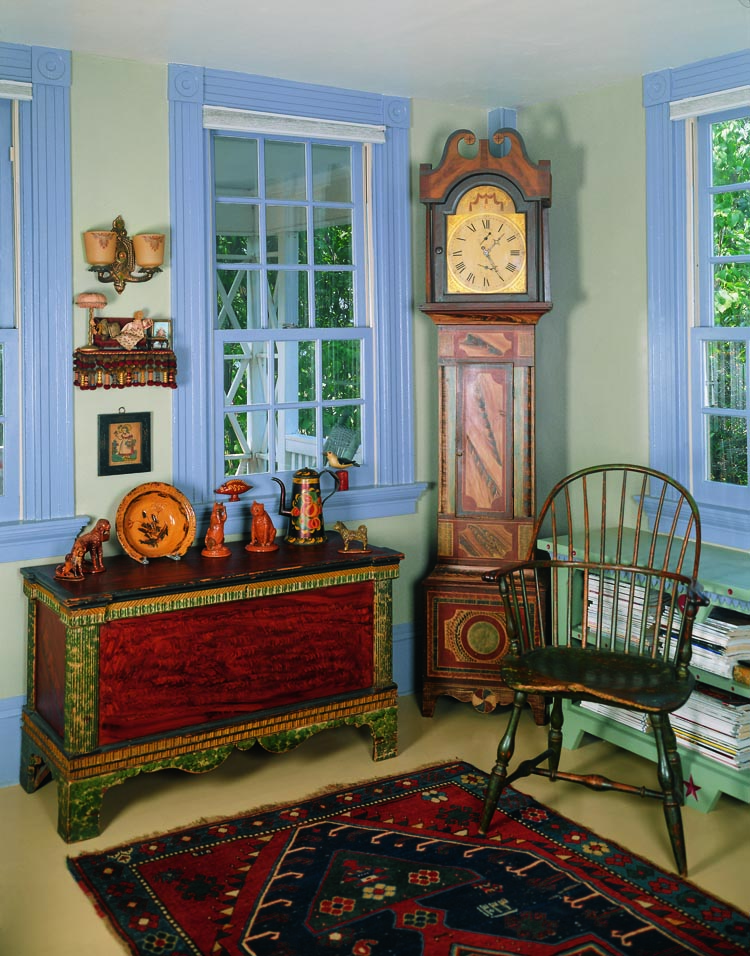 - “This thirty-hour clock in a bonnet-top wood case with applied columns is extraordinary,” Jim says of the circa 1825 timepiece that descended in the Demming family of Bennington, Vermont. The Glazers’ cozy library combines New England and Pennsylvania artifacts. The blanket chest, left, is a Maine example with rosewood graining and applied matchstick decoration. Topping it are nineteenth-century redware pottery animal figures from Virginia and Pennsylvania. The windowsill supports a rare redware hedgehog and a carved and painted figure of a bird by “Schtockschnitzler” Simmons of Berks County, Pennsylvania. The sgraffito-decorated redware shaving bowl with a German inscription is from Bucks County, Pennsylvania, and dates to circa 1820. The circa-1830 tole-painted coffee pot is from Lancaster County, Pennsylvania. The late-eighteenth-century Philadelphia Windsor knuckle-arm chair is attributed to Joseph Henzey.
|
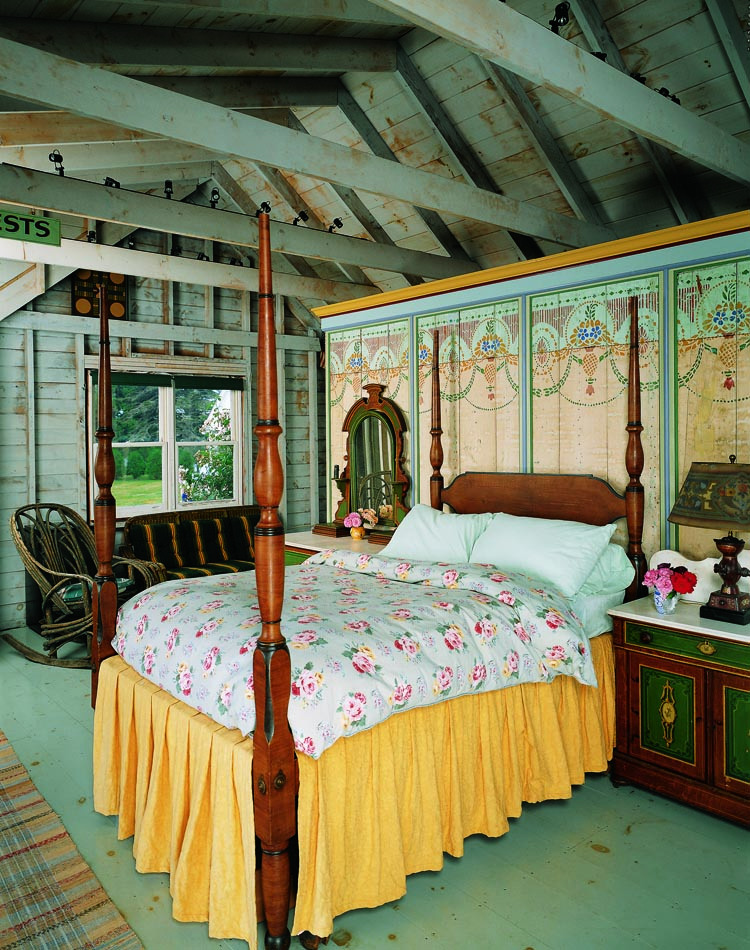 - Nancy used early-nineteenth-century paneling rescued from a dismantled Delaware Valley house to create the partition that hides a bathroom and a closet. Decorated with gold anchors, the mid-nineteenth-century marble-top cottage furniture is from a five-piece suite probably made in Boston. The paint-decorated New Jersey Sheraton bed dates to 1820.
|
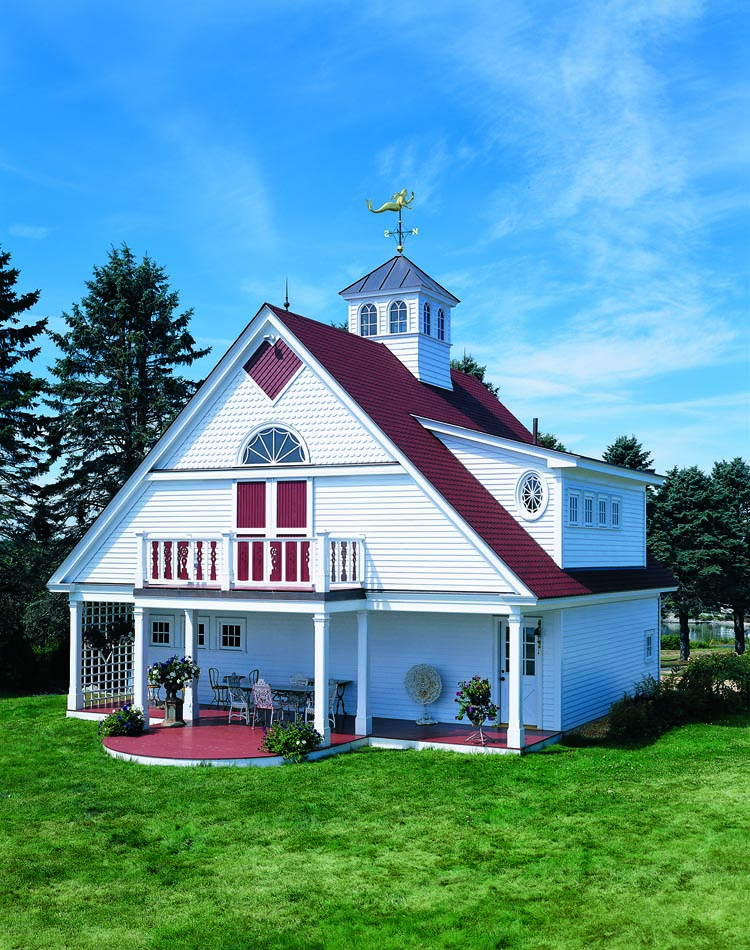 - Exterior view of the the barn.
|
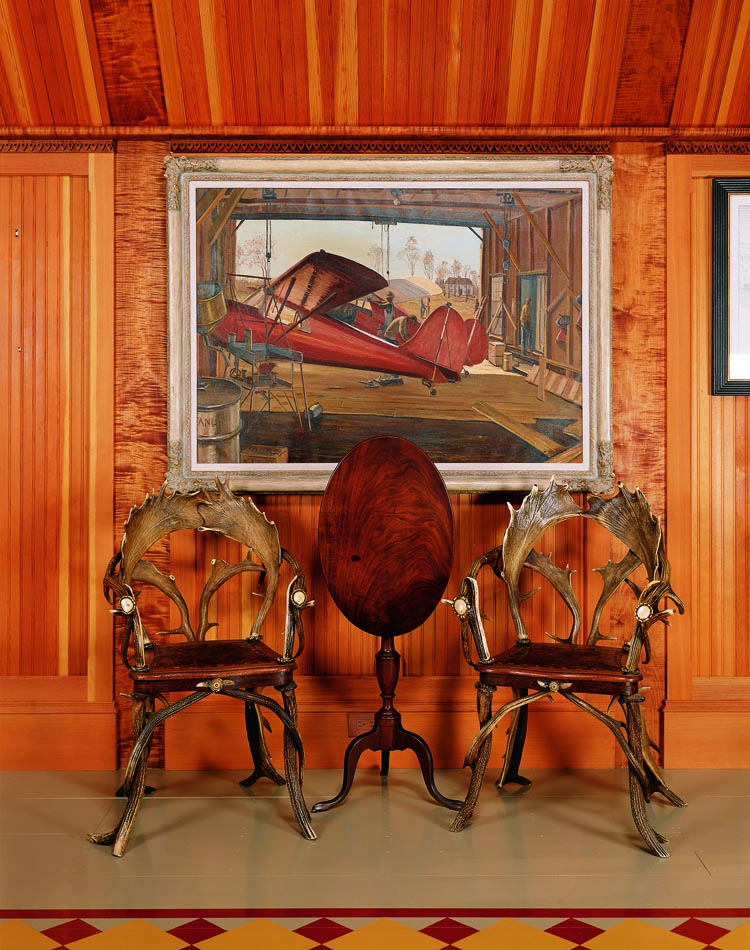 - A pair of circa-1880 horn chairs made by the San Francisco Chair Company for the Swank Creek Mining Company offices in Willowsport, Pennsylvania, flank a circa-1800 New Hampshire Chippendale mahogany tilt-top candlestand. The 1942 oil on canvas painting, In The Hangar, is by Steven Etnier (1903–1984), a York, Pennsylvania-born artist who kept a studio in Harpswell, Maine. The Portland Museum of Art in Maine organized a retrospective of the artist’s work in 1998.
|
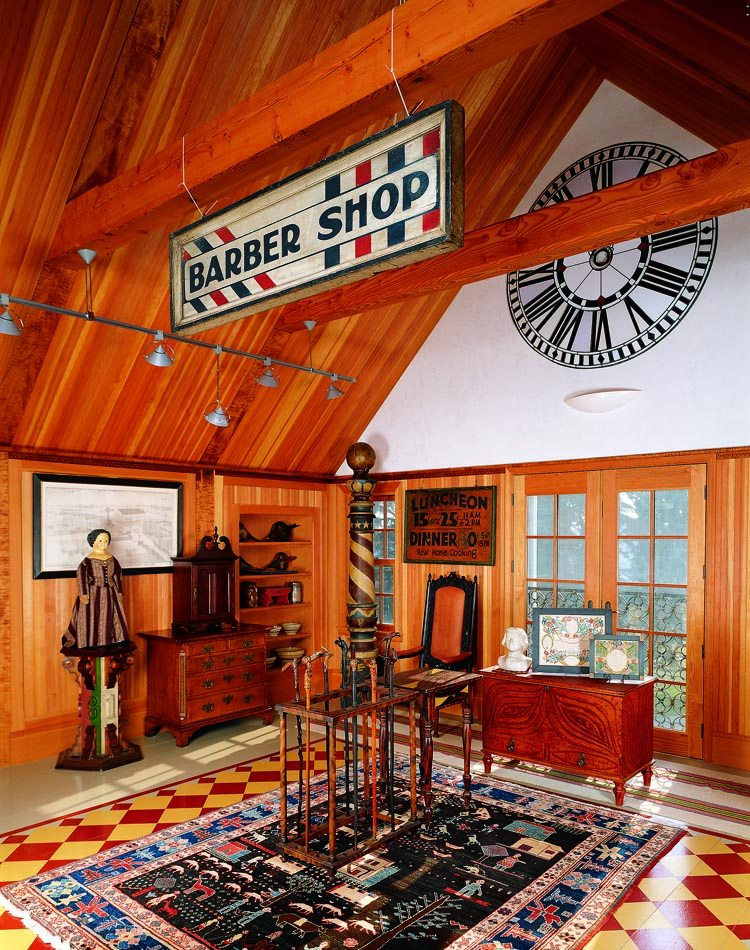 - Taking their cue from local architecture, the Glazers erected a barn to serve as their showroom and provide additional storage space. Jim chose figured maple and fir for the barn’s interior. The couple’s varied inventory includes a circa-1835 composite-head doll and fraktur birth certificates by Karl Münch of Upper Dauphin County, Pennsylvania, and his son William Henry Müench, far right. Topping a circa-1770 Philadelphia Chippendale chest of drawers of figured maple is a circa-1790 Chester County, Pennsylvania, spice chest. A double-sided trade sign found in Nantucket hangs above a signed pole from the Lexington, Virginia, shop of Robert E. Lee’s barber, James Jackson. To the right of the pole is a Berks County, Pennsylvania, carved walnut armchair, circa 1860, and a Bucks County, Pennsylvania, blanket chest, circa 1840 to 1860.
|
The Barnes Foundation was a transforming experience for both husband and wife. Barnes’ intuitive approach to looking at art and his eclectic juxtaposition of objects based on subtle, visual harmonies inspired Nancy, who exercises similar artistry in her own imaginative arrangements and provocative color combinations. These qualities distinguish the Glazers’ private living quarters as well as their public displays at the Philadelphia Antiques Show and the Winter Antiques Show in New York, where the Glazers first exhibited in 1977. It was at Ker-Feal, Barnes’ eighteenth-century farmhouse in Chester County, Pennsylvania, that Jim and Nancy first fell in love with Pennsylvania folk art, which combines earthy practicality with an irrepressible joie de vivre. The Glazers’ collecting odyssey began after they purchased their first home, a five-story Philadelphia townhouse, in 1969.
“This blue cobbler’s bench has stayed with us forever,” says Jim, pointing out one of a handful of pieces that made the long trek from Philadelphia to Maine. The farmhouse is also home to prized Pennsylvania and Virginia redware, boldly decorated tin toleware, solemn Pennsylvania dower chests commemorating nuptials of two centuries ago, and clocks, chests, and cupboards whose makers lavished their creations with imaginative detail.
But there is also room for whimsy. In an upstairs hallway Jim displays late-nineteenth-century occupational shaving mugs, each one hand-painted and individually inscribed in gold leaf with its owner’s name, Nancy hangs her light-hearted collection of early twentieth century cross-stitch kit samplers, many with amusing sayings, in the kitchen and in a nearby bathroom.
The relaxed and comfortable environment of the house is matched by the setting. On gorgeous afternoons Nancy joins granddaughter Sasha, the two positioning themselves on the hammock to take full advantage of their location. The delicate adjustment often requires help from Jim. “We have a balancing act,” says Nancy, who might have been describing the Glazers’ life together, a life that is equal parts serendipity and well-considered design.
By
Laura Beach
Contributors
Photography by J. David Bohl
Nov 1,2013
This article was originally published in the Spring 2006 issue of Antiques & Fine Art magazine. Antiques & Fine Art is affiliated with InCollect.com.