



Incomparable Elegance: W. R. Harvey & Co. Celebrates 75 Years of Fine English Antique Furniture
 |
Patinated woods, gleaming fittings and exquisite craftsmanship, ready to enrich interiors with timeless soul and warmth. |
Incomparable
Elegance
W. R. Harvey & Co. Celebrates 75 Years
of Fine English Antique Furniture
For 75 years, W. R. Harvey & Co. (Antiques) Ltd. has been one of the world’s leading sources for fine English antique furniture. Located today in a Georgian townhouse in Witney, Oxfordshire, in the Cotswolds, their collection is unparalleled in terms of quality and breadth, spanning from the reigns of Charles II through to George IV. David Harvey, son of founder Walter, spoke with Incollect about the enduring elegance of antique furniture and how Harvey’s (as it is affectionately known to its friends and clients) has continued to adapt and grow in the 21st century.
Photography courtesy W. R. Harvey & Co.
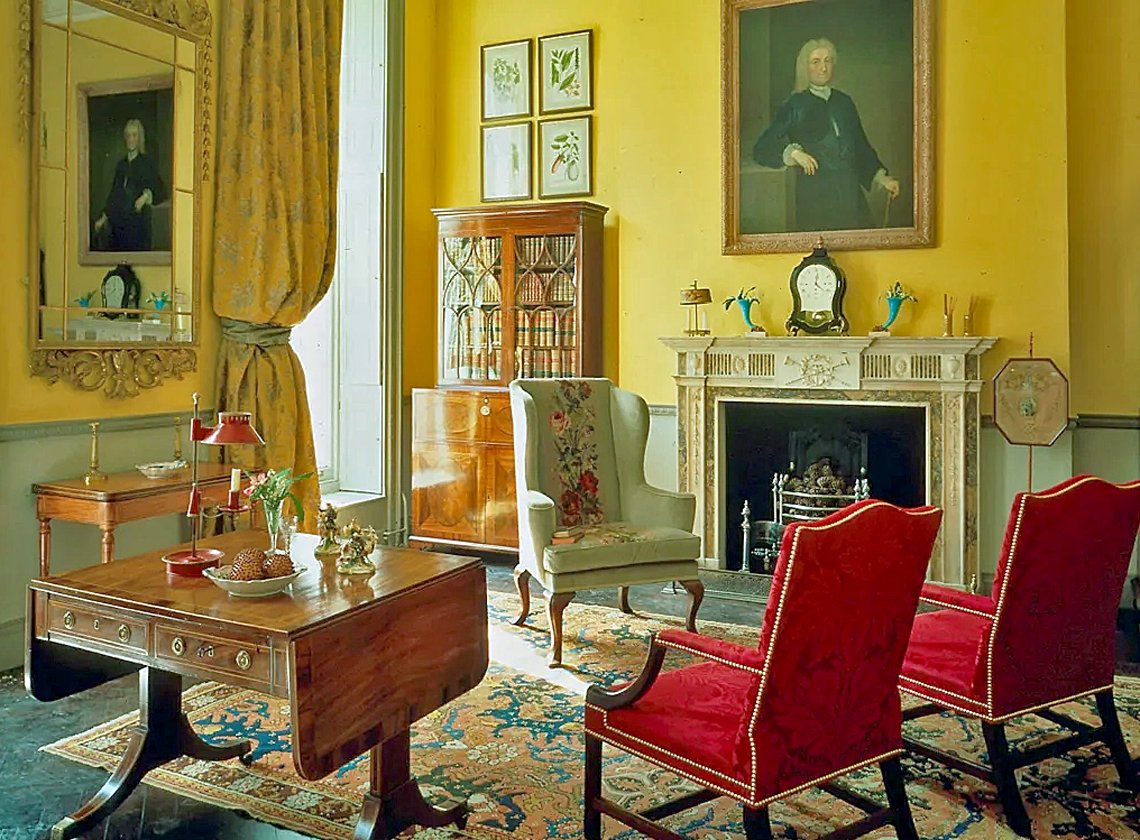 |
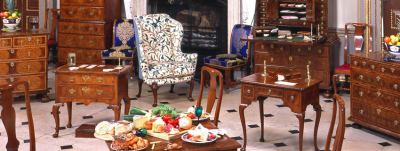
| At W.R. Harvey’s showroom, a formal drawing room furnished with fine pieces from the “golden age” of English furniture. Elegant proportions, refined details and exotic hardwoods are all characteristic of the period. Any of these pieces could enhance a range of interiors, from the most formal salon, to layered and comfortable English country style. |
What makes fine English antique furniture so covetable, even today?
The period from approximately 1660 to 1840 is often regarded as the pinnacle of English antique furniture-making. As we transition from the years of austerity under Oliver Cromwell to the Restoration of the Monarchy by Charles II, followed by William and Mary, we see a progression from joinery to cabinetmaking, with new techniques and styles being shared from the European continent. The rebuilding of London after the Great Fire of 1666 saw large numbers of skilled artisans from all over Europe descending on London and elsewhere for projects such as the building of the replacement St. Paul’s Cathedral, which offered employment opportunities for many.
“If a piece makes you smile when you first see it, then it may well charm you for many years to come. Antique furniture was made to be used, and it should continue to be.” |
— David Harvey |
Then there is the overall quality of furniture, for the makers during those 200 years constructed pieces to last. They were commissioned to be used and to be serviceable, so that the runners on drawers were replaceable, which is why a chest of drawers over 300 years old can still be used perfectly well today and may well last for the next couple of centuries with minimal restoration. Indeed, antique furniture dealers are probably the earliest recyclers on the planet, taking items that need a little care and attention and making them fit for continued use by new owners.
How have pieces changed over centuries in appearance and even meaning in a home?
The appearance of furniture has matured over the centuries and has the ability to add a different nuance and warmth to a room. These items have a presence and, in many cases, make a statement about their owners. Often, they have been inherited into one family over generations and may have traveled with their owners to overseas postings throughout the world.
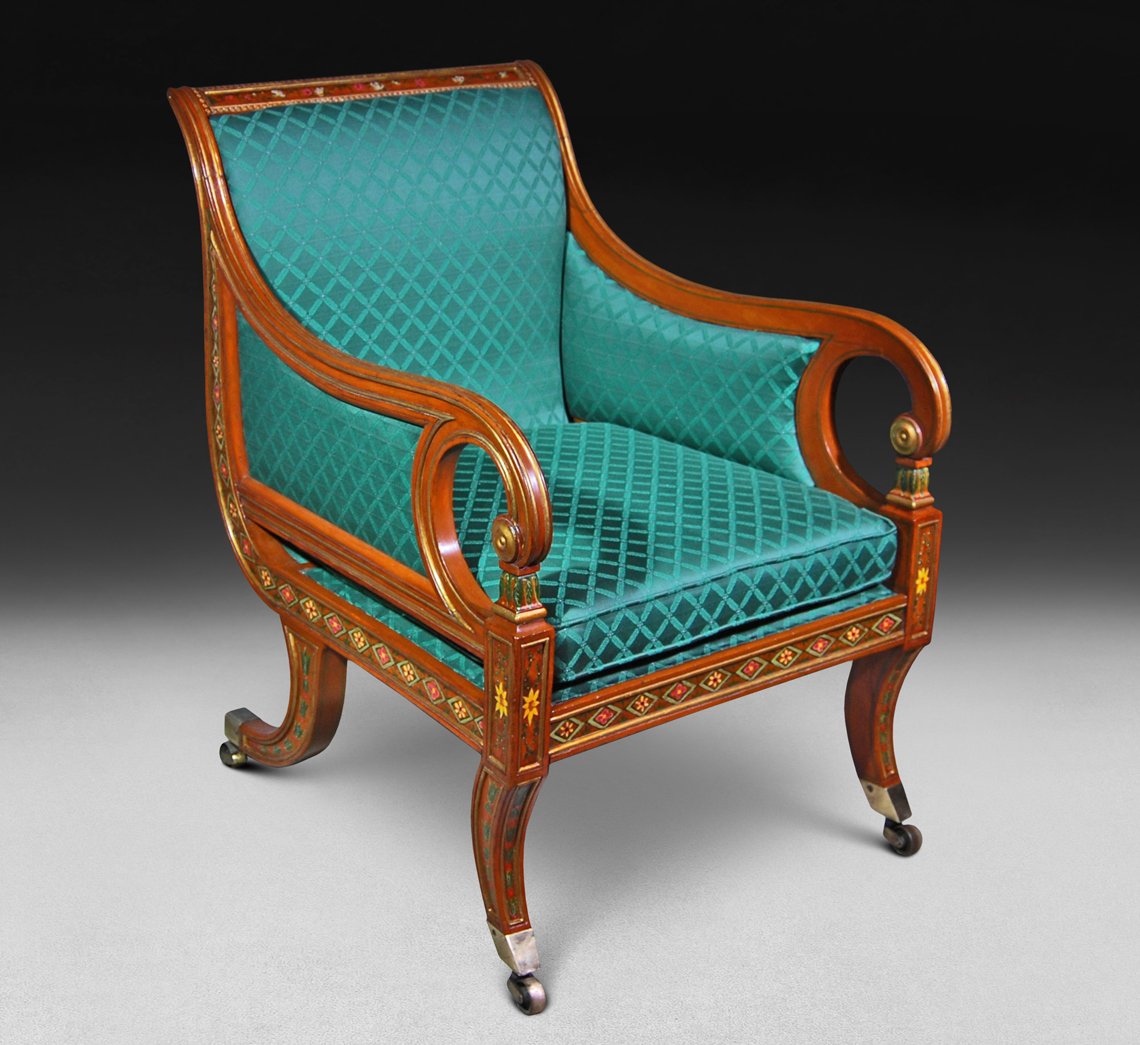 | 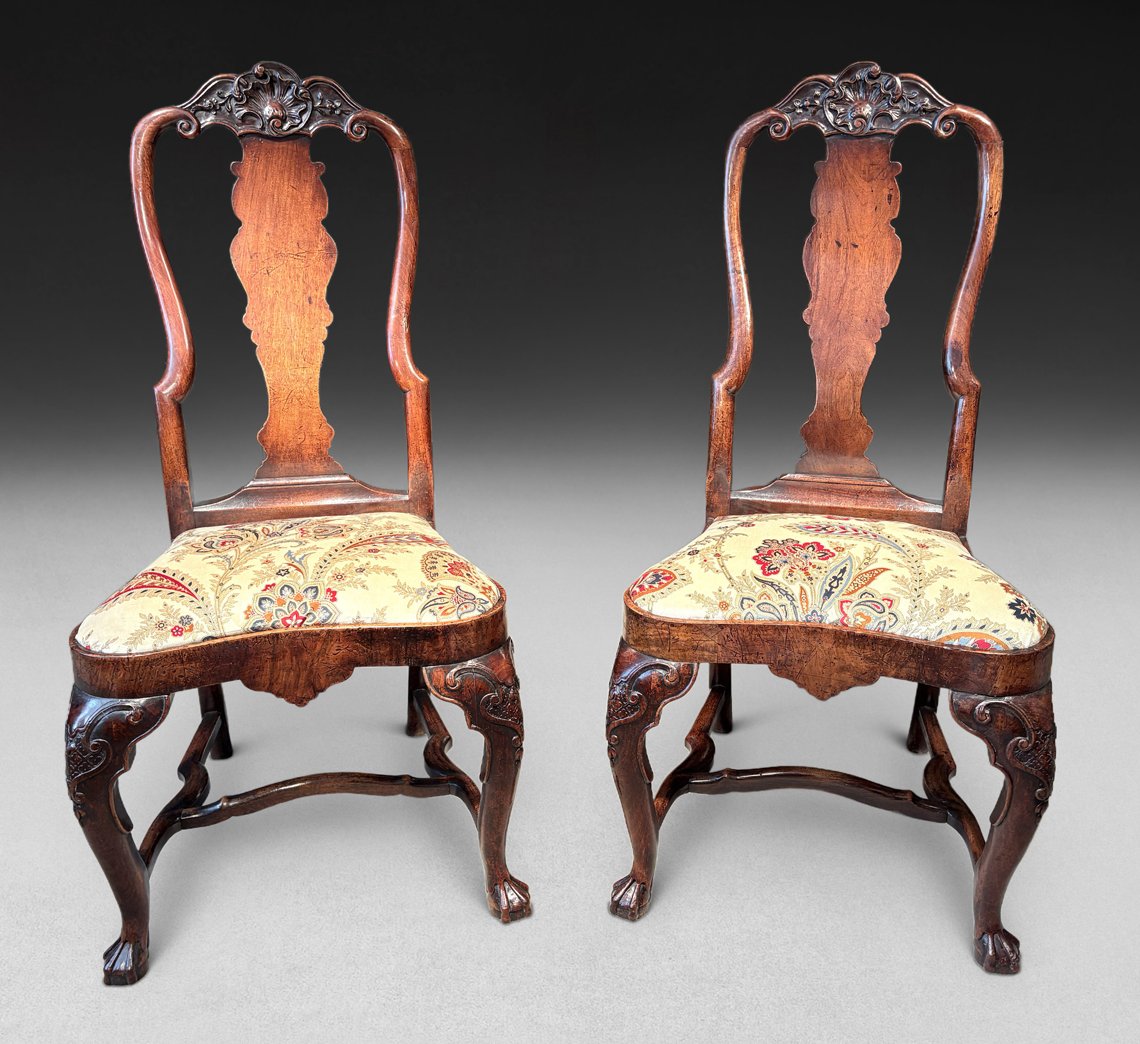 | |
| Left: An exceptional Regency Period decorated and gilt simulated satinwood library chair with scrolled back and arms and sabred legs. Decorated with flowers and leaves and gilt mouldings. Right: A pair of 18th-century George I Anglo Dutch walnut side chairs with lovely carving, serpentine seat front, and ball and claw feet. | ||
“When furnishing with antiques, they will sit comfortably with modern furniture provided that pieces from both disciplines are of comparable quality. Interior designers are particularly adept at achieving this, often with stunning results.” |
— David Harvey |
How would you describe the ‘English Country House Look’?
The essential English Country House look is based on the coexistence of different styles, with inherited pieces combined with wedding gifts such as dowry and newly acquired items, all sitting in the same room. The overriding principle seems to be that one can usually combine this kaleidoscope of colors and fashions, provided it is all of similar high quality. In today’s increasingly “disposable” society, it is reassuring to be surrounded by furniture with longevity.
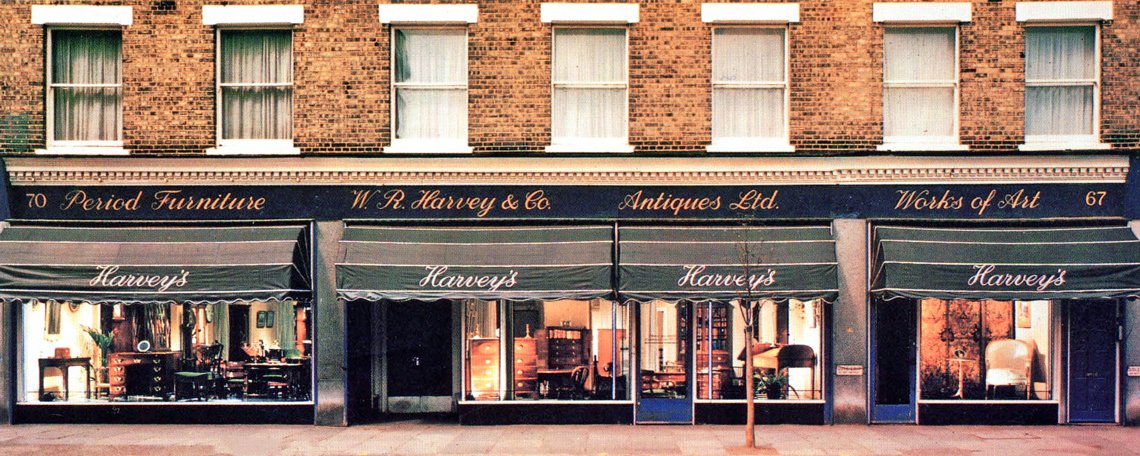 |
| The original location of W.R. Harvey & Co., known as “Harvey’s,” on Chalk Farm Road in northwest London, established in 1951 by the parents of David Harvey, the current owner. |
This year marks the 75th anniversary of the founding of W. R. Harvey. Tell us about the history of the gallery.
My parents established the business in 1951 after a few years of owning an import/export agency, when inquiries for antiques were coming in increasingly from around the world. Their first antiques shop was in Chalk Farm in London, which they rented from a wise old man who recognized their qualities and ordered his executors to offer the freehold on the premises at 67—70 Chalk Farm Road to my father for a reduced sum. The business grew from strength to strength, serving clients, collectors, dealers, and museums across many continents. By the 1970s, it consisted of 14 showrooms, a warehouse, and conservation workshops all on one site, at the back of which was a Queen Anne farmhouse.
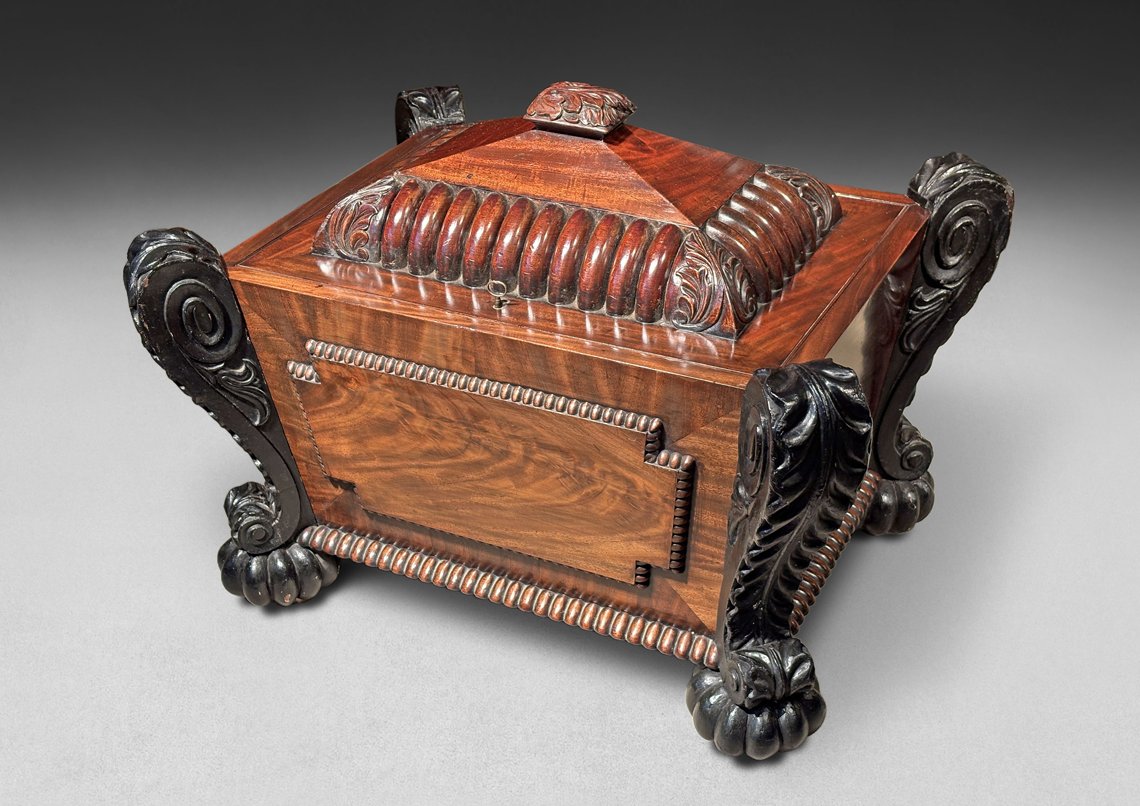 |
A Regency period carved mahogany and ebonized cellarette used for storing wine and liquor bottles, with lead-lined interior for six bottles. This would have been displayed under a sideboard in a dining room. Of outstanding quality, circa 1815. |
When did you join the business?
I joined my father in the business full-time in 1971 and, after a year spent establishing an antiques department for a firm of interior designers in Hamburg, Germany, in 1973, I returned to London to continue at Chalk Farm. The principles on which our business was founded – quality, originality, and condition – hold true as strongly today as they did 75 years ago. When we add research to that as well, then we have what I feel is a strong offering for clients. We opened a further shop at 5 Old Bond Street in the early 1980s and exhibited at many top-quality antiques fairs, including The Grosvenor House Fair. London was certainly a major capital in antique and fine-art terms, and this was probably the golden age for many in the trade. By the late 1990s, I was unable to get a reasonable rental deal with my landlords, and a multinational leather goods company made me an offer for the remainder of my shop's lease as they wanted to be located opposite Gianni Versace. My father wanted to retire and sell the Chalk Farm property to provide for his family, and the Bond Street deal gave me the wherewithal to buy the freehold property I now have here in Witney in Oxfordshire. It comprises 5 showrooms. This was all happening as the antiques world was rapidly changing, with the introduction of online buying through websites.
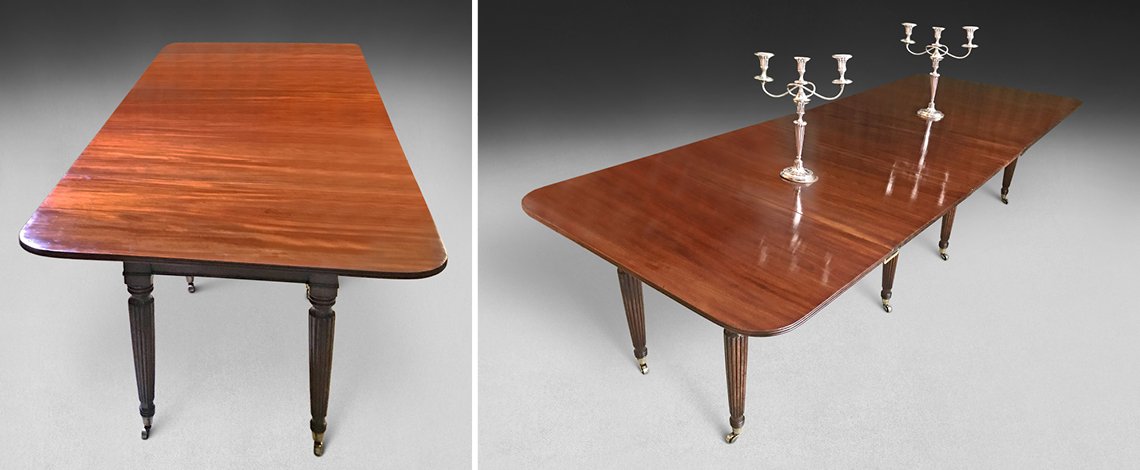 |
An extremely rare and important George III period mahogany extending dining table patented by Gillows in 1800. This unique design has the advantage of a rotating center leaf so it can be used as a serving or side table when not being used for dining. The original design is in the Gillows work books. It has retained all 5 original leaves cut from one huge piece of mahogany so the grain is consistent all the way through. It is a spectacular run of solid mahogany when opened, measuring 122 in. x 46 in. |
Gillows furniture is a specialty of yours. When and how did you become fascinated with it?
I was lucky to have had my father in my life for over 60 years, and I am grateful for all he taught me. On a trip to the Isle of Wight in 1972, we bought a strange-looking billiards-type of table, which I then researched and found to bear the label of Gillows and Taylor of London. This was my introduction to Gillows of London and Lancaster, whose work I have admired for over 50 years. I held an exhibition of Gillows pieces in my showrooms last year (2025) and produced a fully illustrated catalog, which is available on my website at www.wrharvey.com. It involved a great deal of research, and we are extremely fortunate to have Gillows’ workbooks on microfiche at the Westminster Central Library.
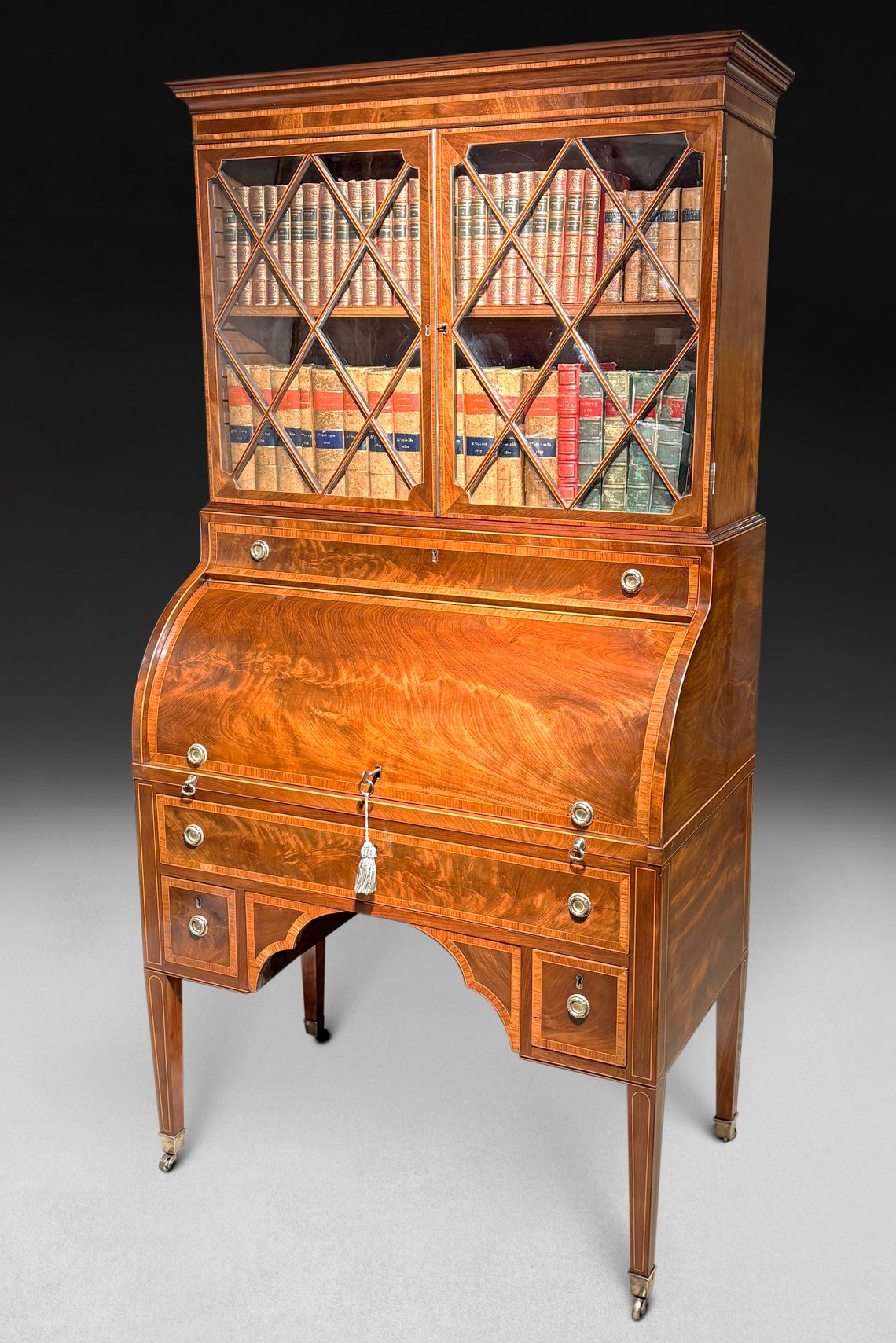 | 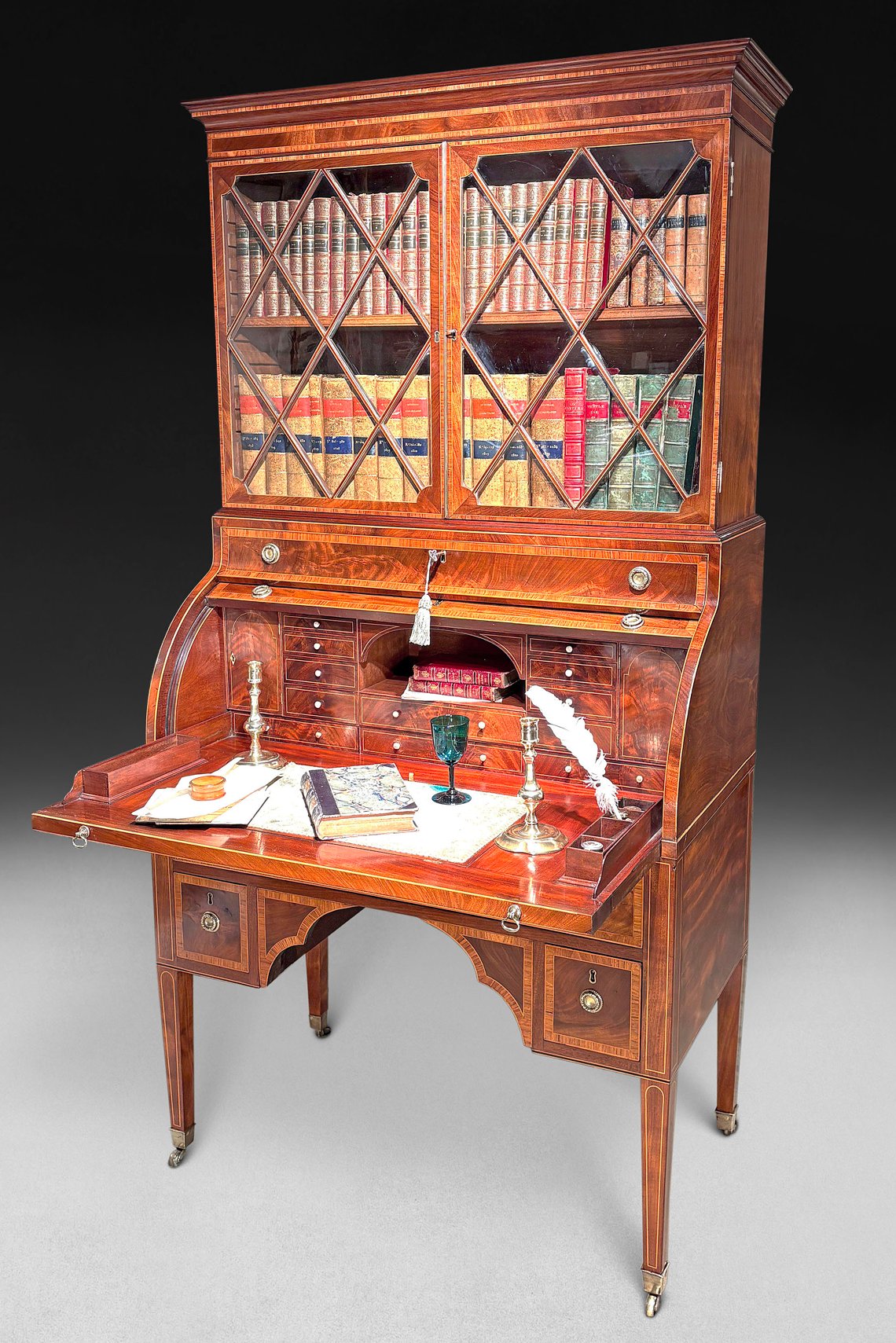 | |
An extraordinarily fine George III period mahogany, kingwood crossbanded and Inlaid cylindrical bureau bookcase by Gillows of Lancaster. | ||
How do you determine the authenticity of these pieces?
Some of their pieces are stamped, and some even bear the worker's name written on the back of a drawer, for example. Others are easy to identify from sketches in the workbooks and reference books on Gillows that are now available. They had a strong “house style,” and the quality of timber and materials used was as good as one may find anywhere. They furnished several large homes, and the catalogs produced for sales such as Mere Hall and Hackwood Park are a good source of information, often relating individual items to bills and receipts. I am now often able to identify Gillows examples just from looking at them after so many years handling their pieces.
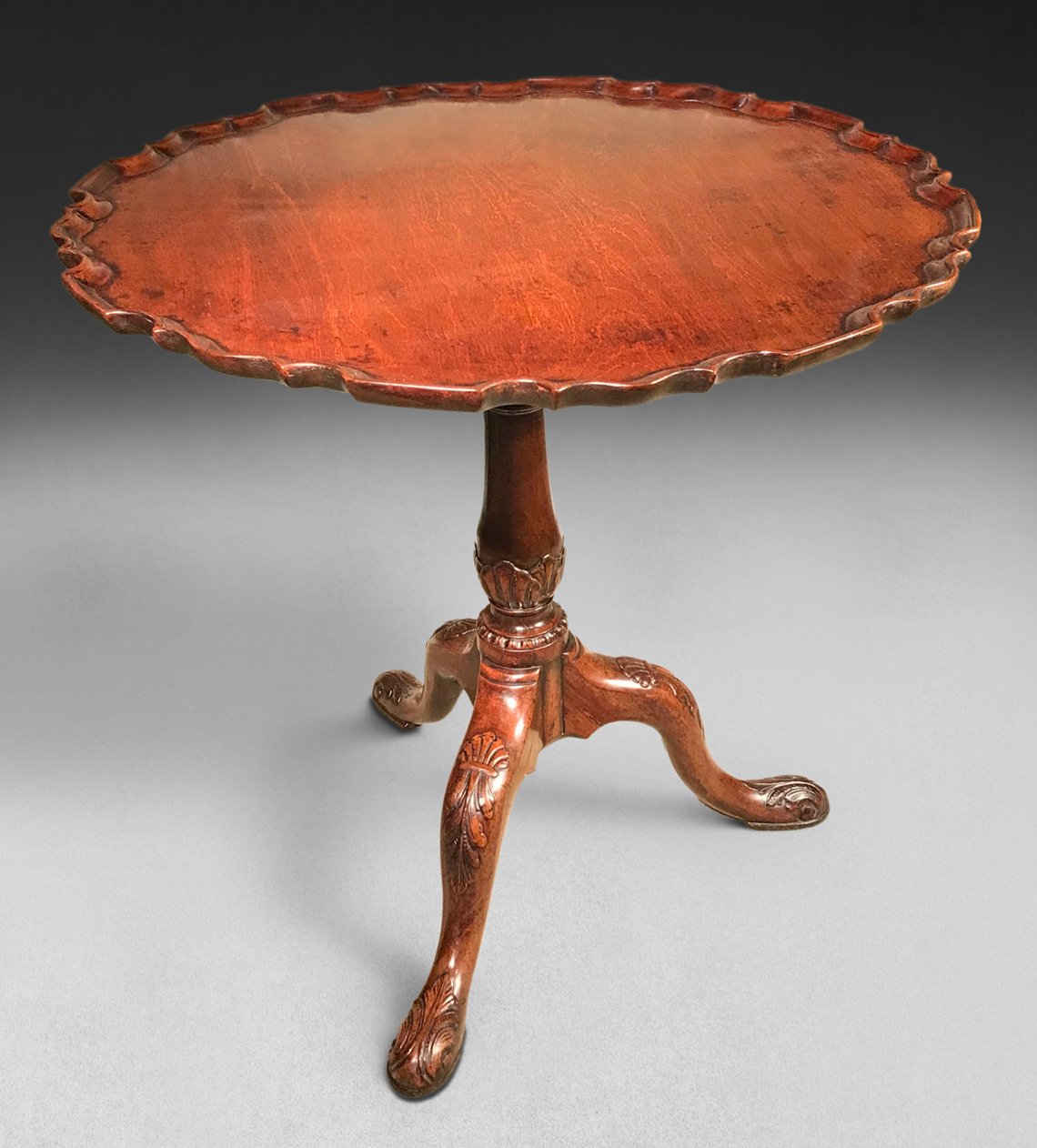 | 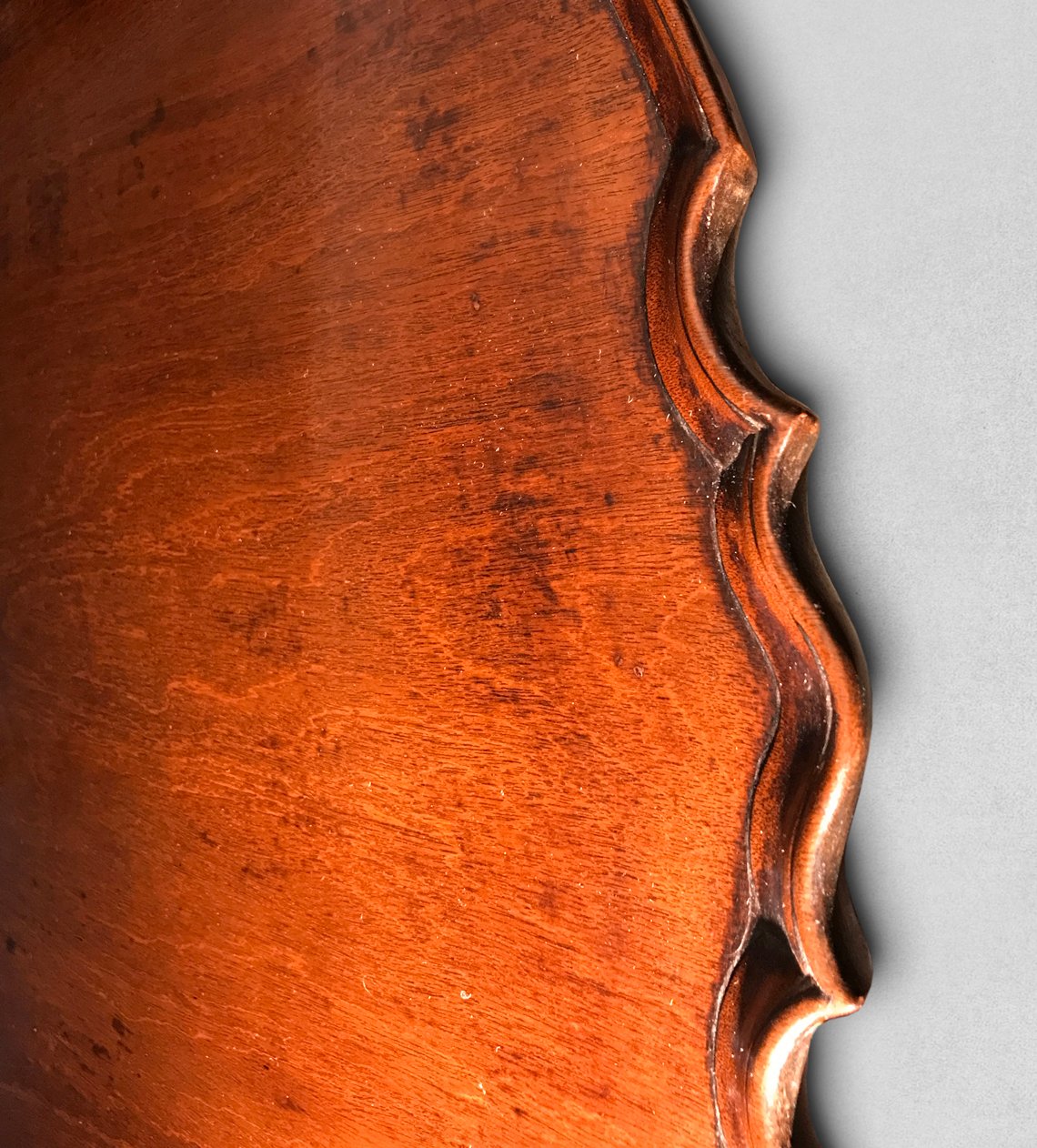 | |
| Rare circa 1755 Chippendale period carved mahogany piecrust tripod table. The circular top and piecrust edge are carved out of one piece of solid mahogany. | ||
What are the things to look for when buying antiques?
When buying antiques, there are many things to watch for. If you have a question about a piece, ask the dealer for clarification. Look at the item carefully – I always do to satisfy myself that it has not been altered, adapted, or changed. As an example, I am lucky to have a very good Chippendale period mahogany pie-crust tripod table. In the 18th century, the top with its proud edge would have been sculpted from one large piece of solid mahogany. In later years, plain-topped tripod tables from the same period were enhanced by having a fancy carved edge added. This can often be discovered by looking at the grain on the top, which should run uninterrupted across the top and the carved edge. With an extending dining table, on the other hand, it is important that all the leaves are original, and although the color may vary slightly due to fading of regularly used sections, the figure and grain should be consistent, indicating that all come from the same block of timber.
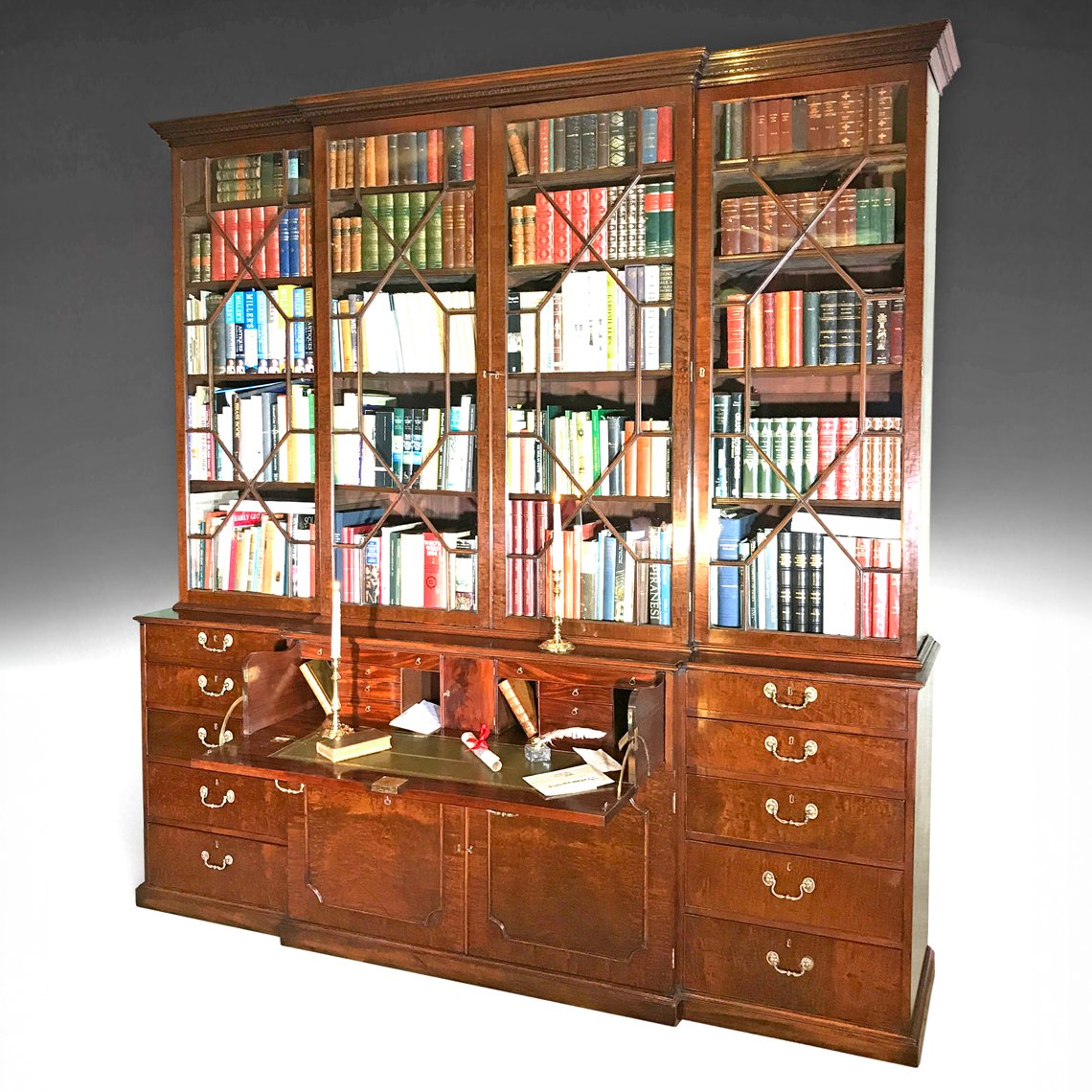 |
| Chippendale mahogany library secretaire breakfront bookcase, circa 1765. Four thirteen-pane astragal glazed doors, the base with a central desk containing cubbies, drawers, and hinged writing surface and below, cupboards with sliding trays. The quality of the mahogany, its figuring and grain, is exceptional and the workmanship throughout is quite extraordinary. |
What is the most interesting piece you’ve bought lately?
I recently acquired a beautiful pair of early 18th-century walnut chairs and, although they are English, we can clearly see the influence of Daniel Marot, designer to William III, who came to England from Holland on his accession with Mary in 1689. Of course, every dealer needs somewhere to keep their collection of reference books, and I was lucky to find this impressive Chippendale period Library Secretaire bookcase recently, which does the job brilliantly.
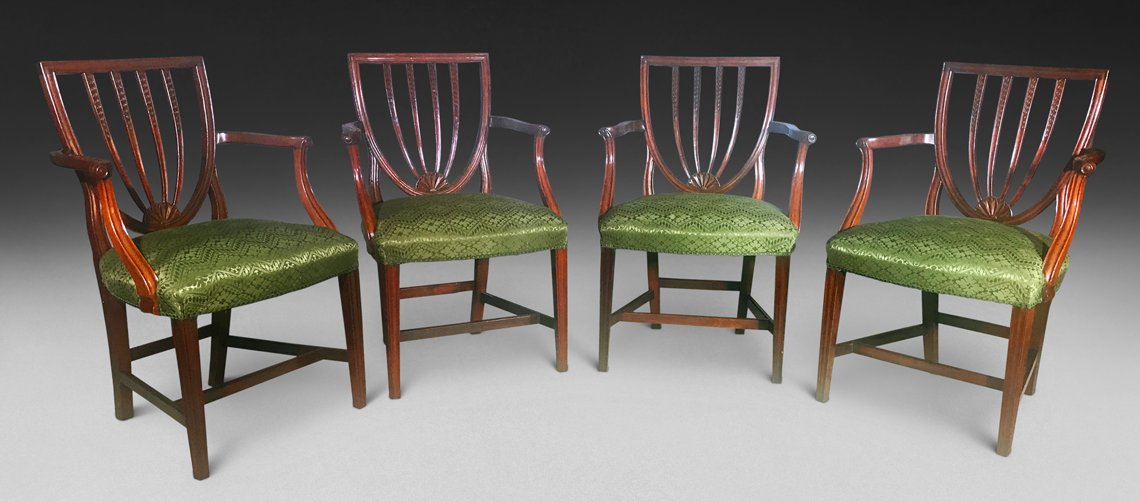 |
| It is extremely rare to find a set of four of these very fashionable and high-quality George III Hepplewhite period mahogany armchairs with crisp carving to the backs and moulded sections. The seats have been newly reupholstered in a gorgeous green geometric damask silk fabric from Chelsea Textiles, London. |
How do you distinguish between different English antique furniture periods and styles?
Percy Macquoid wrote one of the first major histories of English furniture and broke the subject down into The Age of Oak, The Age of Walnut, The Age of Mahogany, and The Age of Satinwood. Printed in 1904, we have all learned a great deal since then, and levels of scholarship have improved greatly. But in using these four titles, he certainly laid the groundwork for later studies. Of course, marquetry inlay was used in all four ages and into the 19th century. Macquoid’s works give no account of many of the exotic timbers which were becoming increasingly available throughout the 18th and 19th centuries, and, of course, Rosewood, which was so beloved in the Regency and Victorian periods. The early Oak period is from about 1660 until the end of that century, but it continued to be used as the mainstay of vernacular furniture right up to modern times. The age of Walnut is the last decade of the 17th century and up until about 1730, when Mahogany started to overtake it as the fashionable timber. Cabinetmakers enjoyed the hardness of the wood, which lent itself to carving. Again, Mahogany stayed as a popular choice right through to the early 20th century but was overtaken by Satinwood during the reign of George III. As designs became lighter and more feminine, the paler color and vivid figuring of Satinwood became the choice of well-to-do clients, many of whom were part of the increasingly wealthy merchant classes. It is often used with bandings of Rosewood and Kingwood, as well as being inlaid in the neoclassical taste with marquetry panels. As world trade increased, more Rosewood and other rare timbers were imported from South America to supply the increased demand in Britain.
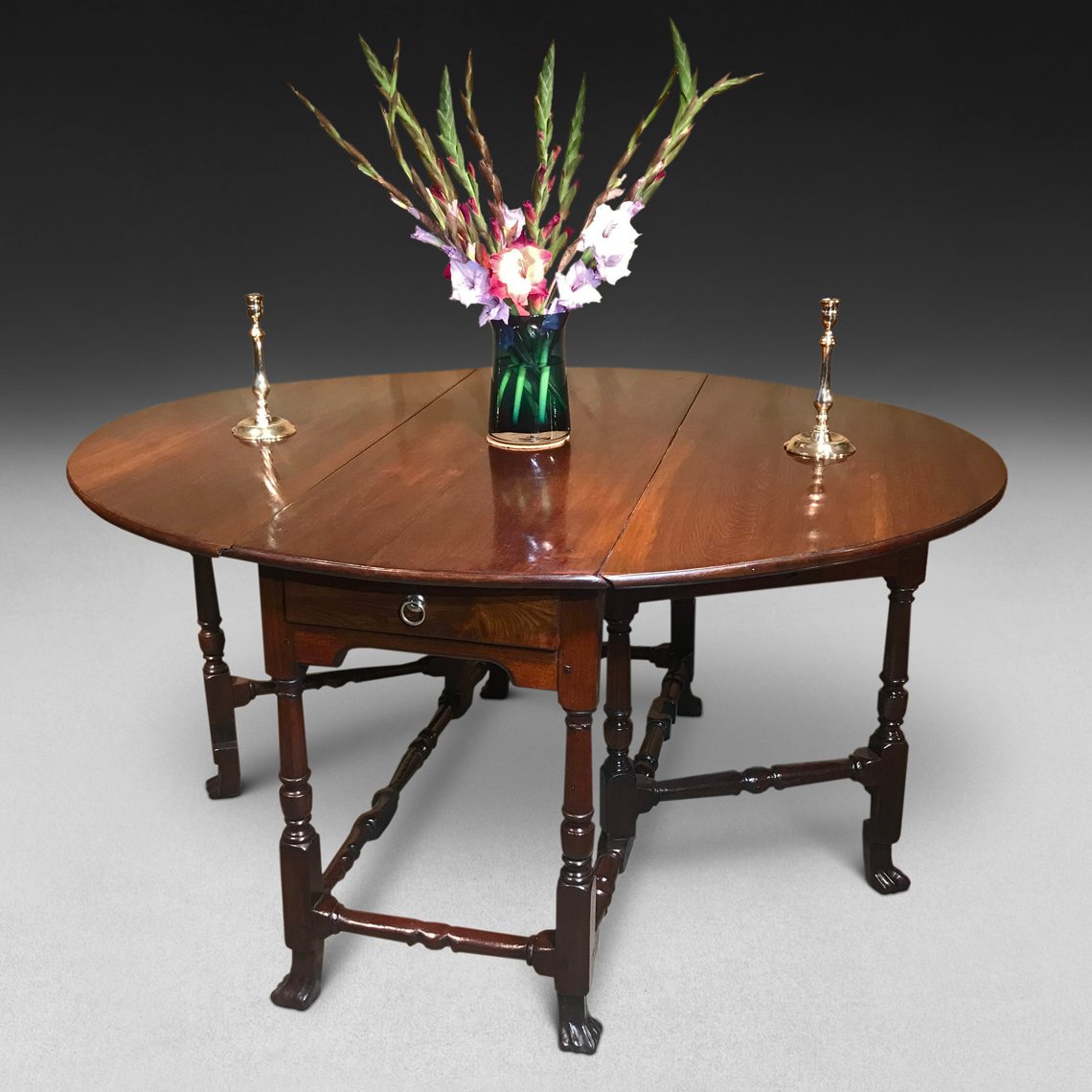 |
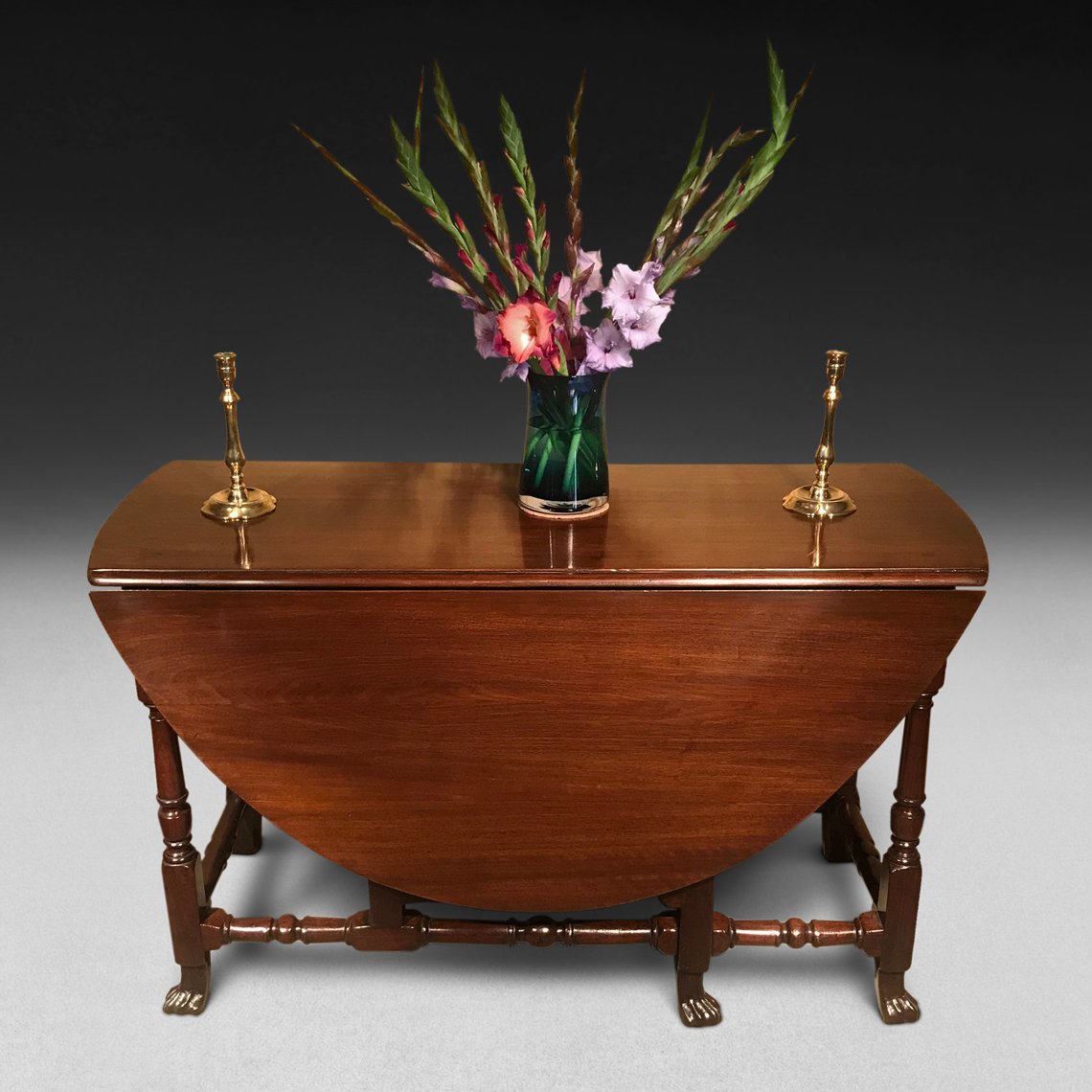
| Queen Anne period solid mahogany oval gate-legged table, circa 1710. |
 |
Are there other notable stylistic differences and influences?
Formally, we go from the rather box-like early Oak to the more refined William and Mary and Queen Anne Walnut, but there was also a strong passion for oriental goods, which occurs repeatedly, with lacquered pieces much in demand at this time, if one could afford them. During the early Mahogany period, we see the continuation of the early forms giving way, by the middle of the 18th century, during George II’s reign, to the fashion for the Rococo in imitation of what was current in Paris. With mythical beasts and birds as well as oriental figures, carved gilt icicles and gothic details, we also see the continuation of the oriental icons. Makers such as Chippendale, Ince and Mayhew, Meschain and Herve, and Vile and Cobb were amongst the best, alongside Gillows of Lancaster. When we move into the Regency period, we see an upsurge in invention and innovation, with companies such as Morgan and Sanders producing wonderfully inventive pieces. Indeed, Ackermann’s Repository of Arts, Literature, Commerce, Manufactures, Fashions, and Politics was a monthly periodical that was published from 1809 to 1828. It carried numerous designs by Morgan and Sanders, illustrating their wares. They had been appointed by Admiral Nelson to furnish his home in Merton before his death, and they even named their premises “Trafalgar House” in his honor. After many years of war with France, peace finally came, and with it, unforeseen wealth. I am forever grateful for the quality of the manufacturing and materials used during the period I specialize in, as without this, I would not have a business. I am now seeing some of my favorite pieces again for a second or even a third time.
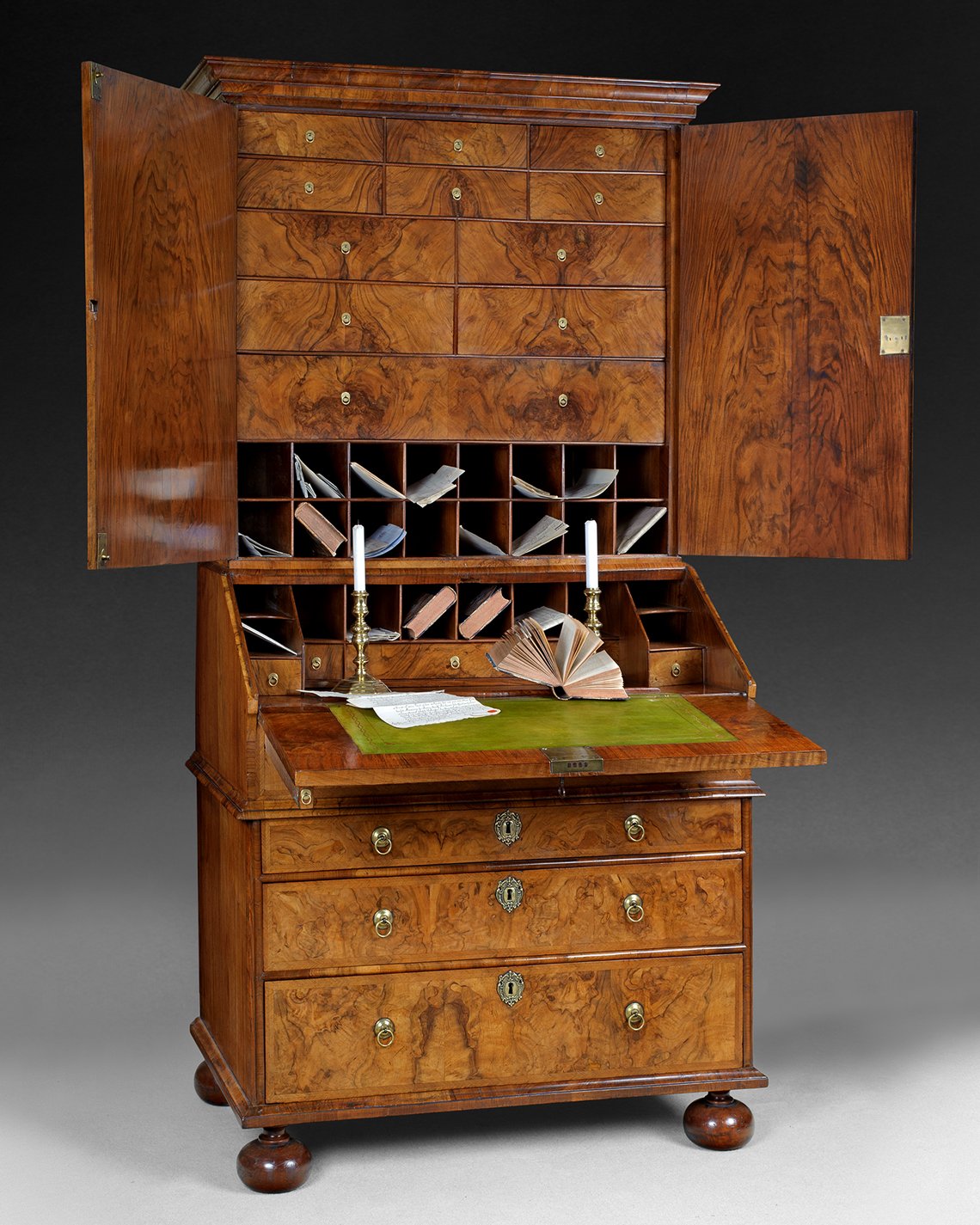 | 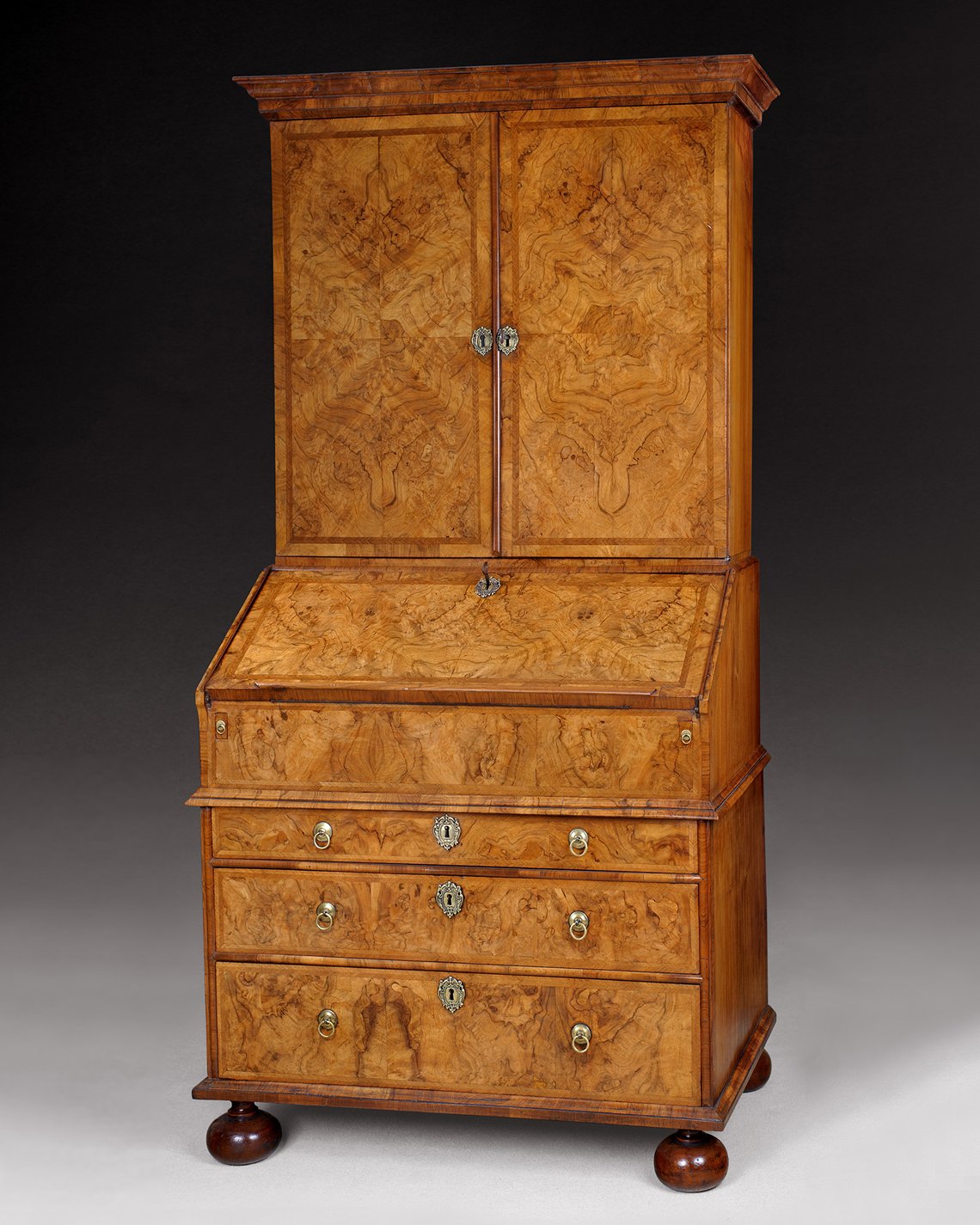 | |
A very good and early (circa 1685) James II/William and Mary Period highly figured walnut bureau cabinet. | ||
Do all antiques require some kind of conservation, and is that something you carry out?
We do undertake our own conservation. I do not buy pieces with drawers or other sections missing, but I do enjoy cleaning off many years of wood smoke, ash, and dust from an item and waxing it to bring back a lost luster. I would always advise clients to seek expert advice on this subject, as do-it-yourself could cause untold damage to a valuable item.
Do you offer any special services for designers and trade clients?
Here at Harvey’s we will always try to offer a good deal to trade and interior designers as we all have a living to make from our industry. We work with all the major specialist shippers and regularly send purchases as far as Australia, the USA, Hong Kong, South Africa, and all over Europe, to say nothing of the UK. One of the exciting aspects of being in this business is finding sought-after items for clients who regularly become good friends. Whether it is a 15-foot-long dining table or a standard lamp, a bureau bookcase or a four-poster bed, we keep records of clients’ requirements and can often source exactly the right piece for them.
How do you see antiques integrating with modern pieces in contemporary homes?
When furnishing with antiques, they will sit comfortably with modern furniture provided that pieces from both disciplines are of comparable quality. Interior designers are particularly adept at achieving this, often with stunning results. Because we have a long history of working with clients from many different areas, we are comfortable in ancient and modern settings. A good antique piece can certainly bring warmth to an otherwise cool setting.
You are based in Oxfordshire, but retain a domestic and international clientele. How do you connect with them?
I am active online and send out regular e-newsletters to stay in touch with friends and clients across many countries and have published some 85 Masterclass Videos on our YouTube channel, and both of these can be subscribed to from my website at www.wrharvey.com.
 |
Discover More From W. R. Harvey & Co. on Incollect
 |