









Levi Wells Prentice
American, 1851 - 1935

Levi Wells Prentice grew up on a farm in Lewis County, NY. He opened his first studio as a landscape painter in Syracuse, NY in 1875. By 1872, Prentice has traveled through the Adirondack Mountains, painting the views as well as the surrounding region. He moved briefly to Brooklyn, where he began painting still lifes, focusing on fruit, usually apples and plums, piled high in pots or in natural settings. Prentice moved around from 1903-07 before setting in Philadelphia. He was a craftsman who enjoyed making his own brushes, palettes and frames. Prentice placed an emphasis on dark outlining with a concern for textual precision. However, his work did not gain much recognition with historians until the 1970s. Prentice was a member of the Brooklyn Art Association. He died in 1935.Biography courtesy of The Caldwell Gallery, www.antiquesandfineart.com/caldwell
Levi Prentice Paintings
Levi Prentice Paintings
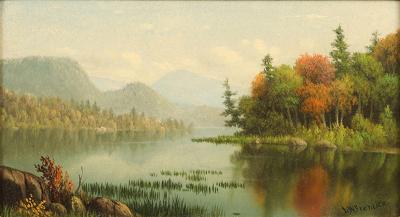
Levi Wells Prentice is remembered principally for his Adirondacks Mountain and Lake Landscapes painted in the I870's and early 1880's.
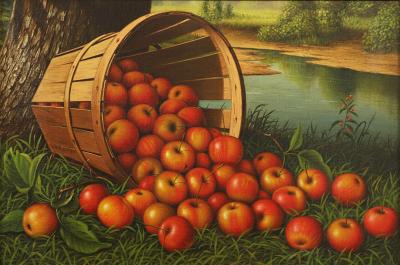
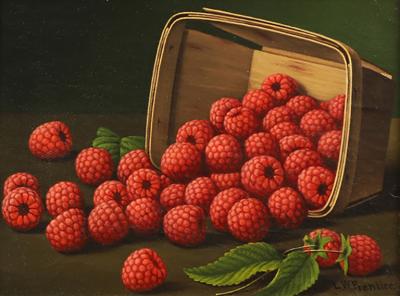
He had a second artistic specialty t hat has received recent attention, his late nineteenth-century still life's of fruit, executed with almost photographic precision in exactitude. Prentice's best work is a tabletop still life, Apples in a Pail (1892, location unknown).
Prentice was born in 1851 at Harrisburgh, New York, in the Adirondacks. Little is known of his training, but his aptitude had developed into skill by his late teens. In the early 1870's, the Prentice family moved to Syracuse, New York, here the artist opened a studio in 1875. He married in 1882 and moved to Buffalo, New York in 1883.
Prentices mountain landscapes gained favor. He also painted portraits, decorated parlor ceiling's, and designed and built furniture and houses. He made some of his own brushes, palette's and frames.
In the late 1880's, Prentice moved to Brooklyn, a center for artist's of trompe loeil still lifes, then very much in vogue. Prentice's earliest still life is dated 1892. From then on, still lifes with fruits-apples and plums were his favorites and were his principal subjects. These still life's are very sharp in definition, gaining further emphasis from the artist's habit of dark outlining.
Prentice's work has been compared to that of William Mason Brown and William Michael Harnett, the preeminent painters in t he ultra-realist "illusionist" mode. However, Prentice was more concerned with textural precision than Harnett who strove for a complete illusion three dimensionality. And while Browns fruits and vegetables have a voluptuous almost preternatural glow, Prentices are plainer, more of this world, and in that sense, more realistic than Brown's. The artist, who lived in Manhattan, Connecticut and New Jersey, finally settling in Philadelphia, where he died in 1935.
MEMBERSHIPS:
Brooklyn Art Association
PUBLIC COLLECTION:
Adirondack Museum, Blue Mountain Lake, New York
Biography courtesy of Roughton Galleries, www.antiquesandfineart.com/roughton
He had a second artistic specialty t hat has received recent attention, his late nineteenth-century still life's of fruit, executed with almost photographic precision in exactitude. Prentice's best work is a tabletop still life, Apples in a Pail (1892, location unknown).
Prentice was born in 1851 at Harrisburgh, New York, in the Adirondacks. Little is known of his training, but his aptitude had developed into skill by his late teens. In the early 1870's, the Prentice family moved to Syracuse, New York, here the artist opened a studio in 1875. He married in 1882 and moved to Buffalo, New York in 1883.
Prentices mountain landscapes gained favor. He also painted portraits, decorated parlor ceiling's, and designed and built furniture and houses. He made some of his own brushes, palette's and frames.
In the late 1880's, Prentice moved to Brooklyn, a center for artist's of trompe loeil still lifes, then very much in vogue. Prentice's earliest still life is dated 1892. From then on, still lifes with fruits-apples and plums were his favorites and were his principal subjects. These still life's are very sharp in definition, gaining further emphasis from the artist's habit of dark outlining.
Prentice's work has been compared to that of William Mason Brown and William Michael Harnett, the preeminent painters in t he ultra-realist "illusionist" mode. However, Prentice was more concerned with textural precision than Harnett who strove for a complete illusion three dimensionality. And while Browns fruits and vegetables have a voluptuous almost preternatural glow, Prentices are plainer, more of this world, and in that sense, more realistic than Brown's. The artist, who lived in Manhattan, Connecticut and New Jersey, finally settling in Philadelphia, where he died in 1935.
MEMBERSHIPS:
Brooklyn Art Association
PUBLIC COLLECTION:
Adirondack Museum, Blue Mountain Lake, New York
Biography courtesy of Roughton Galleries, www.antiquesandfineart.com/roughton


 Loading...
