






Louis Icart
French, 1888 - 1950

Louis Justin Laurent Icart was born in Toulouse in 1890 and died in Paris in 1950. He was first son of Jean and Elisabeth Icart and was officially named Louis Justin Laurent Icart. The use of his initials L.I. would be sufficient in this household. Therefore, from the moment of his birth he was dubbed 'Helli'. The Icart family lived modestly in a small brick home on rue Traversiere-de-la-balance, in the culturally rich Southern French city of Toulouse. Toulouse was the home of many prominent writers and artists, the most, of course being Henri de Toulouse-Lautrec.
Icart entered the l'Ecole Superieure de Commerce de Toulouse in order to continue his studies for a career in business, particularly banking (his father's profession). However, he soon discovered the play writings of Victor Hugo (1802-1885), which were to change the course of his life. Icart borrowed whatever books he could find by Hugo at the Toulouse library, devouring the tales, rich in both romantic imagery and the dilemmas of the human condition. It was through Icart's love of the theater that he developed a taste for all the arts, though the urge to paint was not as yet as strong for him as the urge to act.
It was not until his move to Paris in 1907 that Icart would concentrate on painting, drawing and the production of countless beautiful etchings, which have served (more than the other mediums) to indelibly preserve his name in twentieth century art history.
Art Deco, a term coined at the 1925 Paris Exposition des Arts Decoratifs, had taken its grip on the Paris of the 1920s. By the late 1920s Icart, working for both publications and major fashion and design studios, had become very successful, both artistically and financially. His etchings reached their height of brilliance in this era of Art Deco, and Icart had become the symbol of the epoch. Yet, although Icart has created for us a picture of Paris life in the 1920s and 1930s, he worked in his own style, derived principally from the study of eighteenth-century French masters such as Jean Antoine Watteau, Francois Boucher and Jean Honore Fragonard.
In Icart's drawings, one sees the Impressionists Degas and Monet and, in his rare watercolors, the Symbolists Odilon Redon and Gustave Moreau. In fact, Icart lived outside the fashionable artistic movements of the time and was not completely sympathetic to contemporary art. Nonetheless, his Parisian scenes are a documentation of the life he saw around him and they are nearly as popular today as when they were first produced.
Art Deco was a period of perfection of workmanship, and in this Icart's art is tied closely to the period. He was an expert craftsman and aimed for perfection in his etching technique. Art Deco was also a smart and sophisticated style, and Icart surrounded himself with rich materials, fine furniture, Chinese lacquer screens, and other luxuries. This refinement of taste and the luxury with which he lived also linked him to the opulent spirit of the times. Fashions were undergoing major transition. Women were eager to divest themselves of the heavy overflow of lace, cotton, buckles, and high necklines worn by their mothers. New trends called for higher waistlines, and for clothing that clung to the body rather than billowing out. Icart reflected such fashion changes in, for example, his famous and inimitable illustrations for the magazine Luxe de Paris.
In 1914 Icart had met a magical, effervescent eighteen-year-old blonde named Fanny Volmers, at the time an employee of the fashion house Paquin. She would eventually become his wife and a source of artistic inspiration for the rest of his life.
Icart's portrayal of women is usually sensuous, often erotic, yet always imbued an element of humor, which is as important as the implied or direct sexuality. The beautiful courtesans cavort on rich, thick pillows; their facial expressions projecting passion, dismay or surprise, for the women of Louis Icart are the women of France as we have imagined them to be - Eve, Leda, Venus, Scheherazade and Joan of Arc, all wrapped up into an irresistible package.
Literature:
Louis Icart: Erotica, May 1998 Wm. R. Holland
Louis Icart: The complete Etchings February 1998 Louis Icart, et al.
Boudoir Art: The Celebration of Life, March 1997 Clifford P. Catania
Icart, Michael Schnessel, West Chester, Pennsylvania, 1976
"L'oeuvre du peintre Louis Icart", Beaux-Arts, Paris, June 1921
"L'exposition Louis Icart a la Haye", Le Provencal de Paris, 8 May, 1922 Jules Veran, Art Deco: A Guide fir Collectors, New York, 1972 Katherine McClinton,
Reference:
E. Benezit, vol. V
Biography courtesy of Roughton Galleries, www.antiquesandfineart.com/roughton
Icart entered the l'Ecole Superieure de Commerce de Toulouse in order to continue his studies for a career in business, particularly banking (his father's profession). However, he soon discovered the play writings of Victor Hugo (1802-1885), which were to change the course of his life. Icart borrowed whatever books he could find by Hugo at the Toulouse library, devouring the tales, rich in both romantic imagery and the dilemmas of the human condition. It was through Icart's love of the theater that he developed a taste for all the arts, though the urge to paint was not as yet as strong for him as the urge to act.
It was not until his move to Paris in 1907 that Icart would concentrate on painting, drawing and the production of countless beautiful etchings, which have served (more than the other mediums) to indelibly preserve his name in twentieth century art history.
Art Deco, a term coined at the 1925 Paris Exposition des Arts Decoratifs, had taken its grip on the Paris of the 1920s. By the late 1920s Icart, working for both publications and major fashion and design studios, had become very successful, both artistically and financially. His etchings reached their height of brilliance in this era of Art Deco, and Icart had become the symbol of the epoch. Yet, although Icart has created for us a picture of Paris life in the 1920s and 1930s, he worked in his own style, derived principally from the study of eighteenth-century French masters such as Jean Antoine Watteau, Francois Boucher and Jean Honore Fragonard.
In Icart's drawings, one sees the Impressionists Degas and Monet and, in his rare watercolors, the Symbolists Odilon Redon and Gustave Moreau. In fact, Icart lived outside the fashionable artistic movements of the time and was not completely sympathetic to contemporary art. Nonetheless, his Parisian scenes are a documentation of the life he saw around him and they are nearly as popular today as when they were first produced.
Art Deco was a period of perfection of workmanship, and in this Icart's art is tied closely to the period. He was an expert craftsman and aimed for perfection in his etching technique. Art Deco was also a smart and sophisticated style, and Icart surrounded himself with rich materials, fine furniture, Chinese lacquer screens, and other luxuries. This refinement of taste and the luxury with which he lived also linked him to the opulent spirit of the times. Fashions were undergoing major transition. Women were eager to divest themselves of the heavy overflow of lace, cotton, buckles, and high necklines worn by their mothers. New trends called for higher waistlines, and for clothing that clung to the body rather than billowing out. Icart reflected such fashion changes in, for example, his famous and inimitable illustrations for the magazine Luxe de Paris.
In 1914 Icart had met a magical, effervescent eighteen-year-old blonde named Fanny Volmers, at the time an employee of the fashion house Paquin. She would eventually become his wife and a source of artistic inspiration for the rest of his life.
Icart's portrayal of women is usually sensuous, often erotic, yet always imbued an element of humor, which is as important as the implied or direct sexuality. The beautiful courtesans cavort on rich, thick pillows; their facial expressions projecting passion, dismay or surprise, for the women of Louis Icart are the women of France as we have imagined them to be - Eve, Leda, Venus, Scheherazade and Joan of Arc, all wrapped up into an irresistible package.
Literature:
Louis Icart: Erotica, May 1998 Wm. R. Holland
Louis Icart: The complete Etchings February 1998 Louis Icart, et al.
Boudoir Art: The Celebration of Life, March 1997 Clifford P. Catania
Icart, Michael Schnessel, West Chester, Pennsylvania, 1976
"L'oeuvre du peintre Louis Icart", Beaux-Arts, Paris, June 1921
"L'exposition Louis Icart a la Haye", Le Provencal de Paris, 8 May, 1922 Jules Veran, Art Deco: A Guide fir Collectors, New York, 1972 Katherine McClinton,
Reference:
E. Benezit, vol. V
Biography courtesy of Roughton Galleries, www.antiquesandfineart.com/roughton
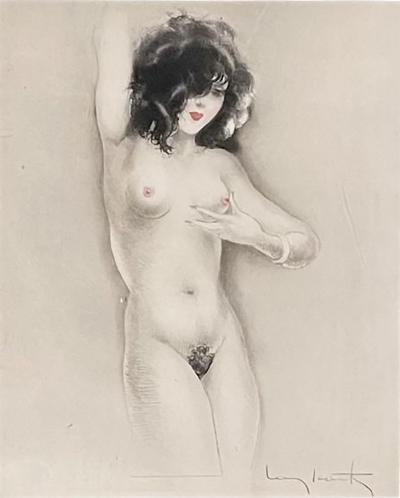
Louis Icart
Hand Colored by Louis Icart: Slightly Swollen Areola. Authenticated
H 32 in W 28 in D 2 in
$ 5,200

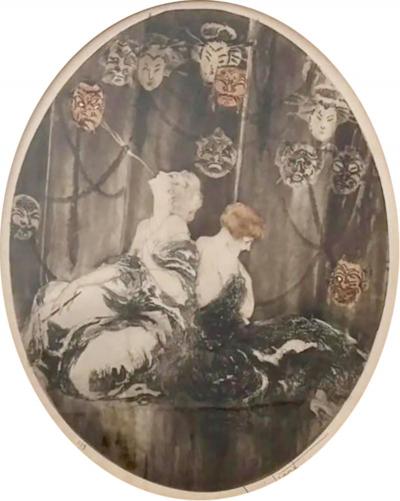
Louis Icart
Antique Louis Icart Les Masques Hand Colored Print C.1926
H 30 in W 24 in D 1 in
$ 2,500

 Loading...
