










Showrooms
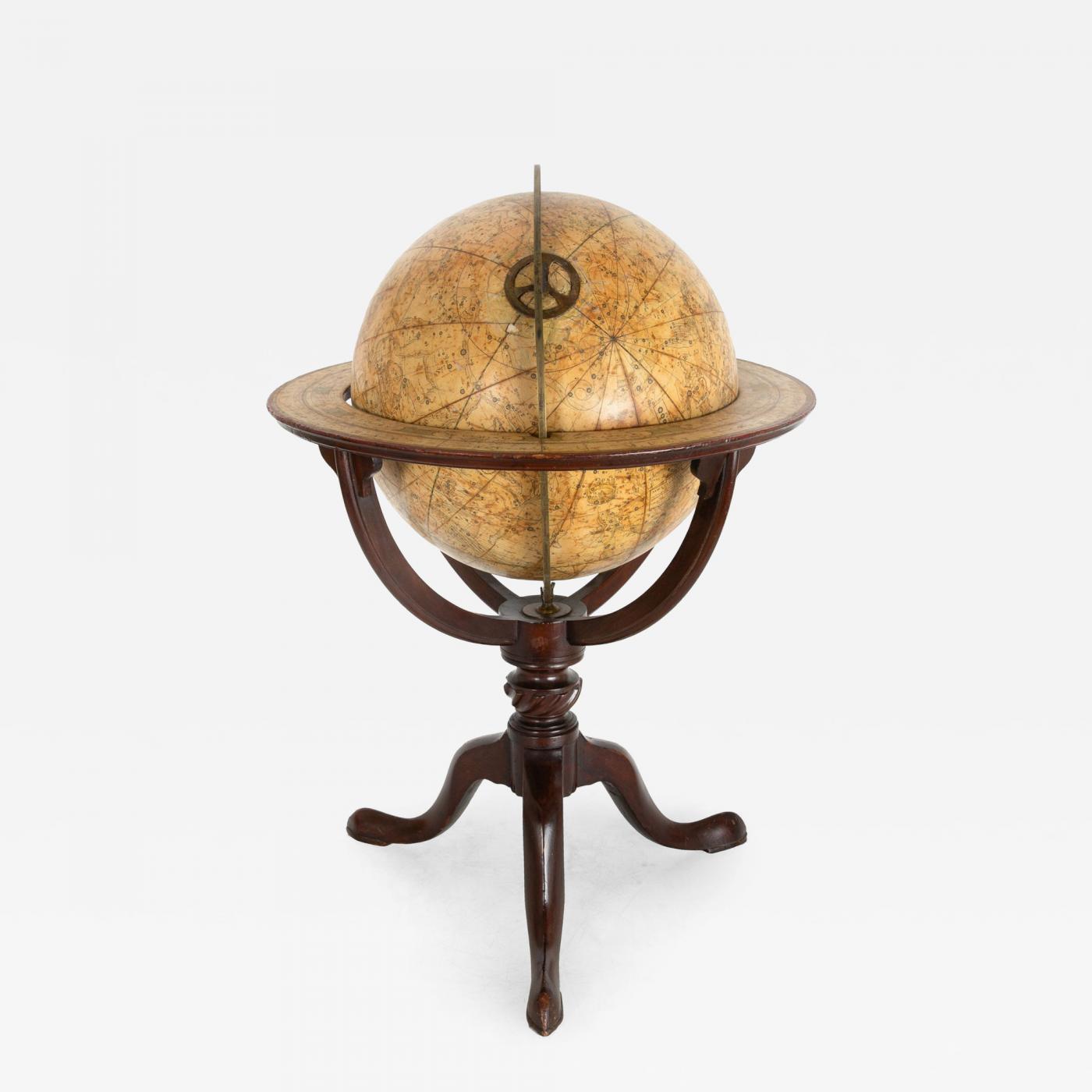
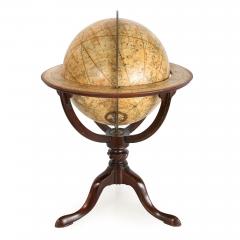
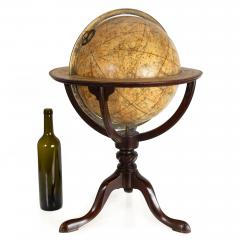
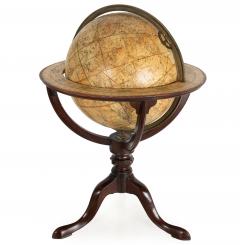
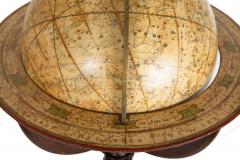
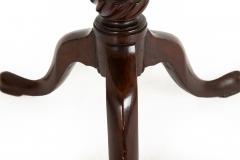
Fine Rare Regency Table-Top Celestial 12” Globe by J & W Cary ca. 1816
-
Description
A FINE REGENCY TABLE-TOP CELESTIAL 12" GLOBE ON MAHOGANY TRIPODAL STAND
John and William Cary, 181 Strand, London | circa 1816
24 5/8" H x 15" W x 15" D
12" globe diameter
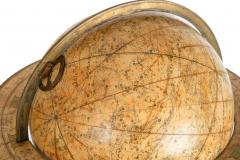
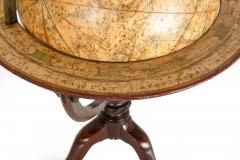
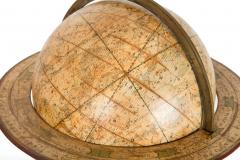
A fine Regency 12-inch celestial table-top globe by John and William Cary, the sphere made up of twelve hand-colored engraved gores laid to the ecliptic poles, the axis through the celestial poles, the equator graduated in degrees and hours, the colures in degrees and the ecliptic graduated in days with the signs of the zodiac and a twilight zone. The zodiac belt is within a graph-form grid.
The constellations, which include the twelve signs of the zodiac, are depicted as figures from Greek mythology, animals, and scientific instruments, delicately outlined and lightly shaded in tones of pink, brown, olive, and grey against a cream ground. Stars are shown to seven orders of magnitude, along with nebulae and clusters, following the key engraved above the cartouche. Brighter stars such as Aldebaran are identified by name, and many others are labeled with their Bayer Greek letter designations.
The cartouche reads:
CARY’S NEW CELESTIAL GLOBE,
On which are correctly laid down upwards of 3500 Stars
selected from the most accurate observations
and calculated for the year 1800.
With the extent of each constellation precisely defined
by Mr. Gilpin of the Royal Society.
Made and Sold by J. & W. Cary,
Strand, London, Jan. 1, 1816.
The reference to George Gilpin, Clerk of the Royal Society (1785–1810), and the stated calculation date of 1800 reflect the Cary firm’s reliance on the late-18th-century cataloguing of stellar positions, retaining the traditional mythological constellation forms before mid-19th-century reforms began stripping away pictorial imagery in favor of schematic star maps.
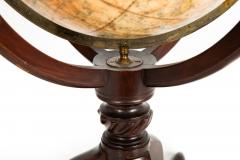
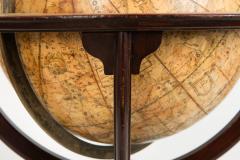
The globe is set within a calibrated brass meridian circle and an engraved horizon ring with printed calendar and zodiac, supported on an elegant George III–style mahogany tripod stand with slender, curved supports rising from a spiral-turned vase baluster, on outswept slipper feet.
Historical Context
The celebrated Cary firm of cartographers and globe-makers was founded by John Cary (1754–1835), whose partnership with his brother William Cary (c.1760–1825), a distinguished instrument maker, produced some of the finest English globes of the late Georgian period. Operating from 181 Strand, the brothers offered celestial and terrestrial globes in multiple sizes from 1791 onward, introducing the 12-inch format in 1798. The celestial globes in this series incorporated upwards of 3,500 stars based on the most accurate contemporary observations, with constellation boundaries and extents carefully defined by Gilpin of the Royal Society.
In the years immediately following its introduction, the 12-inch celestial globe became one of Cary’s most popular formats, suitable for use in both institutional and domestic settings. Customers could select from various stand designs, from simple table mounts to more elaborate library stands.
Curator’s Note
In 1816, the Cary brothers’ celestial globes represented the state of British astronomical cartography, synthesizing Enlightenment-era star catalogues with the enduring classical iconography of the heavens. While later 19th-century globes moved toward abstraction, the Cary designs retained a harmonious blend of scientific precision and artistic tradition. The present globe is distinguished by its early 19th-century date, crisp and well-preserved engraved gores, and its original finely crafted mahogany stand. It is at the same time an artistic object and a notable surviving Regency-era scientific instrument.
A nearly identical example with a ring-turned versus the present spiral turned baluster is held in the permanent collection of the Smithsonian National Museum of American History (acc. no. 214358). The same ring-turned format sold at Christie's, London, 13 September 2007, lot 1403 for 9375 GBP (converting to approximately $ 18,900 USD at the time of sale).
Condition: Scuffs, losses and scratches to the surfaces throughout, these mostly part of the patina now. Old repairs at the tip and base of the globe, both ends with discoloration to the repair material over time and losses: the bottom repair with loss of the repair material. Old discolored varnish, quite early, the globe with foxing, staining and discoloration. Horizontal ring slightly wavy. Old repairs to the tripodal legs, including a screw to the top of one leg where it joins the base, restored cracks to the base where the legs join in and more recent screws to the iron bracket beneath the legs. Compass stretcher was removed from between the legs at some point.
Literature:
Globes from the Western World, Dekker and van der Krogt, Zwemmer, 1993.
John Cary, Engraver, Map, Chart and Print-Seller and Globe-Maker, Fordham, Cambridge University Press, 1925.
ref. 506RQE26S -
More Information
Documentation: Documented elsewhere (similar item) Origin: England Period: 19th Century Materials: Mahogany, Engraved Condition: Good. Creation Date: 1816 Styles / Movements: Traditional, Regency Dealer Reference #: 506RQE26S Incollect Reference #: 849115
Message from Seller:
Silla, Ltd. is a family-owned antique gallery located at 117 W Burd St., Shippensburg, PA 17257, specializing in 19th and early 20th century bronze sculptures and unique period furniture. For more information or to schedule a visit, contact us at sales@sillafineantiques.com or call 717.708.9017.
More Listings from SILLA View all 376 listings
-
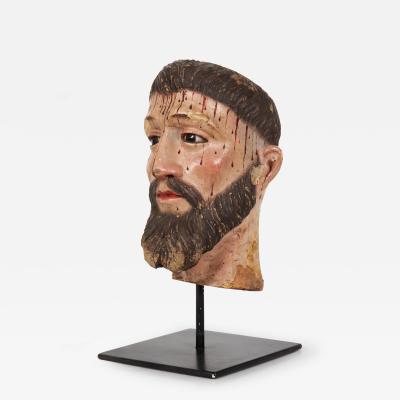
Spanish Polychromed Carved Head of Christ as Ecce Homo, early 18th century
-
Fine Maritime Seascape Painting of American Clipper Ships by Henry Scott

-
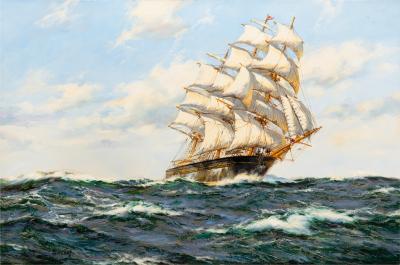
Seascape Painting of American Clipper Ship “Red Cloud” by Henry Scott
-
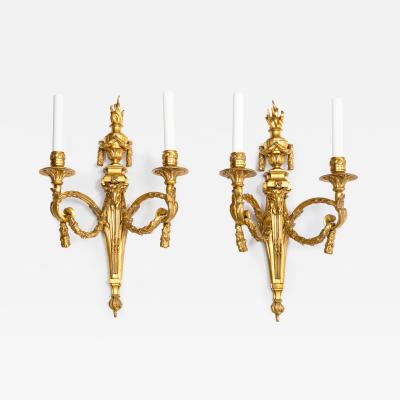
19th Century Pair of French Louis XVI Style Two-Light Wall Sconces Candelabra
-
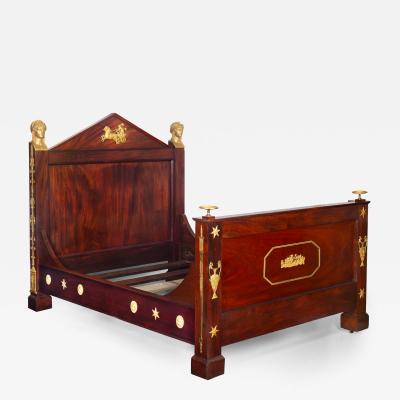
Rare Fine French Empire Mahogany Bed by Jacob-Desmalter ca. 1805-15
-
Neoclassical Simulated Bamboo Giltwood Console Pier Table, 20th century

-
A Fine 36” H French Antique Bronze Sculpture “Victory” by Eugene Marioton

-
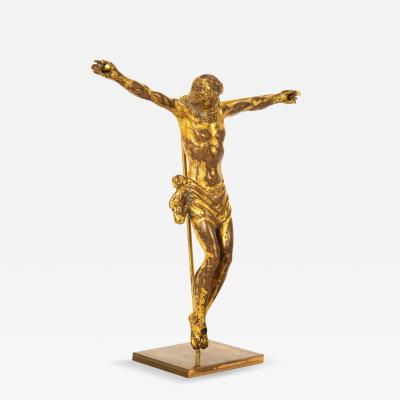
Fine German Renaissance Gilt Bronze Corpus Christi, 17th/18th Century
-
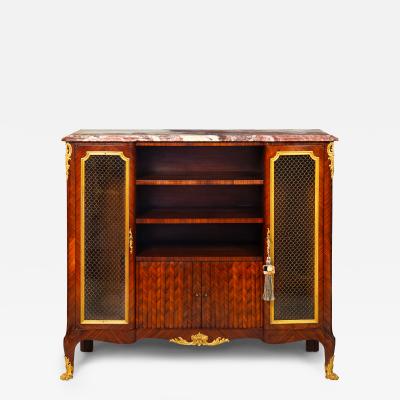
French Louis XV Style Kingwood Marble Top Bibliotheque Cabinet
-
German Gilt Bronze Corpus Christi after Guglielmo della Porta, 17th century
-
Rare American Federal Mahogany Cylinder Desk, Baltimore or Annapolis ca. 1800
-
18th Century Finely Carved Boxwood Corpus Christi on Stand
-
Fine Pair of American Classical Mahogany Card Tables, Massachusetts ca. 1820
-
Pair of English Regency Rosewood Bookcase Cabinets att. John McLean c. 1820