








Showrooms
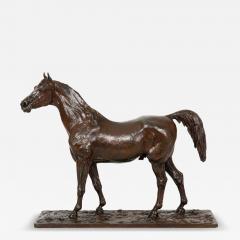
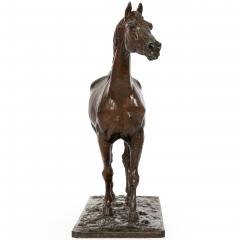
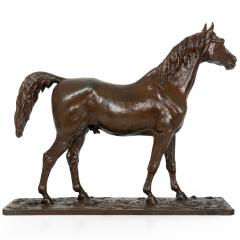
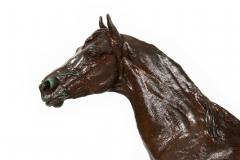
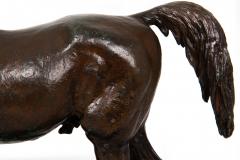
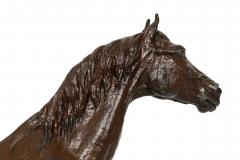
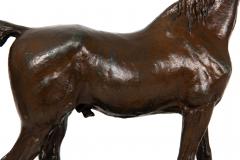
French Bronze Sculpture of Arabian Stallion “Rainbow” by Christophe Fratin
-
Description
CHRISTOPHE FRATIN
French, 1801-1864
"Rinbow - Cheval Arabe"
Sand-cast; verdigris and mid-brown patinated bronze
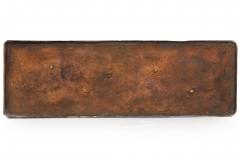
Titled "Rinbow" to front edge of base; inscribed for Eck & Durand foundry verso
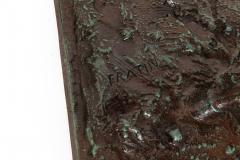
Signed in naturalistic base FRATIN, cast "R" into underside
Cast circa 1850
12 3/8" H x 4 7/8" D x 14 5/8" W
This model is described in Lami's reference text as Rinbow, étalon appartenant à M. Rieussec and was presented at the 1835 Paris Salon as no. 2253 - it includes a note in his text that "Ce bronze et les précédents ont éte fondus au sable d'un seul jet par Quesnel" (This bronze ... was cast in sand in a single throw by Quesnel). The present work was executed by the foundry of Eck & Durand, whom Fratin collaborated with regularly on his work.
A rich and scarce model by Fratin, this very fine cast of an Arabian Stallion is notable for the fluid textured surface captured in the bronze directly from the mold. It enjoys a silky translucent surface patina finished in an overall mid-brown hue with traces of verdigris underlying the brown patina and coming through with strength in raised elements. Typical of his lifetime works, the model is remarkably crisp and has been executed to the highest of standards.
Condition:
Very fine original condition. Light rubbing to raised elements. Carefully cleaned and sealed in conservator's wax. Ready to place.
Biography
Christophe Fratin was among the earliest sculptors in France to devote his career exclusively to animal subjects, helping to lay the groundwork for what would become known as the Animalier school. His work diverged sharply from the academic standards of the early 19th century, favoring animated compositions and a vigorous surface treatment that conveyed movement and immediacy. His figures, often modeled with impressionistic roughness, challenge the polished aesthetic of his contemporaries and instead evoke the energy and unpredictability of the natural world.
Born in Metz in 1801, Fratin was the son of a taxidermist, an upbringing that provided him with a profound understanding of animal anatomy. This early exposure influenced both the technical rigor and occasionally rigid poses of his earliest sculptures. He began his formal training under the local sculptor Charles Augustin Pioche before moving to Paris, where he studied in the studio of Théodore Géricault. Géricault’s influence is evident in Fratin’s recurring interest in equestrian themes and his expressive modeling style, which departs from the neoclassical ideal and reflects the emotive intensity of Romanticism.
Fratin first exhibited at the Paris Salon in 1831 and continued to show his work there regularly through 1842. He returned to Salon exhibitions from 1850 through 1862 after a hiatus during the politically tumultuous 1840s. His international reputation grew significantly during this period. At the Great Exhibition of 1851 in London, Fratin received a medal and was recognized for the inventiveness and expressiveness of his animal sculpture—an acknowledgment that helped solidify his reputation beyond France.
Unlike some of his Animalier peers such as Antoine-Louis Barye, Fratin never established his own foundry. He instead relied on prominent Parisian firms to cast his models, beginning with Susse Frères in the 1830s. By the mid-1840s, he was closely associated with the foundry of Quesnel, where he oversaw the casting of many of his bronzes—pieces that are today regarded among the most refined of his production. Later in his career, his work was also cast by Thiébaut Frères, Daubrée, Eck & Durand, and Debraux D’Anglure. Although Fratin produced a number of models in terracotta, relatively few examples have survived.
Fratin’s sculpture found a ready audience in England, Austria, and Germany, and he completed numerous private commissions abroad. In the United States, his best-known public work is Eagles and Prey, a dramatic bronze group depicting two raptors descending upon a ram. Cast in 1850 and installed in 1863, it is the oldest sculpture in New York’s Central Park and remains a lasting testament to his international appeal.
Among his most collected works are a series of humorous and highly anthropomorphic bear groups, which depict the animals engaging in human activities with exaggerated expression and satirical flair. These works are often interpreted as tongue-in-cheek critiques of sentimental Romanticism in animal depiction—a genre Fratin both participated in and subtly subverted.
Christophe Fratin died at Le Raincy in Seine-et-Oise in August 1864. Today, his sculptures are held in major collections including the Louvre, the Musée des Beaux-Arts de Metz, the Victoria and Albert Museum, and the Walters Art Museum. His work occupies a pivotal place in the history of 19th-century sculpture for its blend of anatomical precision, expressive form, and narrative innovation.
References:
Dictionnaire des Sculpteurs de L'École Française, vol. II, Stanislas Lami, 1970, p. 404
Animals in Bronze, Christopher Payne, 1986, p. 273
ref. 607KIP24X -
More Information
Origin: France Period: 19th Century Materials: Bronze, Sculpture Creation Date: 1850 Styles / Movements: Classical, Other, Victorian Dealer Reference #: 607KIP24X Incollect Reference #: 884265 -
Dimensions
W. 14.63 in; H. 12.38 in; D. 4.88 in; W. 37.16 cm; H. 31.45 cm; D. 12.4 cm;
Message from Seller:
Silla, Ltd. is a family-owned antique gallery located at 117 W Burd St., Shippensburg, PA 17257, specializing in 19th and early 20th century bronze sculptures and unique period furniture. For more information or to schedule a visit, contact us at sales@sillafineantiques.com or call 717.708.9017.
More Listings from SILLA View all 379 listings
-
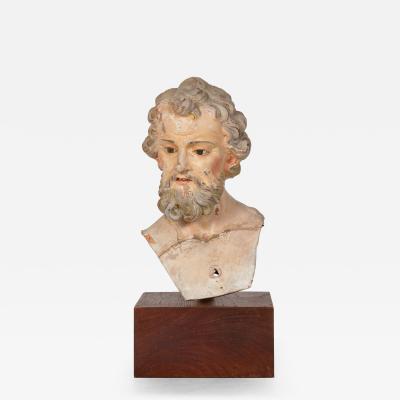
19th Century Italian Polychromed Terracotta Bust of a Saint
-
Fine Austrian Empire Black Lacquered Cabinet Sideboard circa 1820

-
Pair of English Regency Rosewood Chiffoniers Cabinets Bookcases ca. 1810

-
Baltic Neoclassical Mahogany, Brass & Leather Writing Desk, late 19th century

-
Pair of Louis XVI Style Lamps | Entwined Snake Handles

-
French Louis XVI Period Mahogany Commode, stamped by J. Canabas ca. 1775

-
German or Austrian Polychromed Statue Sculpture of Saint John the Baptist
-
George III Period Inlaid Mahogany Serpentine Sideboard, English ca. 1790
-
Rare Grand Tour Marble Basin Model of a Roman Bath ca. 1810

-
Hollywood Regency Steel Marble Top Pedestal Plant Stand Gueridon Table
-
American Art Nouveau Bronze Sculpture of “Wildflower” by Edward Berge

-
Fine George II Carved Giltwood Wall Mirror, English or Scottish circa 1750
-
Swedish Modern “Oresund” Oak Bookcase and Dresser by Borge Mogensen

-
"Bridge Metteur en Scene" Leather Arm Chairs | after Jean-Michel Frank