









Offered by:
H&S Fine Art and Antiques
by appointment only, based in San Francisco, Bay Area
San Francisco, CA , United States
Call Seller
Showrooms
John Vivolo (American, 1886–1987) Two Production Bosses
-
Description
John Vivolo (American, 1886–1987) Two Production Bosses 20th century Carved wood with plaster and polychrome paint.
Two Production Bosses
John Vivolo (American, 1886–1987)
Two Production Bosses
20th century
Carved wood with plaster and polychrome paint Taller figure: 39 × 13½ × 14 in.
Smaller figure: 28 × 9 × 10½ in..
Provenance
James Kronen, New York
The Marvill Collection, Marvin “Mickey” and Jill Baten
Christie’s, New York, Courageous Spirits: Outsider and Vernacular Art, January 20, 2017, lot 508
Private Collection.
Related Literature
Ken Laffal, Vivolo and His Wooden Children, Gallery Press, Essex, Connecticut, 1976. A related figure identified as Production Boss is documented in the publication, p. 61, no.
Two Production Bosses
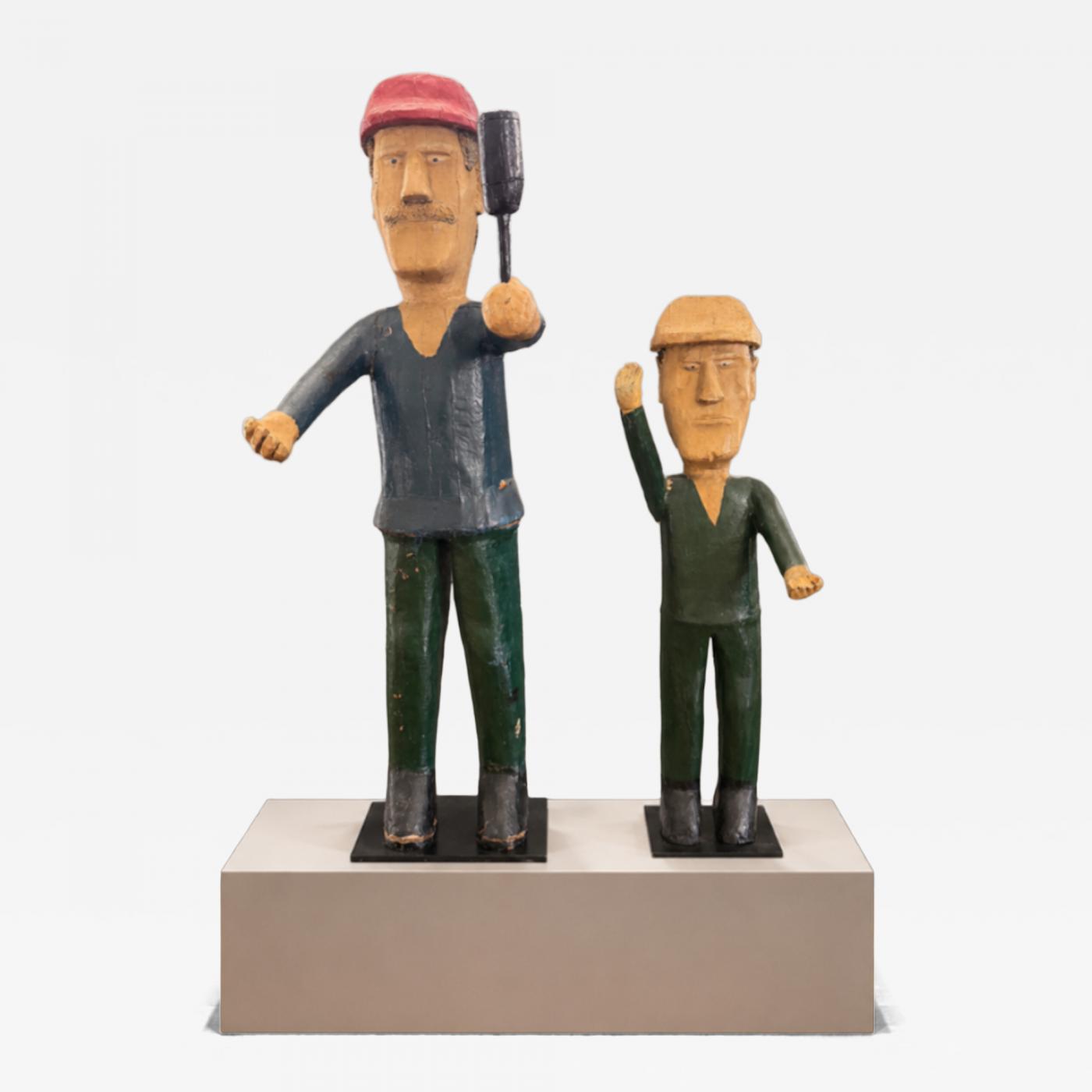
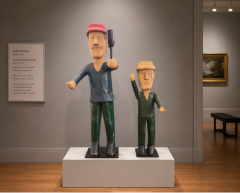
Standing nearly forty inches high, the larger of John Vivolo's Two Production Bosses confronts the viewer with an imposing combination of authority, humor and psychological presence. Beside him stands his smaller counterpart, one arm raised in an emphatic gesture of instruction or command.
The two figures belong to the distinctive sculptural world created by John Vivolo (1886–1987), whose carved figures transformed familiar personalities and occupations into highly individualized works of American vernacular art.
Rather than pursuing anatomical accuracy, Vivolo developed a deeply personal sculptural vocabulary. Heads are dramatically enlarged; bodies become elongated and columnar; hands and feet are simplified; noses project boldly from angular faces; and painted eyes give his figures an unusually direct relationship with the viewer.
In Two Production Bosses, these distortions are fundamental to the character of the sculptures. The bosses are not conventional portraits. Instead, Vivolo reduces his subjects to the attributes, gestures and expressions through which their identities are understood.
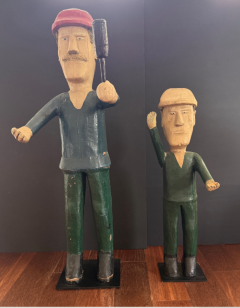
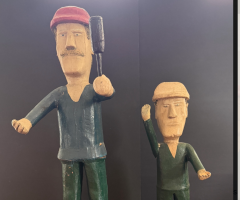
The taller figure wears a brilliant red cap and dark blue shirt over green trousers. His right arm projects horizontally from the body and supports a dark implement, while his other hand opens toward the viewer. His prominent mustache, elongated face and intense blue eyes give him an almost theatrical authority.
His smaller companion is quieter but equally expressive. Dressed predominantly in green and wearing a pale cap, he raises one hand while extending the other before him. The gesture can be interpreted as direction, instruction or command—the essential language of the production supervisor translated into sculpture.
Together, the figures become a study in gesture and hierarchy.
The American Worker as Subject
Vivolo's choice of the production boss as a subject places these sculptures within a broader tradition of American vernacular artists depicting the people and occupations of everyday life.
Unlike the heroic workers of academic painting or government-sponsored public sculpture, Vivolo's bosses remain emphatically human. Their oversized heads, rigid postures and almost comic solemnity introduce an element of affectionate caricature.
There is humor in them, but not ridicule.
Vivolo gives ordinary working figures the physical presence normally reserved for more elevated subjects. The taller boss in particular assumes an almost monumental character. His enormous head and upright posture dominate the space around him, while his workman's clothing and tool keep him firmly rooted in everyday experience.
This tension between the ordinary subject and extraordinary presence is one of the most compelling characteristics of Vivolo's sculpture.
Material and Surface
Vivolo constructed the figures from carved wood augmented with plaster and polychrome paint. The technique allowed him to move beyond carving alone, modeling portions of the surface before introducing color as an essential component of the composition.
The palette is deliberately straightforward: deep greens and blues for work clothing, black footwear, flesh-colored faces and hands, and the striking red cap of the taller figure.
The surviving surfaces display irregularities, abrasions and areas of wear accumulated through age. Rather than diminishing their visual power, these variations contribute to the tactile quality characteristic of vernacular sculpture.
The surfaces should therefore be understood as an integral part of the objects' history rather than merely as decoration.
Vivolo and the Self-Taught Tradition
Vivolo belongs to a generation of self-taught American artists whose work eventually attracted the attention of collectors, scholars and museums interested in artistic traditions existing beyond formal academic practice.
His sculptural world was overwhelmingly human. Workers, authority figures and familiar personalities became what the title of Ken Laffal's 1976 monograph memorably called Vivolo's “wooden children.”
That publication, Vivolo and His Wooden Children, provided early documentation of the artist and his sculptural vocabulary. Significantly, it records another sculpture identified as a “Production Boss,” establishing the subject as part of Vivolo's recognized body of work.
The subject therefore appears not to have been incidental. It was one to which Vivolo returned.
Curatorial Note
Two Production Bosses demonstrates how profoundly expressive a seemingly simple piece of carved and painted wood can become in the hands of a self-taught artist.
Vivolo strips the human figure of academic refinement while retaining the elements necessary to establish character: a cap, a tool, a mustache, an authoritative gesture and an unwavering gaze.
Scale and proportion become psychological rather than anatomical.
The heads are too large because the personality of each man resides there. Hands become conspicuous because gesture communicates occupation and authority. Bodies are reduced to almost architectural forms upon which these expressive elements are arranged.
Viewed individually, each figure possesses a powerful sculptural personality. Viewed together, however, they become considerably more compelling.
The difference in their heights establishes an immediate visual hierarchy. The taller boss projects authority outward through the horizontal extension of his arm and implement. The smaller figure responds through an upward gesture. Their bodies consequently create an unspoken dialogue across the space separating them.
What might initially appear naïve is therefore remarkably sophisticated in effect.
Vivolo did not monumentalize presidents, military heroes or celebrated historical figures here. He monumentalized the American workplace.
hat distinction gives Two Production Bosses particular resonance within American folk and vernacular art. The sculptures preserve not merely the appearance of two working men but something more elusive: the gestures, personalities and social relationships of everyday working life.
Their survival as a pair, together with their documented passage through the collection of New York dealer James Kronen, the distinguished Marvill Collection, and their subsequent appearance at Christie’s New York in 2017, provides an important history of appreciation for objects that originated outside the traditional boundaries of academic fine art.
Today, Two Production Bosses stands at the intersection of folk sculpture, portraiture, occupational imagery and social observation—two ordinary working men transformed by John Vivolo into enduring characters of the American vernacular imagination.
Exhibition History / Published Record
Christie’s, New York, Courageous Spirits: Outsider and Vernacular Art, January 20, 2017, lot 508, illustrated.
Related Literature
Ken Laffal, Vivolo and His Wooden Children, Gallery Press, Essex, Connecticut, 1976. See p. 61, no. 26 for a related Production Boss.
The difference in their heights establishes an immediate visual hierarchy. The taller boss projects authority outward through the horizontal extension of his arm and implement. The smaller figure responds through an upward gesture. Their bodies consequently create an unspoken dialogue across the space separating them.
What might initially appear naïve is therefore remarkably sophisticated in effect.
Vivolo did not monumentalize presidents, military heroes or celebrated historical figures here. He monumentalized the American workplace. -
More Information
Documentation: Makers Label/Invoice Origin: United States, Connecticut Period: 1920-1949 Materials: plaster and paint on carved wood Condition: Good. good some wear consistent with age Number of Pieces: 2-3 Styles / Movements: Folk Art, Americana, Traditional Patterns: Traditional Incollect Reference #: 878953 -
Dimensions
W. 13.5 in; H. 39 in; H.2. 28 in; W. 34.29 cm; H. 99.06 cm; H.2. 71.12 cm;
Message from Seller:
H&S Fine Art and Antiques is a distinguished gallery based in the San Francisco Bay Area, specializing in American folk art, decorative and modern art, as well as Oriental antiquities. With a keen eye for craftsmanship, historical richness, and aesthetics, we offer a carefully curated collection for collectors and enthusiasts alike. By appointment only. Contact us at h.s.fineartandantiques@gmail.com for inquiries.
More Listings from H&S Fine Art and Antiques View all 71 listings
-
Manner of Joseph Alexander Ames (1816–1872) Portrait of Abraham Lincoln
-
ZOUAVE BATTALION AT FORTRESS MONROE, C. 1861.
-
A Large Blue and White Phoenix roundel bowl, Qing Dynasty, Kangxi period.
-
38 STAR ANTIQUE FLAG,COLORADO STATEHOOD, CIRCA 1876.
-
George “Angelo” Crowhurst (1795–1839) Attrib. Lady in a Blue Dress.
-
Chinese Han Dynasty Horse Groom
-
Carved Polychrome Wood Whirligig of a Policeman circa 1880–1900.
-
David Roberts, R.A. (London) Distance view of Sebaste, Ancient Samaria.
-
A Sancai-Glazed Guardian Figure with Breast Plates and Biscuit Head.

-
American Carved and Painted whirligig soldier.
-
Robert Rauschenberg 1925-2008. Untitled.

-
American Military Officer Whirligig An Important Nineteenth-Century, c.1840-1870
-
American Centennial Celebration Flag Stars Forming “1776–1876”
-
Peintre de profil, Marc Chagall (1887-1985).