









Offered by:
Kristan Hauge Japanese Art
2-32 Saishoji-cho, Okazaki, Sakyo-ku,
Kyoto 606-8342 , Japan
Call Seller
81757515070
Showrooms
18th Century Japanese framed painting. Tiger and Cub
-
Description
Anonymous
Tiger and Cub
Japanese. Second half of the 18th century.
Wall panel. Ink, color and gofun on paper.
Dimensions (frame): H. 158 cm x W. 97 cm (62” x 38”)
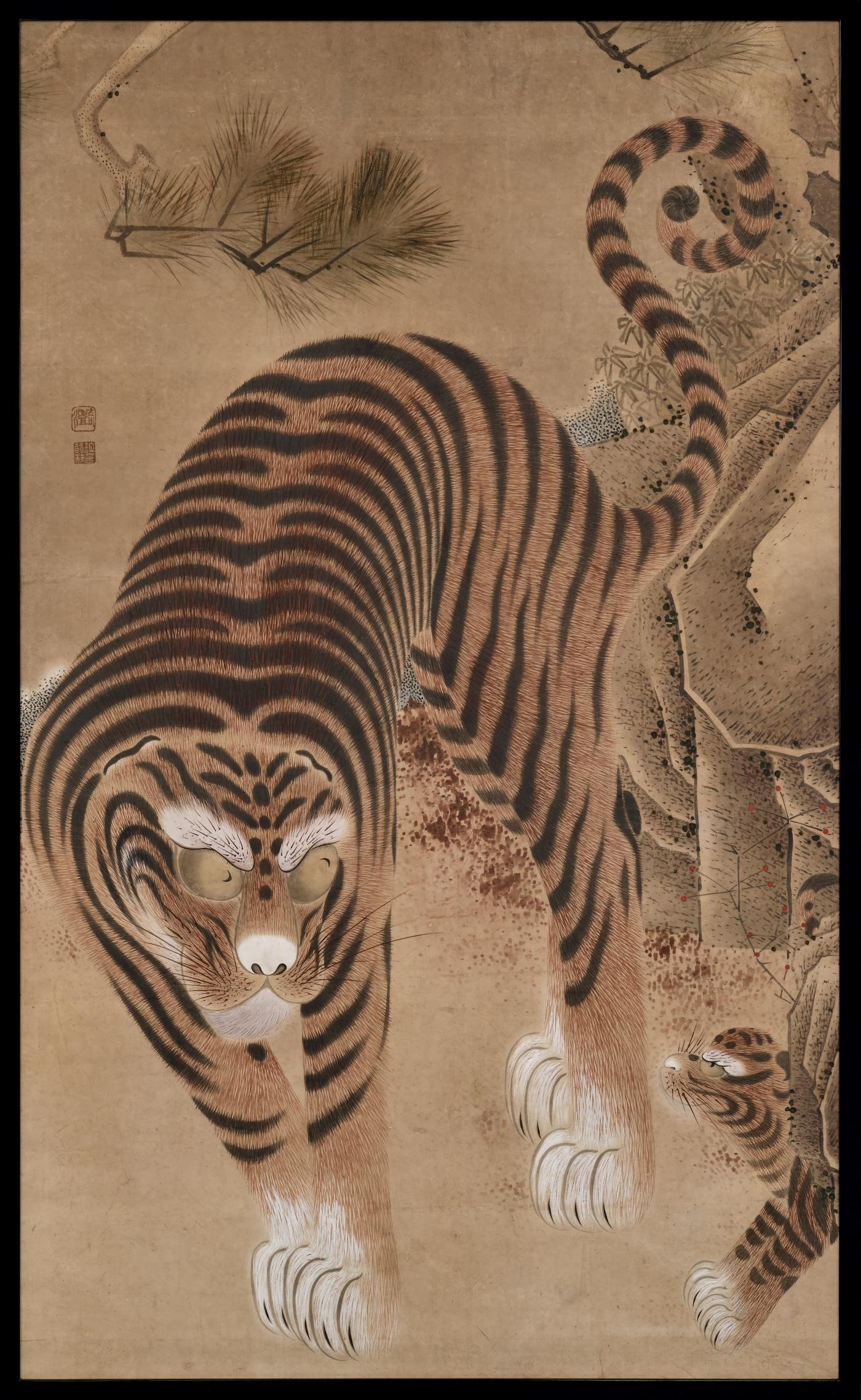
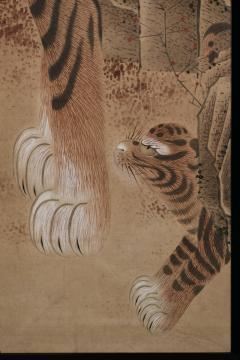
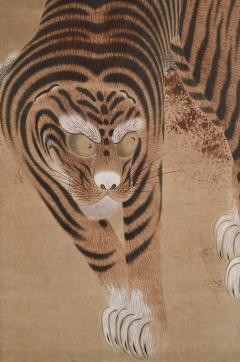
The composition is dominated by the powerful body of the tiger, which advances diagonally across the picture plane. Rather than presenting the animal in profile, the artist has chosen a frontal viewpoint that allows the broad shoulders, arched back, and sweeping tail to occupy almost the entire surface, creating an immediate sense of physical presence. The cub, emerging cautiously from behind a rocky outcrop, provides both a visual counterpoint and an emotional narrative, transforming the painting into a scene of familial guardianship.
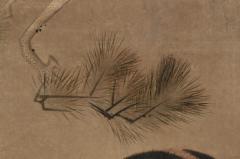
The artist has conceived the tiger with commanding presence, deliberately enlarging the forequarters and head to enhance the animal's sense of mass and power. Combined with the low viewpoint, this distortion creates the illusion that the animal is emerging directly into the viewer's space. Equally impressive is the treatment of the striped coat. Each stripe has been applied individually with extraordinary precision. As the musculature expands across the shoulders and contracts along the flanks, the stripes widen, compress and curve accordingly, reinforcing the impression of three-dimensional form. Fine individual hairs soften the edges of each band, lending the fur remarkable vitality and tactile richness. The surrounding landscape is rendered with restraint. Sparse pine branches and angular rock formations provide just enough context to suggest a mountainous setting while allowing the tiger to dominate the composition.
The choice to depict a tiger accompanied by a cub, rather than the more familiar solitary tiger, is particularly noteworthy. While tiger paintings were popular throughout East Asia, this motif appears to draw inspiration from Korean painting, where depictions of a tiger with their young formed part of a rich symbolic tradition. In Korea, the tiger was revered as the guardian spirit of the mountains and a powerful protector against evil, while cubs symbolized family prosperity and the hope for future generations. Korean examples often include magpies, messengers of good fortune, and pine trees, emblems of longevity and resilience. Although the present work omits the magpies, the protective relationship between tiger and cub clearly reflects this well-established iconography. Korean tiger paintings were highly admired in Japan during the Edo period, and it is likely that the artist adapted one of these models while interpreting it through the refined naturalism of Japanese painting.
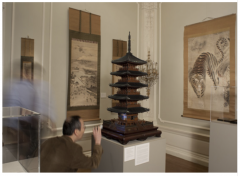
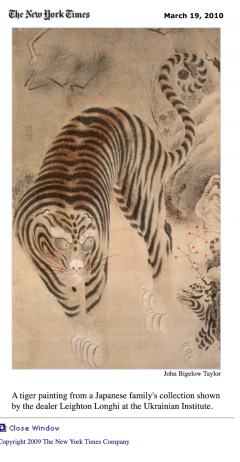
An almost identical composition by the same artist was exhibited by the late Leighton R. Longhi at the Japanese Art Dealers Association (JADA) exhibition held at the Ukrainian Institute, New York, in 2010. Although the overall design closely corresponds—including the contour of the body, the positioning of the limbs, the sweeping tail, and the expression of the face—the two paintings are not mechanical repetitions. The stripes, landscape elements, and details of the cub are all slightly different, demonstrating that the artist was revisiting a successful composition rather than copying it. The Longhi painting was subsequently illustrated in The New York Times on 19 March 2010, in a photograph by John Bigelow Taylor.
This painting has recently undergone a complete ground-up restoration and remounting in a traditional Japanese conservation studio. Carried out by master craftsmen employing centuries-old materials and techniques, the process is exceptionally complex, requiring extensive knowledge and meticulous handwork at every stage. Comprehensive restoration of this calibre is a substantial undertaking that safeguards the work of art for future generations while ensuring its continued structural stability and aesthetic integrity. -
More Information
Period: 18th Century Styles / Movements: Asian Art Incollect Reference #: 873977 -
Dimensions
W. 38 in; H. 62 in; W. 96.52 cm; H. 157.48 cm;
Message from Seller:
Kristan Hauge Japanese Art, based in Kyoto's museum district since 1999, specializes in important Japanese screens and paintings for collectors, decorators, and museums worldwide. Contact us at khauge@mx.bw.dream.jp or +81 75-751-5070 for exceptional access to Japanese art and history.
More Listings from Kristan Hauge Japanese Art View all 63 listings
-
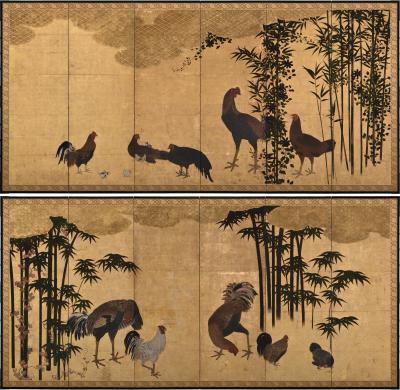
17th Century Japanese Screen Pair. Roosters and Chickens in a Bamboo Grove
-
Mitani Toshuku (1577-1654). Unkoku School. Japanese falcon painting.

-
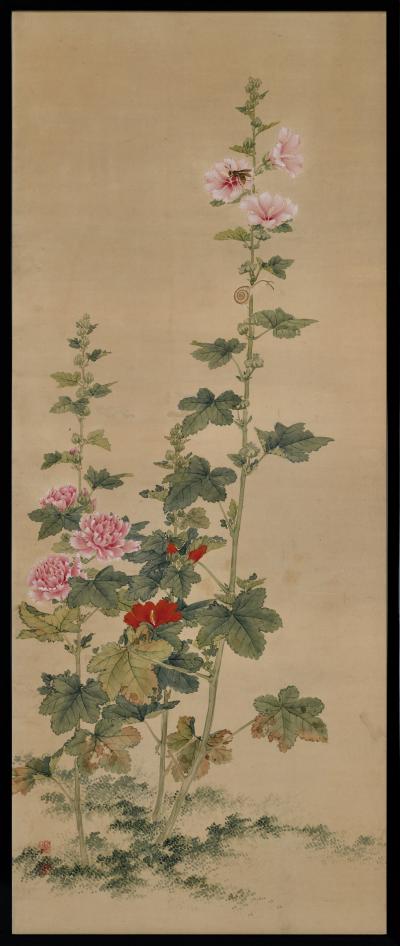
Mid 19th Century Framed Japanese Painting. Snail, Wasp & Hollyhock.
-
Early 20th Century Japanese Nihonga Screen. Bamboo Forest
-
19th Century Japanese Scroll Painting by Igarashi Chikusa, Poppies & Butterflies
-
19th Century Japanese Scroll Painting, Birds & Flowers of the Four Seasons.
-
urtledoves in a Peach Tree | Nakamura Daizaburo

-
Playful Cat | Hirose Toho (1875-1930) | Japanese scroll painting

-
Amaranth & Rooster | Circa 1930 | Japanese scroll painting

-
17th Century Momoyama era. Crows on Pine. Studio of Hasegawa Tohaku
-
Mother’s Breast (Chichi) 1844. Japanese scroll painting.

-
Early 20th Century Japanese Screen. Flowers of the Four Seasons
-
Korean grapevine painting. 17th century.

-
Early 20th Century Japanese Nihonga Scroll. Crow & Persimmon.

