









Offered by:
Kristan Hauge Japanese Art
2-32 Saishoji-cho, Okazaki, Sakyo-ku,
Kyoto 606-8342 , Japan
Call Seller
81757515070
Showrooms
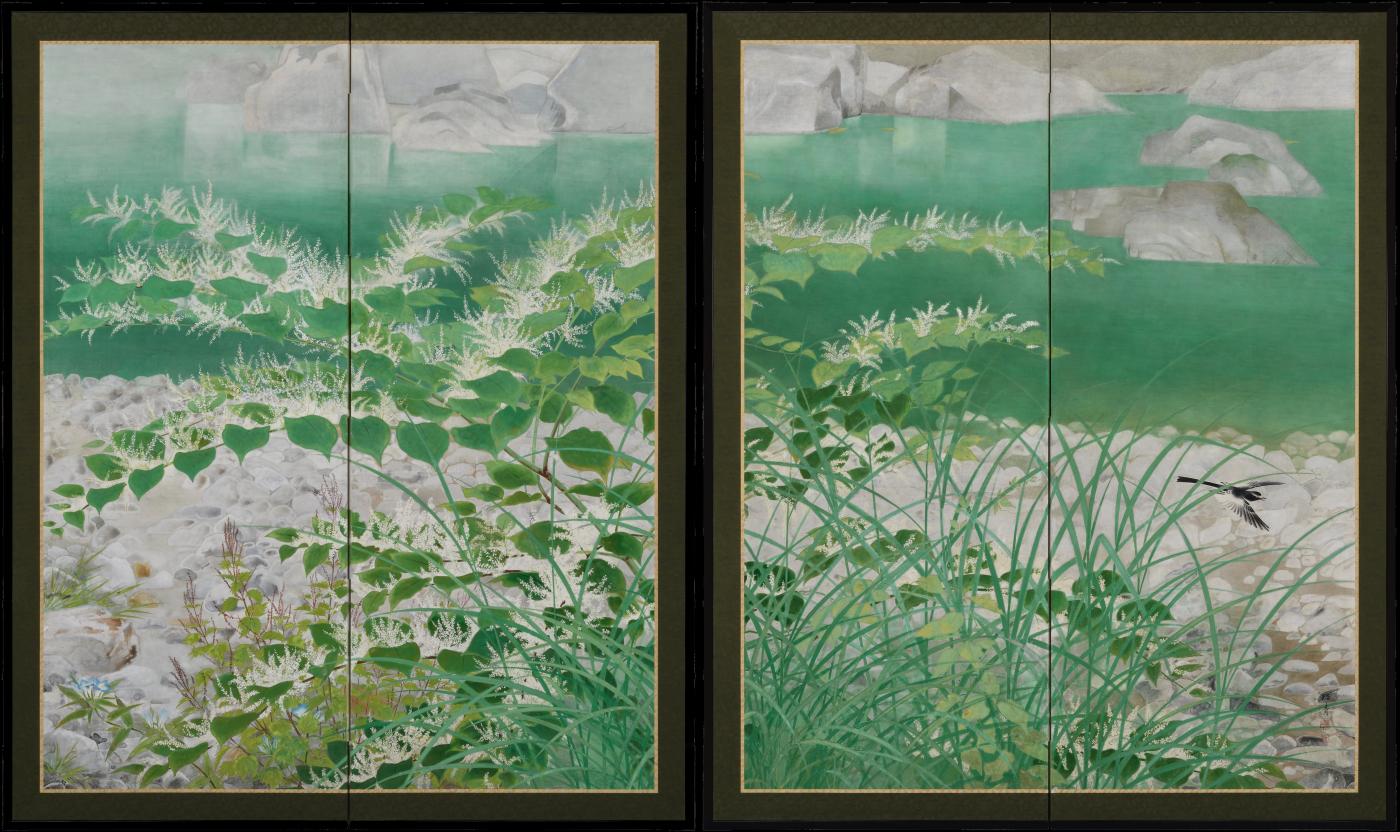
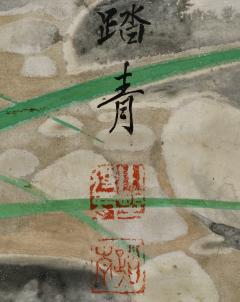
Japanese Screen Pair. Showa era. Nihonga Riverside landscape. Late Summer
-
Description
Ono Tosei (1902–?)
Late Summer
Showa era. Circa 1935
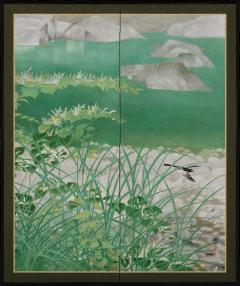
Pair of two-panel Japanese Screens. Ink, gofun and pigment on silk.
Dimensions (each screen): H. 176 cm x W. 148 cm (69” x 58”)
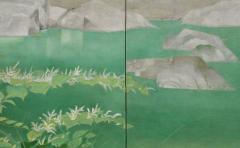
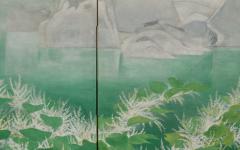
The composition unfolds as a tranquil riverside landscape observed at close range. Following the traditional right-to-left reading of Japanese screens, the viewer first encounters a wagtail in mid-flight at the extreme right. Its outstretched wings introduce the only moment of movement within an otherwise motionless scene, inviting the eye to follow its imagined path across both screens.
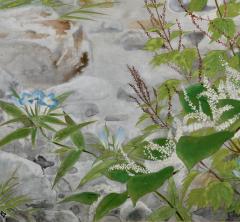
The river forms the compositional anchor, its slow-moving emerald waters reflecting the pale boulders lining the opposite bank. These broad reflections are rendered with remarkable subtlety, dissolving the distinction between solid rock and reflected image. Painted in washes of white gofun delicately modulated with cool greys, soft ochres and pale purples, the rocks avoid hard definition in favour of simplified planes of tone, their forms approaching abstraction. This deliberate economy contrasts beautifully with the richly observed foreground vegetation, allowing the rocks to shimmer in both substance and reflection.
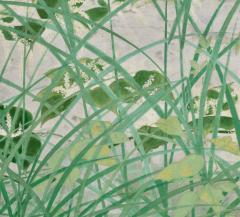
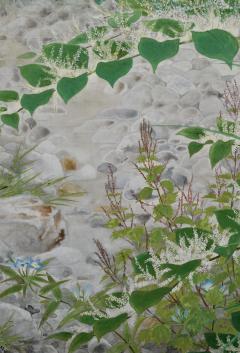
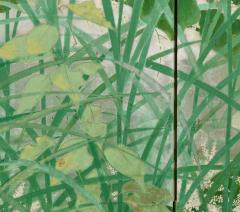
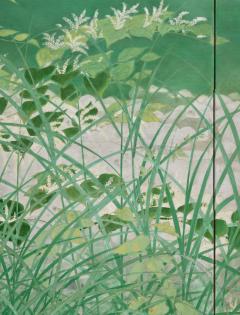
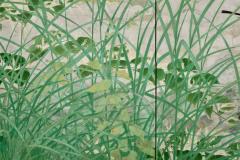
The artist prepared the silk support with a continuous layer of gesso, establishing a smooth ground upon which successive washes of mineral pigments were applied. Selected motifs—including the leaves, grasses, and delicate white blossoms of the knotweed—were executed with thicker applications of gesso and pigment, creating a subtle relief that lends the surface a restrained sense of three-dimensionality. This layered technique enriches the tactile qualities of the work while enhancing its remarkable spatial depth.
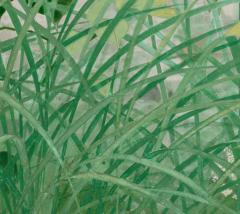
The painting balances careful observation of nature with a refined sensitivity to light and atmosphere. The riverside flora and fauna are rendered with convincing naturalism, while equal attention is given to sunlight striking stone, the diffusion of reflected light across the river, and the subtle shifts in colour created by these effects. The foreground is dense and immersive: wild grasses, flowering Japanese knotweed and pale blue Chinese bellflowers advance toward the viewer in overlapping planes. Particularly striking is the contrast between this crisply articulated foreground and the softened forms of the distant riverbank, which dissolve into broad passages of tone and reflection.
Perhaps the work’s greatest achievement is its profound sense of stillness. The grasses bend beneath their own weight rather than under the influence of wind; the river remains perfectly calm; the reflections lie undisturbed across its surface. Only the wagtail momentarily interrupts this serenity, its swift passage providing a fleeting counterpoint to the timeless quiet of the landscape. Brilliant emerald greens convey the lush abundance of late summer, while the cool whites of the rocks glow with an almost translucent luminosity. Delicate blue bellflowers and reddish seed heads quietly anticipate the approaching autumn, leaving the landscape poised between seasons and suggesting the quiet melancholy that accompanies summer’s passing.
Ono Tosei (1902–?) was a prominent Nihonga (traditional Japanese-style) painter born in Osaka Prefecture who spent much of his career in Kyoto. He graduated from the prestigious Kyoto City Specialist School of Painting, an institution that produced many of Japan’s leading twentieth-century artists, and later studied under Nishiyama Suisho and Nishiyama Hideo. Renowned for his refined landscapes and nature paintings, Ono achieved considerable success on the national exhibition circuit, with works accepted nineteen times to the Nitten Exhibition, three times to the Bunten Exhibition, and three times to the Teiten Exhibition. His accomplishments were further recognised with the Kansai Award, and throughout his career he remained an associate member of the Nitten exhibition circle and an active member of the Bokujin-sha art collective.
The screens have recently undergone a complete ground-up restoration and remounting in a traditional Japanese conservation studio. Carried out by master craftsmen employing centuries-old materials and techniques, the process is exceptionally complex, requiring extensive knowledge and meticulous handwork at every stage. Comprehensive restoration of this calibre is a substantial undertaking that safeguards the screens for future generations while ensuring their continued structural stability and aesthetic integrity. -
More Information
Documentation: Signed Period: 1920-1949 Creation Date: 1935 Styles / Movements: Asian Art Incollect Reference #: 872229 -
Dimensions
W. 58.27 in; H. 69.29 in; W. 148 cm; H. 176 cm;
Message from Seller:
Kristan Hauge Japanese Art, based in Kyoto's museum district since 1999, specializes in important Japanese screens and paintings for collectors, decorators, and museums worldwide. Contact us at khauge@mx.bw.dream.jp or +81 75-751-5070 for exceptional access to Japanese art and history.
More Listings from Kristan Hauge Japanese Art View all 68 listings
-
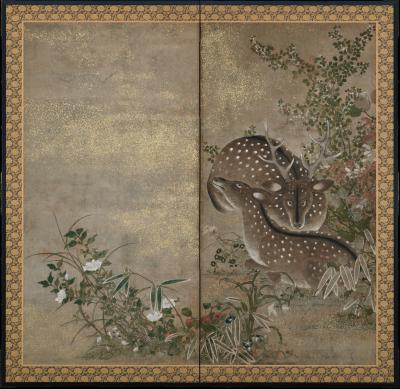
Edo period Japanese Screen. Spotted Deer and Autumn Flowers
-
Mitani Toshuku (1577-1654). Unkoku School. Japanese falcon painting.

-
Mid 19th Century Framed Japanese Painting. Snail, Wasp & Hollyhock.
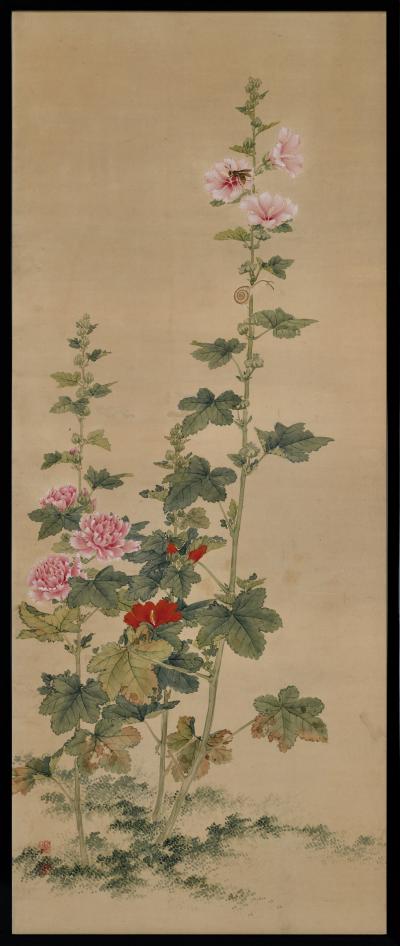
-
Early 20th Century Japanese Nihonga Screen. Bamboo Forest
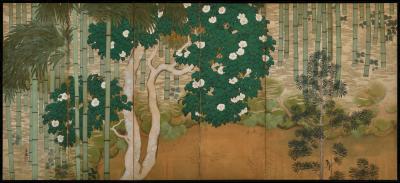
-
Mitani Toshuku (1577-1654). Unkoku School. Japanese falcon painting.
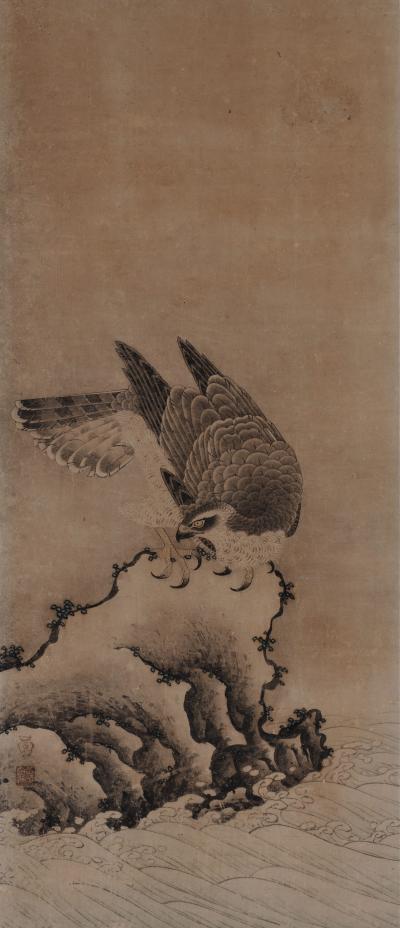
-
17th Century Japanese Unkoku Screen. Flowers & Birds of Winter and Early Spring
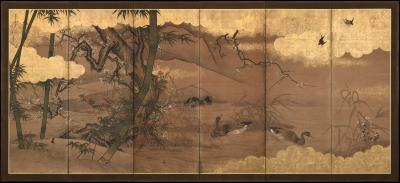
-
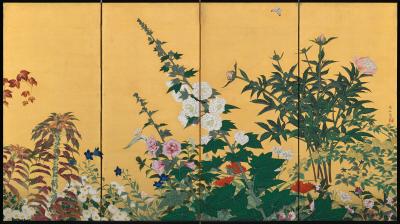
Early 20th Century Japanese Screen. Flowers of the Four Seasons
-
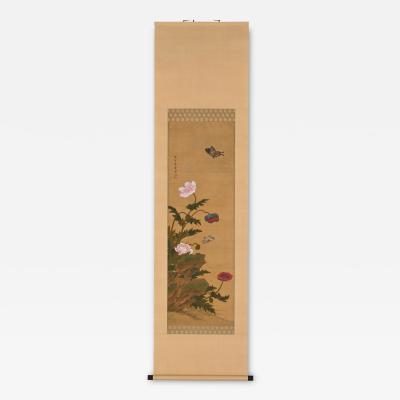
19th Century Japanese Scroll Painting by Igarashi Chikusa, Poppies & Butterflies
-
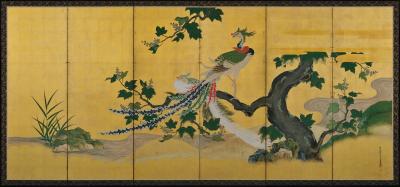
Tsunetake Yotei (18 c.) | Phoenix & Peacocks | Japanese folding screen pair
-
Mother’s Breast (Chichi) 1844. Japanese scroll painting.

-
Korean grapevine painting. 17th century.

-
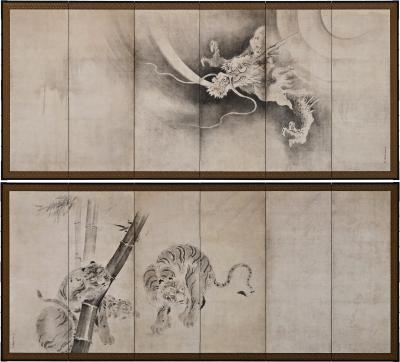
17th Century Japanese Screen Pair. Tiger & Dragon by Kaiho Yusetsu
-
Amaranth & Rooster | Circa 1930 | Japanese scroll painting

-
Early 20th Century Japanese Nihonga Scroll. Crow & Persimmon.

